





The Scene
The low rate of AI adoption in the workplace may not be due to lack of trying, but lack of dedicated training.
Last June, roughly 70 individuals across Microsoft’s engineering teams stopped working for a week and gathered in person to discuss workflow, friction points, and what an AI-first team looks like. They even covered the professional identity crisis of developers, who once spent days writing code and now manage bots that do it for them.
“They come away as real evangelists,” said Katy George, Microsoft’s corporate vice president of workforce transformation.
The developers returned to their normal jobs but intentionally worked at a slower pace during the next two weeks, aiming to practice their AI learnings and form new habits in their work. They continued virtual training sessions on Microsoft’s specific AI tools and how to build custom agents, and participated in a hackathon.
Starting in January, Microsoft began expanding this initiative, called “Camp AIR,” first to human resources workers, with plans to implement it across the entire company. The three-week boot camp is Microsoft’s bid to make employees more efficient using the latest AI, without leaving them to experiment on their own.
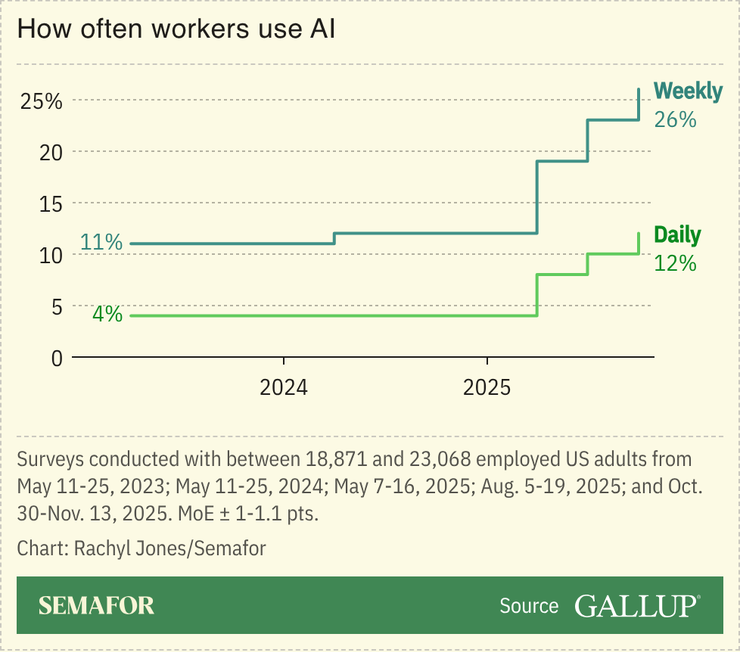
AI adoption is something many companies, even in tech, struggle with when there’s no clear roadmap for training workers, free time for employees to play with tools is limited, and many fear AI will eventually replace their jobs. The existence of a program at Microsoft indicates that even employees leading the AI charge need guidance on integrating it into the workplace and clarity about what AI-driven changes mean. It also suggests that overall business transformation promised by executives could take longer than expected. While AI adoption is rising across US workplaces, it’s doing so slowly. Daily usage is up from 4% in 2023 to 12% at the end of 2025, according to a Gallup survey. Even tech workers aren’t fully on board, with just less than one-third using AI on a daily basis.
In this article:

Know More
Boot camps that take employees offline for a week aren’t the prevailing mechanism to drive AI adoption. Many companies are opting for training sessions during the workday. Citi mandates its 180,000 employees with access to its AI tools complete a 30-minute module on writing effective prompts, said Head of AI Shobhit Varshney. Roughly 4,000 workers have volunteered to be “AI champions,” with the goal of influencing their peers to use more of the technology.
Other trainings are led by the AI company selling the tools. Perplexity, an AI-powered search engine, creates specialized workshops and follow-up sessions for their clients. In the case of its customer Nvidia, Perplexity hosted training sessions with hundreds of workers spanning its HR and business operations units, with more workshops to come.
While these sessions do correlate to increased usage, Perplexity’s Chief Business Officer Dmitry Shevelenko said, “the single best predictor of enterprise AI adoption is the CEO at internal meetings, not just telling everyone they should be using AI, but sharing with them how he or she personally uses it.”
Perplexity also funds prizes like $500 gift cards, AirPods, and Oura Rings for their clients’ employees who win a follow-up eight-week challenge to integrate AI into their workflows.
Still, training efforts don’t fall entirely on management and incentives, according to IBM’s Neil Dhar, senior vice president of consulting in the Americas. “There’s also a responsibility on the individual to make sure they’re learning what they need to,” he said at a dinner with journalists this week.

Rachyl’s view
While it’s likely true that workers who take the initiative to automate their roles will be the most successful in the AI age, I tend to believe more hand-holding is required for broader workplace adoption. Businesses are running up against barriers like decades of formed workplace habits, a general lack of free time for their employees, AI fatigue, and a history of workers having tried and been unimpressed by AI tools.
Speaking with business leaders at a conference recently, it became clear that non-tech companies don’t know where to start. One attendee told me that at her law-adjacent firm, the responsibility of “upskilling” workers on AI was essentially a hot potato being passed between HR, IT, and individual team managers, with no one taking the initiative to lead it.
The different levels of trainings — from a guided courses akin to the sexual harassment modules everyone skips through to boot camps that take employees offline — don’t make it easier. While some experimentation is involved, executives need to have long, serious conversations about the technical literacy of their workforce, what new skills they want their employees to gain, and how they plan to roll out AI. Perhaps most importantly, they need to give employees the time to create new habits, and expect slower work in the meantime.
As Perplexity’s Shevelenko told me, “Whatever strategy actually gets your employees using AI, that’s the answer.”

Notable
- Some employees are fighting back against AI implementation, according to Vox. The reporter advised readers opposing AI in their workplace to unionize.