




Ben’s view
President Donald Trump’s flirtation with the antitrust crusaders was always, and only, about unfettered speech on the internet.
The long-in-coming collapse last week of the Department of Justice’s antitrust division — whose chief, Gail Slater, was forced out Thursday, days after her deputy quit — began on Inauguration Day, when the chiefs of Google, Meta, and Amazon flanked Trump.
If that sounds simplistic, it’s because many analysts still don’t understand how foundational Republican complaints about censorship are to contemporary politics.
For many on the right, including top administration officials like Robert F. Kennedy, Jr., Stephen Miller, Sebastian Gorka, and of course Trump himself, getting tossed off social platforms was a searing, formative political experience. (I’m always surprised Democrats find this hard to imagine, while being up in arms about less successful and less important battles over control of declining legacy media outlets like CBS News and the Washington Post.) And the social platforms won that power to censor through their sheer, unprecedented size. Antitrust action seemed like a genuinely obvious remedy — or, as it turned out, at least a useful thing to threaten.
But bear with me for a quick obituary of the mirage of a serious crackdown on big American business.
Bipartisan skepticism of corporate power comes and goes in America, but the latest wave has roots in the parallel streams flowing from the Great Financial Crisis, Occupy Wall Street and the Tea Party. A few years later, thinkers in both parties were pushing a neo-Brandeis approach to antitrust enforcement that would consider corporate mergers not just for their consequences for consumers, but for whether consolidated power could have other ill effects.
By 2023, Politico was describing Sens. JD Vance and Elizabeth Warren as “the new power couple taking on Wall Street,” while Vance praised the Warren protege and Federal Trade Commission Chair Lina Khan. Republicans often couched their fury at speech restrictions — around right-wing cultural politics and COVID-19, in particular — as part of a broader critique of corporate power.
Slater is an experienced antitrust lawyer who has worked on both sides of the tech wars, but when Trump announced her nomination, he couched it in those sweeping terms: “Big Tech has run wild for years, stifling competition in our most innovative sector and, as we all know, using its market power to crack down on the rights of so many Americans, as well as those of Little Tech!”
Worried Washington lawyers took this as a signal that the “populist wing” of the Republican Party was ascendant at the FTC.
And that notion captured the attention of the public (well, the media), too. We love strange bedfellows. Could the anti-corporate populists who staffed bits of the Biden administration find common ground with a coalescing MAGA ideology apart from the figure of Donald Trump?
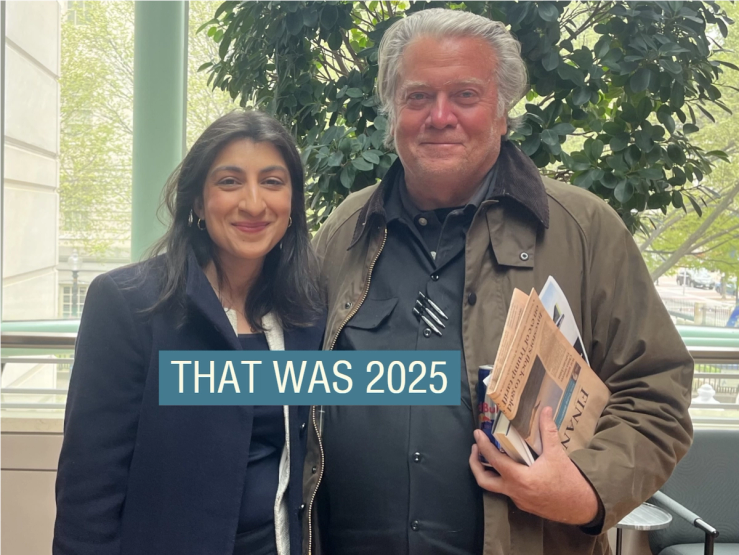
That fantasy peaked at the Little Tech Summit that Y Combinator hosted in Washington last April 2. The speakers included former Trump adviser and self-appointed MAGA ideologist Steve Bannon and Khan.
“My girl!” Bannon addressed her as they posed together for a photograph outside, according to the tech journalist Nancy Scola. “We want you back. You’re the best.”
“We’re all relying on you to keep the fight alive for the populist wing,” Khan replied.
In this article:

Know More
The administration’s approach to the actual cases never fit the pattern of a new antitrust movement. Many cases the Biden administration had pursued were quickly settled or dropped entirely. Well-connected administration consultants helped their clients go over the head of the antitrust division for settlements — one of the sources of the friction that led to Slater’s departure.
When Slater was ousted last week, the administration sprayed out explanations. An anonymous source suggested firing Slater was an “affordability” measure, and criticized a trip to Paris without mentioning that it was for an OECD conference.
But while there do seem to be running management issues at the Department of Justice, this is one of those cases where personnel isn’t policy, and where Trump himself is setting the tone.
As Semafor Business Editor Liz Hoffman wrote Saturday, the clear message has been that the “nation’s chief dealmaker wants more deals.”
Now antitrust enforcement is back to a narrow remit around Big Tech. (Project 2025, incidentally, laid this out, if you made it to page 879.) In particular, the Justice Department is pressing for stiffer remedies in a verdict against Google over an alleged advertising monopoly.
But in conversations with people across a government of people who love to post on the internet, the general view is that the issue of Big Tech power has been largely solved. When Elon Musk took over X, Trump gained leverage over Tiktok, and Meta and YouTube quickly retreated from any effort to control political speech, the substantive issue went away — and with it, any White House enthusiasm for the broader crusade.
The one that seems to be getting attention in the White House is the one that’s about the real Trumpian passions of politics and media power: the FTC’s recent pressure on what it sees as bias in Apple News.

Room for Disagreement
As enthusiasm for antitrust action in Washington fades, Europe remains a beacon of hope for anti-consolidation activists, and particularly those focused on tech.
“What we’ve been trying to do is make sure folks see that the Digital Markets Act stands apart from some of the stereotypes — that it really is about ensuring that companies like Apple and Google are not choking off all the oxygen,” said Luther Lowe, a Y Combinator executive who leads a “Little Tech” coalition. “We’re encouraging people to think opportunistically and provide evidence, open up lines of communication with the European Commission so they can contribute to how that’s enforced. Because it promises to unlock a lot of innovation and investment in those markets.”