




Reed’s view
Earlier this week, Anthropic released new plugins for specific industries, from legal to finance to biotech research, sending shivers down the spine of Wall Street. Anthropic was making it clear: We are coming for your jobs. Software stocks plummeted. Obituaries for big law firms were written. Goodbye consultants.
Amazon, which built the world’s largest computer for Anthropic’s AI models, said Thursday that it plans $200 billion in capital expenditures this year, mostly for more data centers.
Its shares promptly fell because, well, Wall Street doubts if this AI stuff is really useful enough to warrant such a big investment.
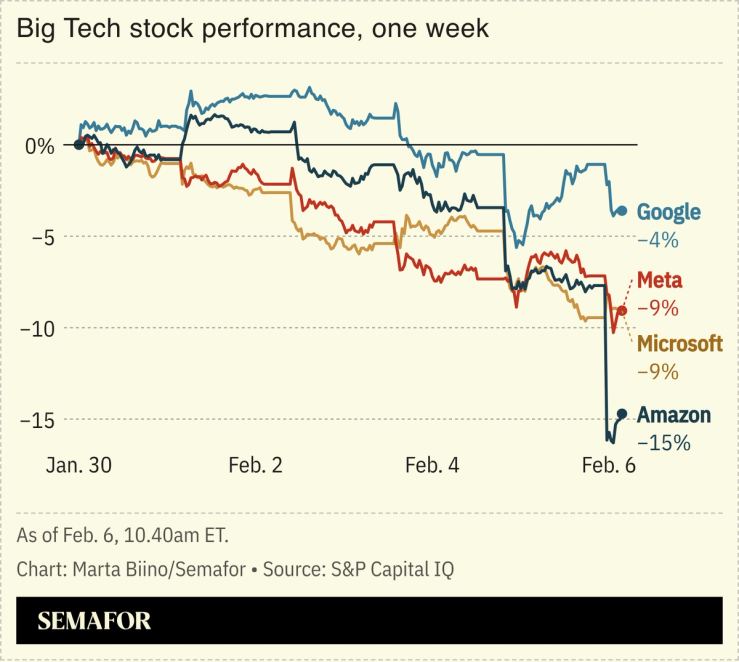
If you’re confused by the mixed message, you should be. The way the market views AI is completely irrational, driven more by viral “it’s so over” X posts than logic or fundamentals.
A year ago, DeepSeek released an AI model that was so efficient that it tanked Nvidia’s stock. The rationale: AI is getting cheaper, so nobody is going to need powerful computers to run it. But the fear was misguided: In this market, efficiency only increases demand for more compute.
This week was Anthropic’s “DeepSeek moment.”
The best way to think about AI is like the next wave in the computer revolution that began in the 1950s. The more monumental the invention, the longer adoption takes. There are probably people born in 1945 — the year the first general-purpose electronic computer went into operation — who retired before learning to type.
Things move faster these days, but there are still huge companies that rely on database software built in the 1970s. They can’t snap their fingers and become AI native, even if they want to.
Almost every company I have talked to that is trying to build AI applications for businesses is embedding some form of “forward deployed engineer” just to get the implementations to work.
Making the AI revolution happen is going to take a herculean effort. It requires a generation of entrepreneurs to step in and build the necessary connective tissue. You can’t just release a “lawyer plugin” and expect big law firms to pack their bags and go home.
And, let’s be honest, investors in frontier model providers like Anthropic wouldn’t like that outcome. AI companies need businesses that buy their products and employees that use them.
AI is going to make people a lot of money and there will certainly be disruption. Software companies and tech consultancies that can’t find ways to become indispensable will disappear. But it won’t happen overnight and it won’t happen to all of them. This is a big deal, but it’s so not over.
In this article:

Room for Disagreement
Dean Baker, co-director of the Center for Economic and Policy Research, warned of an impending recession, in part due to consumption outpacing wages. For the market capitalization of the biggest tech players to make sense to Wall Street, they need profit growth tied to “more rapid economic growth than almost anyone is predicting,” or for every other company to make less money, he wrote in a blog post.
“I know we have a big ‘this time is different’ crowd, but Sam Altman and Mark Zuckerberg don’t seem any sharper that the wizards of the universe who dominated the business pages in Internet bubble days,” he writes.

Notable
- “There’s this notion that the tool in the software industry is in decline, and will be replaced by AI ... It is the most illogical thing in the world, and time will prove itself,” Nvidia CEO Jensen Huang said on Wednesday about the stock plunge. “If you were a human or robot, artificial, general robotics, would you use tools or reinvent tools? The answer, obviously, is to use tools ... That’s why the latest breakthroughs in AI are about tool use, because the tools are designed to be explicit.”