




The News
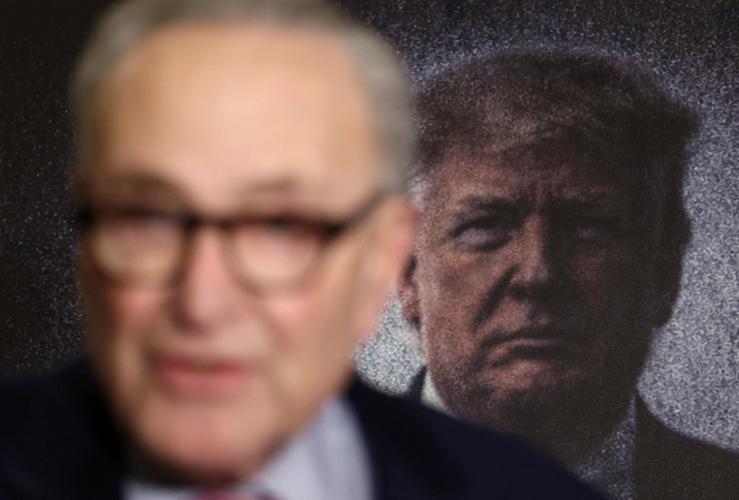
The long-running chill between Donald Trump and Chuck Schumer is thawing — a little.
The president and the Senate minority leader worked proactively in recent days to head off another government funding lapse, culminating on Tuesday with passage of a deal to fund most agencies through September and the Department of Homeland Security until Feb. 13.
Trump and Schumer spoke multiple times last week to head off the immediate threat, according to two people familiar with the conversations. It was a clear shift from last fall’s interminable shutdown standoff, which kept the two men far apart as Schumer held out for negotiations on health care.
But now they will have to pull off a much trickier feat: assembling an immigration enforcement agreement that keeps enough members of both parties happy enough to head off a prolonged shutdown at DHS.
Trump’s initial call to Schumer showed “real leadership,” Sen. Katie Britt, R-Ala., told Semafor. “I’m glad he did it, and I hope that Senator Schumer continues to have these conversations with him.”
The modest but significant bipartisan rekindling between the two New Yorkers, who are at odds on most issues and often tear down each other in public, started even before federal agents’ killing of Alex Pretti in Minneapolis. Before their phone calls, Schumer met with Trump last month about the stalled Gateway Tunnel project connecting New York and New Jersey.
The immigration enforcement negotiations they’re plunging into after the deaths of Pretti and Renee Good, both US citizens, are the kind of politically delicate affairs that split both parties. Trump will be called upon to tame GOP hardliners and Schumer to deal with progressives who say they won’t give ICE another dime.
A senior White House official said it is “certainly” possible Trump and Schumer could meet in person once aides lay the groundwork for any immigration deal. Sen. John Hickenlooper, D-Colo., said that “if Schumer and the president seem to indicate that they’re okay with [an agreement]? That’s a big deal.”
“The more discussion that goes on, the more sharing of ideas and information, the better the potential outcome is to get something that people can support,” said Sen. Jeanne Shaheen, D-N.H.
Still, lingering divisions from the latest round of haggling could complicate things. Democrats think Trump is only engaging because of his sagging poll numbers and his sensitivity to getting blamed for another shutdown.
The situation is tricky for Schumer as well: Progressives want him to forcefully oppose Trump on everything, but he has a long-running predisposition for bipartisanship that belies his blue-state origin.
“Sen. Schumer is completely transactional,” said Sen. John Cornyn, R-Texas, who has sparred with the New Yorker for years. “And I think it depends on the circumstances.”
The senior White House official blamed Schumer for, during one of his calls with Trump, indicating that House Minority Leader Hakeem Jeffries and his Democrats would go along with the funding deal. (Most House Democrats opposed it on Tuesday.)
“We’re about to negotiate reforms to the immigration system in good faith with people who have shown that they are pretty unreliable and disorganized negotiating partners,” the official told Semafor. “The president has had a relationship with Chuck Schumer that goes back decades in New York. But the Democrats are going to have to get their act together.”
A Schumer aide said the minority leader made clear on the call that the White House would need to talk to Jeffries.
In this article:

Know More
For Schumer, more conversations with Trump represent both an opportunity and a risk, since quite a few members of his conference are unlikely to back any deal that funds ICE at all. Schumer said recently that without “real strong change, they should not expect Democratic votes.”
If Schumer is “trying to cobble together 15 people to vote for what I consider to be a weak deal, and I’m telling people, ‘It’s a weak deal?’ That’s a bad position,” one Democratic senator told Semafor.
“He has a lot of power here. He can strike a tough bargain,” this senator added. “And if there’s no deal to be had, he can go out and say, ‘They refused, they wouldn’t agree.’”
Trump and Schumer’s relationship has a long arc, from the president’s long-ago political donations to the senator all the way up to this winter’s conversations. During Trump’s first term, Schumer and then-House Speaker Nancy Pelosi bargained with the president, sometimes successfully and other times to no avail.
Trump barely tried to deal with Democrats last year, using brute force to enact his agenda with GOP votes in both chambers of Congress. That approach ran aground in the fall, when Democrats refused to fund the government without a deal to revive health care subsidies.
Eventually, the government reopened, though not because of Schumer and the president. Yet Britt, Shaheen and others have encouraged more conversations between Schumer and Trump.
They’re optimistic about the backchannel because it’s likely to decide whether or not DHS shuts down next weekend. Democrats are asking for judicial warrant requirements for ICE, an end to masking by agents, and use-of-force standards.
The administration moved to standardize body cameras on Monday, satisfying probably the easiest area of agreement. Republicans are pushing back against warrant and mask demands while trying to end sanctuary cities, which won’t fly with Democrats.
“You’re going to have to have a line of communication between the president and the Democrats,” Senate Majority Leader John Thune said in an interview. “In this case you have people who at least their incentives are aligned … That wasn’t the case last fall.”
The Trump administration has lots of money left over from last year’s tax cut bill to fund immigration enforcement operations, so a DHS shutdown would be unlikely to slow down the administration’s priorities.
But Democrats believe Trump “genuinely wants to avoid a shutdown,” said Senate Minority Whip Dick Durbin, D-Ill.

Room for Disagreement
Democrats want to see major progress in negotiations before voting to keep the department open again, and they don’t sound keen on a modest compromise with Trump.
“It’s not going to be some gang that splits the difference between Lindsey Graham and Alex Padilla,” said Sen. Brian Schatz, D-Hawaii, the next No. 2 in leadership. “Either Trump decides this is a political death spiral for him and he needs to get out of it … or we’re not going to have a deal.”

Burgess’s view
Schumer and Trump are brash New Yorkers who like making headlines. They helped design the US response to the coronavirus, so they have muscle memory for collaboration.
On the other hand, just this week, Schumer compared Trump to a “dictator” for wanting to nationalize elections. Trump’s nickname for Schumer is “Cryin’ Chuck.”
So, yes, the two can talk. But Democrats want Schumer to get the best of Trump, and the White House doesn’t want to give Schumer anything that can be construed as a win. Those are tough parameters for a deal, even between two guys who love striking one.

Notable
- The New York Times first reported two of the Trump-Schumer calls last week.