




Tomi’s view
The Trump administration has placed Somalis in the US under heightened scrutiny — with immigration authorities making them a key focus. But thousands of miles away, Washington is waging a deadly and far more intense — albeit quieter — campaign in Somalia.
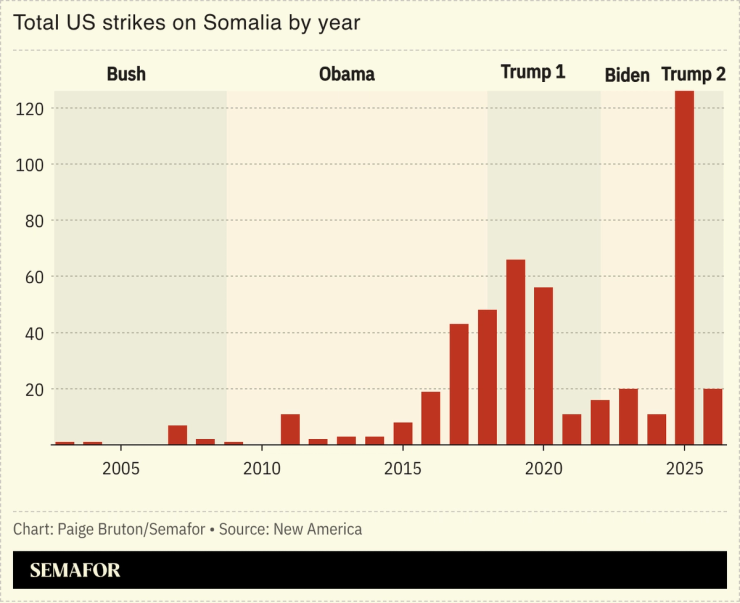
These airstrikes have grown sharply in number during US President Donald Trump’s time in office as Washington targets the al-Shabab and ISIS-Somalia jihadist groups: A year into Trump 2.0, the number of strikes in Somalia is already at 144. That is more than half of the tally from Trump’s entire first term, which was itself record-breaking, according to the nonprofit think tank New America.
Amid this spike, the US announced the termination of the Temporary Protected Status for Somalis, making thousands eligible for deportation by March. “Country conditions in Somalia have improved to the point that it no longer meets the law’s requirement,” said Secretary of Homeland Security Kristi Noem.
Yet, the Pentagon classifies large swaths of Somalia as “areas of active hostilities” requiring the current strike tempo. Indeed, far from stabilized, the threat from al-Shabab has intensified. The group has successfully repelled recent offensives by Somalia’s army, recapturing key territories previously liberated during the government’s 2022-2023 campaigns.
The al-Qaida-linked group’s aim is to overthrow the government and establish strict Sharia law. Its smaller rival, ISIS-Somalia has a similar ambition, of entrenching the regional branch of ISIS’s so-called caliphate.
The current White House security strategy for Africa is thin but emphasizes the need to avoid “long-term American presence or commitments.” Its answer appears to be “maximum pressure” through airpower, which would function as a low-risk alternative to “boots on the ground” and prevent another ill-fated “Black Hawk Down” scenario.
In 2017 the Pentagon, under Trump 1.0, changed the rules of engagement, reducing the threshold for drone strikes, shifting approval authority away from the White House, and lowering the level of command needed to authorize strikes. It also reduced the standard of certainty for civilian casualties.
US Africa Command, has also paused providing casualty estimates to reporters, citing a “temporary” policy finalization. This obscures the outcomes of the air campaign — effectively ruling out any answers for the families of civilians killed. Crucially, this also makes it difficult to measure what the US is achieving, particularly as al-Shabab maintains territorial resilience.
Trump promised to end America’s “forever wars,” yet he’s only expanding them — at least in Somalia’s case — through airpower. The growing opacity in US counterterrorism efforts abroad mirrors a broader trend toward reduced transparency in domestic enforcement as activists have pointed out in US cities like Minneapolis.
This leaves the “precision” of the state measurable only by those who wield it, with little recourse for those on the receiving end.
Tomi Oladipo is an award-winning journalist who covers global affairs with a focus on African security and geopolitics.

Notable
- The US has long viewed al-Shabab through the lens of its threat to regional security, wrote an expert for CTC Sentinel.