




The News
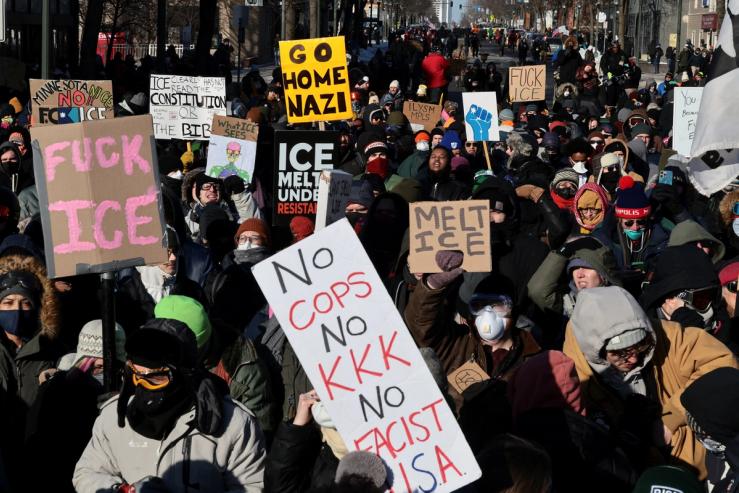
The clash between immigration enforcement agents and protesters in Minneapolis is the latest front in a high-stakes global arms race between governments and their domestic foes over who has better technology — and who has the right to use it.
President Donald Trump’s immigration crackdown — and the extra funding that came along with it — spearheaded an era of surveillance tech aided by Palantir and other powerful AI companies: Facial recognition apps that reveal a person’s immigration status, phone tracking technology, AI agents, and spyware that remotely hacks into phones and helps federal law enforcement target individuals.
Activists are also tapping tech to try and fight back. To warn community members when ICE agents are nearby, Sherman Austin, an activist and technician in Long Beach, California, created a national database of license plates connected with immigration operations, and a text alert system to track and broadcast the movements of federal agents.
“They’re running around en masse. They won’t identify themselves,” Austin said. “This is a tool that we can at least use to keep track of their whereabouts, so we can tell our friends and neighbors when they’re nearby.”
The tracking efforts have been described by the Trump administration and supporters as domestic terrorism, with Palantir co-founder Joe Lonsdale referring to activist networks as “organized illegal insurgency” and billionaire Elon Musk spreading posts on his platform with similar characterizations.
Apps that share the locations of federal agents paint “a target on federal law enforcement officers’ backs,” connecting them to an increase in assaults on agents, ICE director Todd M. Lyons said in June, referencing an ICE-spotting app that officials pressured Apple to remove from its app store. (The DHS didn’t respond to requests for further comment).
From a legal perspective, participating in assaulting or impeding federal officers is illegal, and if a stranger attacks an agent based on the location data provided by another person, that user carries the risk of being charged as a co-conspirator, said Art Arthur, a former immigration judge who held positions at the House of Representatives and now at the Center for Immigration Studies, a right-of-center think tank.
The debate raises an important question: As the US government’s use of sophisticated tracking tech increases, giving it more power and control over its residents, what kind of technology are people allowed to use to monitor the actions of the government and hold it accountable?
“For most of American history, that would just be thought of as First Amendment activity,” said Emily Tucker, executive director at the Center on Privacy and Technology at Georgetown Law.
But applying First-Amendment protections to monitoring government officials is now being questioned, she said.

Step Back
The actions of activists in Minneapolis and other US cities mirror those deployed in protest movements around the world, dating back to the Arab Spring’s use of Twitter and Facebook to Hong Kong’s anti-government protests’ reliance on Telegram.
More recently, Iran’s resistance movement tapped Musk’s Starlink internet terminals to smuggle out images of troops firing and of bodies of those who had been killed. With governments shutting down the internet or weaponizing it, digital squares have emerged to allow people to continue to gather, organize, and evade government actions.
In the US, some groups are organizing patrols via an intricate network of Signal groups used to track and document enforcement actions by immigration agents who often wear face coverings, work without visible badge numbers, and drive in unmarked cars.
In Minneapolis, the current epicenter of the backlash, “Signal is the technological backbone of the operation,” said Megan Peterson, executive director of the Minnesota-based nonprofit Gender Justice. (Signal declined to comment).
It’s not without risk. Big tech companies in the US can be compelled by law enforcement to hand over their data, and operators of apps and websites collecting information on federal agents aren’t totally protected by Section 230, the long-standing rule stating platforms aren’t responsible for the content posted on them, said Santa Clara University School of Law’s Eric Goldman.
When that content incites violence against federal officers, the owners may be held liable, he said. In the UK, there’s a long-standing legal battle between tech giants and the government over whether encryption creates “lawless spaces” where crimes can be committed with impunity.

Know More
To be sure, the technologies used by the government and by individuals are not comparable — “it’s like saying they have an atom bomb, and you have a pen knife,” Tucker says.
But activists say they’re not just focused on stopping ICE agents now, but about recording them for the future.
“We’re hoping for an opportunity for accountability,” said Peterson, who says her nonprofit developed a reporting tool for Minnesotans that could be used to bring future legal action against law enforcement.