



The News
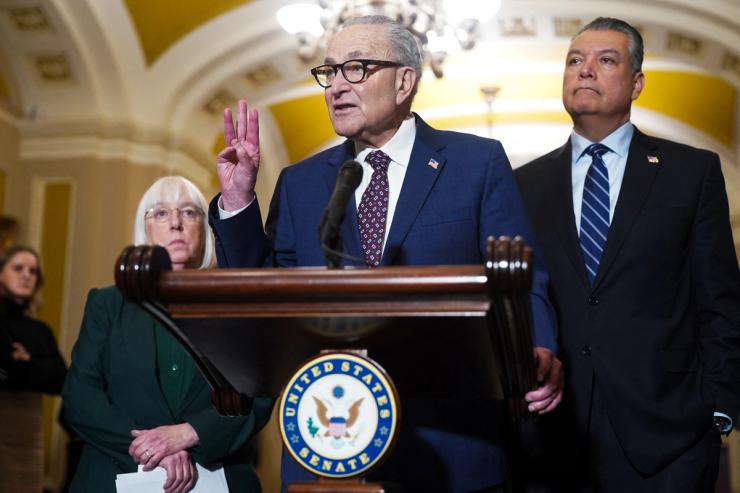
Senators struck a deal to keep the government open and extend the Department of Homeland Security’s funding for just two weeks, giving a short window to make immigration enforcement changes demanded by Democrats.
Democrats pushed for two weeks over Republican objections on Tuesday afternoon. Sen. John Kennedy, R-La., said he believed Senate Minority Leader Chuck Schumer and President Donald Trump were negotiating the agreement directly. Trump made clear both publicly and privately he did not want a shutdown.
After the Senate passes the agreement, it faces an uncertain face in the House, where hardliner resistance could make advancing any bipartisan deal difficult. Speaker Mike Johnson and Minority Leader Hakeem Jeffries both said Wednesday they want to see what the Senate passes before making a game plan.
Seven Senate Republicans defected from GOP leaders on an earlier procedural vote on Thursday, a similar total to other recent spending bills. But in doing so, some Republicans expressed discomfort with replacing a full-year of spending for the Department of Homeland Security with a short-term funding bill to kickstart talks about changes to immigration enforcement.
And once that short-term deal is law, some Republicans say Democrats’ demands for more accountability from Immigration and Customs Enforcement will be counterbalanced in upcoming negotiations by GOP priorities that Democrats will not like.
“I don’t mind adding some things to DHS, to rein in ICE: Body cameras, no masks, some things that are common sense. But if we’re going to do that,” Sen. Lindsey Graham, R-S.C., told Semafor. “It has to include ending sanctuary cities or it’s no deal.”
Graham voted to advance the six-bill spending package on Thursday, which all Democrats opposed because there was no deal yet with the White House on a DHS stopgap funding bill. But there’s a coterie of Republicans who did not, and they voiced their own separate issues.
“I actually support ICE. I support Homeland Security. I’m not going to support something like this,” said Sen. Rick Scott, R-Fla. “I don’t support this idea. This is crazy not to fund Homeland Security.”
Trump is playing an instrumental role in keeping Republicans in line with the plan he negotiated with Democrats, declaring on Thursday that “we don’t want to have a shutdown.” A White House official, asked whether the administration wants an end to sanctuary cities included in the DHS bill, did not answer. The official said Trump has consistently advocated for keeping the government open and officials are “working with both parties to ensure the American people don’t have to endure another shutdown.”
Trump publicly endorsed the deal on Thursday evening and said he’s “working hard with Congress to ensure that we are able to fully fund the Government, without delay.”
Schumer is hoping to craft a bipartisan deal on reforms to immigration enforcement, including warrant requirements and ending masked officers. That will be a huge challenge, but senators are relieved to move past the immediate shutdown threat.

Know More
Scott said he wants to add the SAVE Act, which would require proof of citizenship for voting, and the Shutdown Fairness Act from Sen. Ron Johnson, R-Wis., which would pay federal workers during a shutdown, to the funding package. Those comments demonstrate conservative bellyaching over spending bills.
“They’re going to have to pass those with Democratic votes. I’m not going to support it,” Johnson told Semafor right before voting no on Thursday. “I’m not happy with a lot of things. We didn’t pass the Shutdown Fairness Act, which we should have done so we don’t have to be cowering: ‘Democrats may shut the government down again.’”
Still, it’s clear there remains a large contingent of Republicans who will go along with a White House-backed deal. That may extend to the House as well, though the House is currently not scheduled to reconvene until next week.
Sen. Thom Tillis, R-N.C., said Republicans should “take the win” of passing five funding bills: “The administration, incidentally, I also think they want to take the win. Let’s move on.”

Room for Disagreement
Some GOP rabble-rousers are OK with the deal the White House is discussing with Democrats. They say a shutdown is the worst-case scenario.
“I don’t want to deny our law enforcement or TSA or FEMA [their funds]. I don’t want any of those folks to go dark,” said Sen. Josh Hawley, R-Mo. “I will never vote for a shutdown.”

Burgess, Shelby, and Eleanor’s view
Getting the bill through the Senate requires navigating complaints and issues from people like Johnson, Rick Scott and Sen. Rand Paul, R-Ky., who wants a vote to strip $5 billion in refugee funding. Then there’s challenges in the House. Whip count aside, Johnson said Wednesday leaders “may have trouble” getting members back in DC this weekend.
And it’s entirely possible passing a funding deal with a short-term lifeline for DHS is the easy part. It’s clear that a bipartisan immigration enforcement negotiation is going to be very hard: Just ask literally everyone who’s stepped into that arena in the past.