




The News
Anthropic CEO Dario Amodei’s essay this week warns about AI’s dystopian dangers — biological weapons, supercharged dictatorships, mass brainwashing. Robinhood CEO Vlad Tenev read it and responded: You’re worried about the wrong apocalypse.
Tenev agrees that AI is societal poison but for reasons less suited to an episode of Black Mirror and more suited to this newsletter: AI is exacerbating the “extreme economic concentration of power in the hands of AI’s Silicon Valley backers.” (For the dangers of self-spawning mirror-image bacteria, I’ll refer you to Semafor’s tech editor, Reed Albergotti.)
Tenev is talking his own book: Allowing retail shareholders to invest in AI startups would be great for Robinhood. And Robinhood’s embrace of gamified YOLO investing doesn’t suggest a deep commitment to financial health. But he’s right about the staggering scale of wealth accruing to a select few in Silicon Valley, and how dangerous that can be. Ray Dalio and others have drawn uncomfortable parallels to historical periods where it ended in violent revolution.
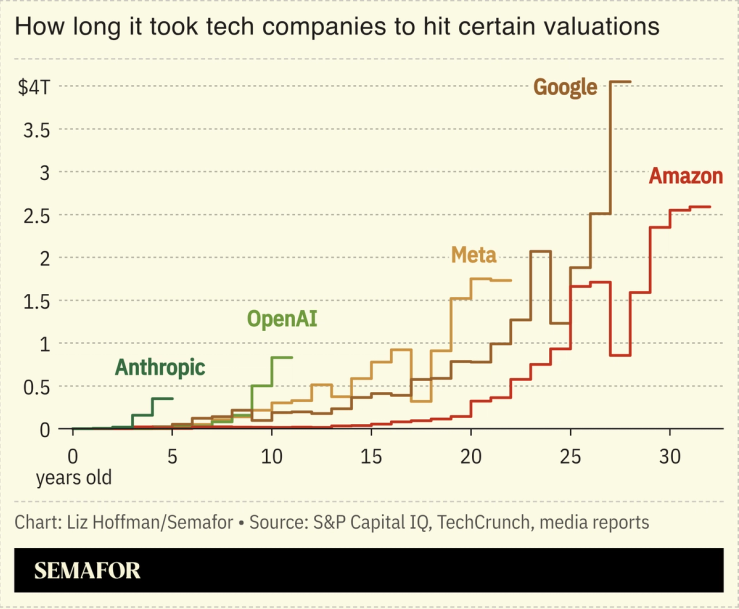
Anthropic, not yet five years old, is as valuable as Google was at 15 and Amazon was at 22, long after those companies had gone public. Google was worth $23 billion at its IPO in 2004. Nearly all of its current $4 trillion valuation has happened in the hands of public stockholders.
For future public shareholders of OpenAI or Anthropic to capture Google-sized gains, they would need to reach valuations in the tens or hundreds of trillions of dollars. Barring a collapse in AI valuations or a seismic redistribution of wealth like the proposed tax currently freaking out California billionaires, the gap may already be too big to close. “Those early gains [are] gone,” David Schwimmer, CEO of the London Stock Exchange Group (also not a disinterested party in this public-versus-private debate), told me in September.
Amodei might be overstating his threat, penning the AI era’s version of Kennan’s Long Telegram that puffs up an exaggerated threat. Or he’s right, and the billionaires can wait out the robot apocalypse in their bunkers or in space.
But Tenev is certainly right. The AI race is pouring gasoline on social unrest and deepening anger toward the superrich. “AI becomes sentient and society collapses” and “the masses take up pitchforks against the elite and society collapses” get you to the same place. Amodei is worried about one risk, Tenev is raising the other.

Notable
- Amodei also has thoughts on Elon Musk’s prediction of a “post-savings” future, Business Insider noted: The Anthropic CEO wrote that “AI promises to ‘raise the quality of life for everyone’ — but there will be a brutal ‘rite of passage’ to get there.”