


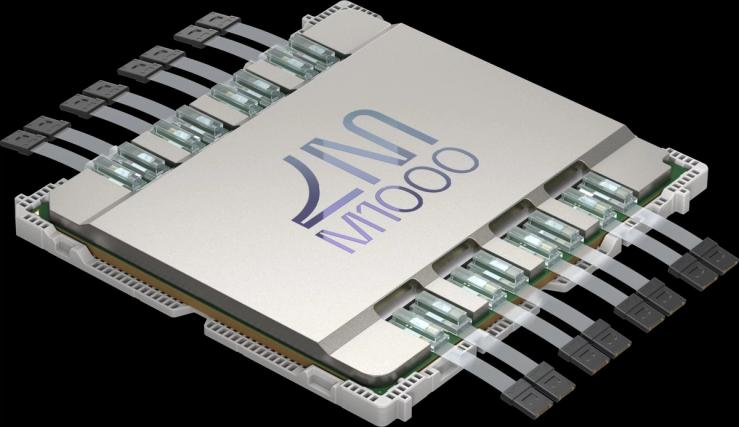
With everything going on in the world, it’s understandable that startup Lightmatter’s announcement Tuesday of a new laser for the data center market drew less attention.
We thought it was worth highlighting because it’s a good example of how the massive scale of the AI buildout is making new kinds of hardware innovation feasible. Lightmatter’s view is that accelerated computing is going to eventually go optical. First, the copper wires that connect GPUs and memory inside data center racks will be replaced by optical cables, removing one of the major bottlenecks of data center performance: The slow, copper wires connecting hundreds of thousands of GPUs.
Eventually, the silicon itself will give way to photons. (That’s still a sci-fi concept, but read Lightmatter’s Nature paper for more on that). Photonic computing, if proven possible, could reignite Moore’s law, improving the speed of processors exponentially.
For now, Lightmatter determined existing lasers just weren’t as economical as they could be and decided to launch a new one.
This would have all seemed a bit silly a few years ago. But today, no data center architecture is sacred. The way chips and memory are organized inside racks is no longer set in stone. And that means there’s a wide open field for new entrants in the stack and plenty of potential for disruption of existing, entrenched players.