



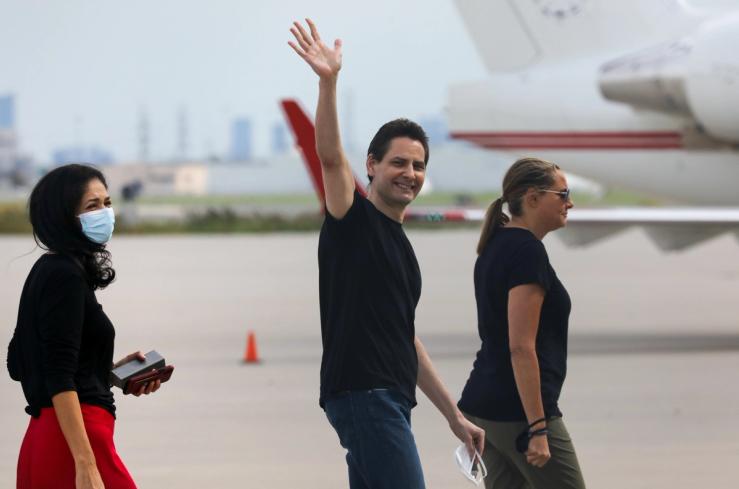
Three years in a Beijing jail gave Michael Kovrig, a former Canadian diplomat, what he calls “a very strange gift”: an insider’s view of a China that foreigners rarely see — prison guards, police interrogators, criminal prosecutors, and his own cellmates.
Kovrig’s incarceration — he was held, along with another Canadian, in retaliation for Canada’s detention of a senior Huawei official — made it painful for him to watch Mark Carney’s recent visit to Beijing, the first by a Canadian prime minister since that episode almost a decade ago, especially Carney’s smiling handshake with Chinese leader Xi Jinping.
It was, Kovrig told me, “morally, if not repugnant, then at least uncomfortable.”
Kovrig has been an analyst for the International Crisis Group for most of the past decade and, in a way, is uniquely placed to understand this moment, having seen deep inside both the Canadian and Chinese bureaucracies. So it’s striking that he doesn’t just question Carney’s moral compass — he questions his strategic judgment.
US President Donald Trump has launched a trade war on Canada and threatened its sovereignty, referring to Washington’s closest ally as the 51st state and to Carney, insultingly, as “Governor.” So, like his counterparts in other democratic “middle powers,” Carney has been reaching out to an authoritarian Chinese government, one that coerces its own people as well as its trading partners, as a hedge against an increasingly unreliable America.
“If you discover that your long-term partner has become abusive, does that mean that your best strategy is to immediately hop into bed with another serial abuser?” Kovrig asks.
China seeks to portray itself as a champion of free trade and multilateralism, and indeed a top Chinese official at Davos urged the world not to return to a protectionist “law of the jungle where the strong prey on the weak.”
Yet “middle powers” face hard choices. As the historian Odd Arne Westad pointed out in the Financial Times, this isn’t the 21st century anybody expected. Smaller countries once worried they would be forced to take sides in a Cold War confrontation between the US and China, but instead they’re trying to navigate a multipolar world marked by rivalry between Great Powers intent on expanding control over their own regions and using economic, military, and other leverage to do so.
This is why Western leaders are now queuing up to meet Xi: They’re looking for trade options, not geopolitical alignment, and most are offering concessions to cut deals.
UK Prime Minister Keir Starmer is expected in Beijing this week, having secured his spot after his government approved China’s new “mega-embassy” in London, overriding concerns about national security risks. A Reuters report said Starmer will seek to revive a UK-China CEO council from an earlier “golden era” of commercial relations that was derailed by disagreements over security, human rights, and Beijing’s crackdown on Hong Kong .
French President Emmanuel Macron was there last November, indulging in “panda diplomacy” and ping-pong, albeit mixed with tough talk on trade amid China’s ballooning trade surplus with Europe. Germany’s chancellor is set to visit next month.
Carney himself secured a deal to lower Chinese tariffs on Canadian canola in exchange for Chinese access to the Canadian auto market — an important breakthrough for China’s carmakers into North America. It caught the attention of Trump, who threatened to impose 100% tariffs on all Canadian exports if China used its neighbor as a “Drop Off Port” for sales to the US.
On the campaign trail last year, Carney called China his country’s biggest security threat. In Beijing, by contrast, he embraced a new realpolitik by declaring a “strategic partnership” with China within a “new world order,” echoing language that China often uses to describe a post-American era and that Beijing, in Kovrig’s words, will “weaponize and normalize.” Later, in a widely-hailed speech at Davos on his way home from China, Carney spoke of a “rupture” in the global system — without specifically mentioning Washington — and called on “middle powers” to form coalitions to work together.
But, as Kovrig warns, China is no sanctuary, for Canada or any other country looking for safety and predictability as Trump assaults the global trading system.
Over the years, Beijing has threatened — and in some cases used — economic coercion against a host of nations, often as a weapon in disputes unrelated to trade, and usually by blocking politically sensitive agricultural imports: Norwegian salmon, Australian wine, bananas from the Philippines and, most recently, Japanese seafood over spats related to the Nobel Prize, the COVID-19 pandemic, sovereignty in the South China Sea, and ties with Taiwan.
One of Kovrig’s insights from his ordeal within the Chinese security state is that “most people in that system don’t like that system.” But the phrase he heard over and over, from jailors and inmates alike, was mei ban fa, which literally means “nothing to be done.” Something of that sense of resignation, if not helplessness, has overtaken the world’s “middle powers” these days.