




The News
The biggest news organization in Minnesota is trying to serve as the sober counterweight to hysterical social media posts, swarming videos, political conflict, and public statements that contradict observable facts.
“There’s lots of rumor and chatter and confusion, and, there’s also just bad and incomplete reporting, that’s flying around lots of outlets,” Minnesota Star Tribune editor and senior vice president Kathleen Hennessey told Semafor. “Not all of it is malicious, and some of it’s just strange. You cannot be an informed person and just sort of scroll through social media, it’s distorting and it doesn’t add clarity, I don’t think. Ultimately, that’s what journalism is in for. You, you need to shed some light and bring true understanding.”
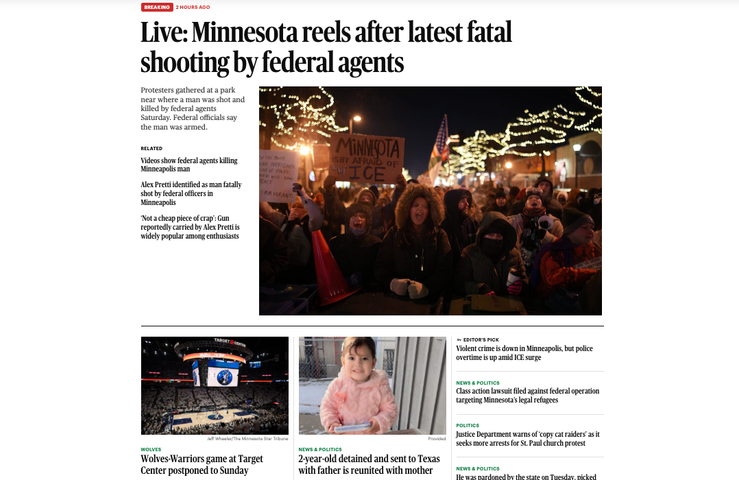
In recent weeks, the 157-year-old newspaper has been the central hub of local information amid a massive immigration enforcement operation that has repeatedly turned deadly. Since the federal government deployed immigration and border patrol agents to Minnesota, the paper has turned to focus much of its journalism on the unfolding enforcement and activism from local citizens. In a telephone call on Saturday, Hennessey estimated that 50 of the paper’s 200 journalists are covering the story daily, doing everything from tracking protests and monitoring immigration enforcement action to covering the significant business impact on the city.
A major focus of the paper’s energies has been the details that are left off of viral short form video clips and widely-shared Instagram stories.
Hennessey said the paper has spent a lot of time every day chasing “ghosts” and trying to make sense of viral images, sifting through rumors circulating on social media. She also noted that the paper is checking facts and building on video clips from national media and independent content creators who have swarmed Minnesota in recent weeks.
“Our goal is to add reporting to figure out what really happened in any particular episode, to go beyond the video that’s firing around Instagram,” Hennessey said.
“We’re not trying to recreate social media, we’re trying to deliver what you’re not getting, which is names, dates, locations, the comment and account from ICE and from DHS, angles that you’re not seeing what happened before, what happened after. Obviously the power of video in the story is real, but it is also limited, and we’re very aware of that every day,” she said.

Know More
The paper’s reporting has gotten the attention of the Department of Homeland Security.
Hennessey said that while initially the paper’s reporters felt they were scrambling to get responses from the federal government and lagging national outlets with better connections, in recent days, the department had been “more responsive in answering some of our questions or at least responding to our queries.”
The saga has increased interest in the 157-year-old regional paper. Hennessey confirmed that the Star Tribune has seen a bump in traffic and subscriptions in recent weeks.
“People are hungry for information in a sort of daily, sometimes hourly way, wanting to know what is happening, and without a doubt they are coming to us in large numbers for that information and that feels great,” she said. “Anyone who works in local news, right, has a sense of mission, you don’t do it unless you believe in the power of local news and its importance in democracy. And so I think we feel that really acutely right now. We feel needed and a real sense of purpose and that’s energizing.”