


President Donald Trump’s tariff threat against European countries opposing his plan to assert control over Greenland could unintentionally hurt the domestic robotics industry the administration has been trying to prop up.
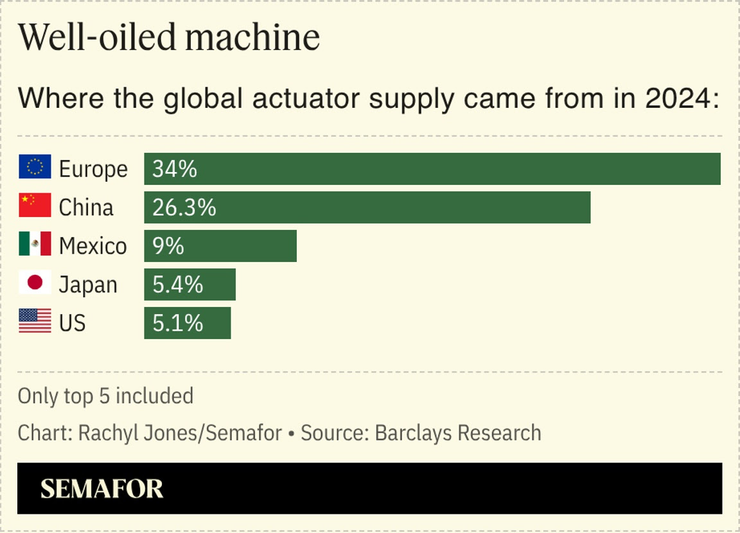
Europe’s carmaking prowess developed a robust market for actuators, the devices that make the humanoids move. The bloc produces 34% of the global actuator supply, followed by China’s 26%, with US companies controlling 5% of the market, according to a Barclays Research report.
The Trump administration recently elevated robotics — largely seen as the physical application for AI — to a matter of national competitiveness in its technology race against China. But US firms largely prioritize software, so many of them rely on foreign companies for their hardware, with Europe poised to be China’s primary competitor on humanoid parts and manufacturing.
“Higher tariffs would mean increased costs for US robotics companies and potentially supply chain disruptions and longer procurement periods,” Barclays Research’s Zornitsa Todorova told Semafor. While China presents an alternative, “there is an urgency to decouple from China and be more strategically independent, hence I don’t think supplying actuators from China is a viable alternative.”