




The News
The US House of Representatives voted to extend the African Growth and Opportunity Act (AGOA), but analysts are uncertain if South Africa will remain eligible after the bill makes its way through the Senate.
South Africa, Africa’s biggest economy and one of AGOA’s largest beneficiaries, has been in conflict with Washington on a variety of geopolitical and diplomatic issues, but tensions have notably escalated under the Trump administration, which has claimed without evidence that South Africa has enabled a “genocide” of its minority white population.
“South Africa has been on the chopping board a few times recently so the chances of it remaining eligible are unclear,” said Kholofelo Kugler, a nonresident scholar at Washington’s Carnegie Endowment for International Peace.
Last November US Senator John Kennedy filed an AGOA extension bill that explicitly called for the removal of South Africa from the 25-year-old preferential trade pact. That bill, which landed during a US government shutdown, did not get very far but could set the tone for negotiations in the Senate.
South Africa’s inclusion remained “50-50,” said Witney Schneidman, a former US deputy assistant secretary for African Affairs. “There are strong headwinds against inclusion,” he said. “But with more than 500 US companies present in South Africa and an administration whose Africa policy is based on trade, not aid, there is a strong argument for its ongoing inclusion.”
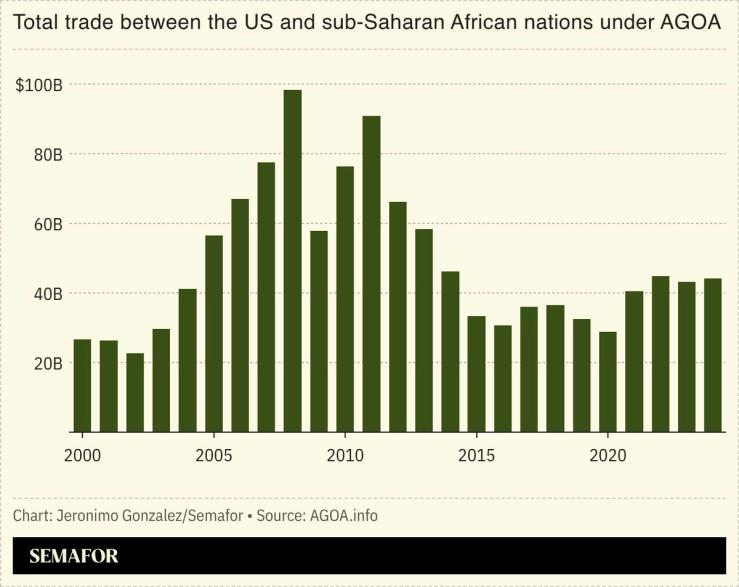
AGOA has allowed dozens of sub-Saharan African countries tariff-free access to the US market for certain products including fuel, agricultural goods, and textiles. For several countries, including Ethiopia, Kenya, and Lesotho, it underpinned textile trade with the US, and the deal’s expiration in September plunged thousands of factory workers into uncertainty.

Know More
The US House’s Ways and Means Committee has presented the AGOA extension as a means to strengthen America’s economic and security interests. “AGOA is a key element of US strategy to challenge Chinese and Russian economic coercion and exploitation of African nations,” it said in a statement, adding that the pact was also key to securing “access to critical minerals.”
There had long been hope that the new version of AGOA would be updated to improve the utility of the agreement. Experts like The ONE Campaign’s North America head Elizabeth Hoffman say AGOA has been “underutilized” by most sub-Saharan Africa countries outside of South Africa and a few others in specific industries.
But after the pact was allowed to expire by Congress last year the focus has been on getting it passed without further delay rather than negotiating additions. Hoffman said the new three-year agreement allows breathing room for work to be done on improving the pact going forward. “I think the challenges can be worked out in the Senate, but in the meantime we needed this baseline to work from.”
Additional reporting by Preeti Jha