


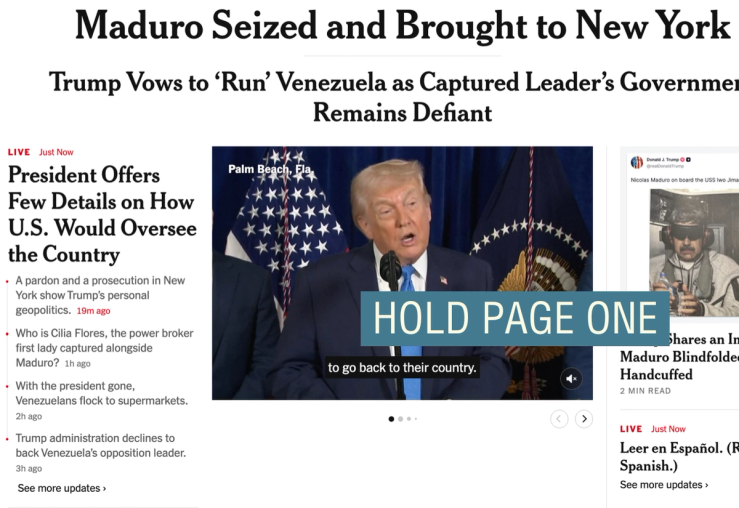

The Scoop
The New York Times and Washington Post learned of a secret US raid on Venezuela soon before it was scheduled to begin Friday night — but held off publishing what they knew to avoid endangering US troops, two people familiar with the communications between the administration and the news organizations said.
The decisions in the New York and Washington newsrooms to maintain official secrecy is in keeping with longstanding American journalistic traditions — even at a moment of unprecedented mutual hostility between the American president and a legacy media that continues to dominate national security reporting. And it offers a rare glimpse at a thread of contact and even cooperation over some of the highest-stakes American national security issues.
President Donald Trump and top administration officials Saturday praised the stunning seizure of the Venezuelan president, which Trump approved at 10:46 p.m. Friday, citing both the lack of American casualties and the total secrecy surrounding the attack.
“The coordination, the stealth, the precision, the very long arm of American justice - all on display in the middle of the night,” Pentagon chief Pete Hegseth said.
Hegseth did not mention that part of that secrecy was the news outlets’ decision — unlike other countries, the US does not have a mechanism for the government to prevent publication of secrets — to hold off their reporting for several hours after the administration warned that reporting could have exposed American troops performing the operation.
Spokespeople for the White House, the Pentagon, and the Washington Post declined to comment on the conversations between journalists and officials Friday night. A Times spokesperson didn’t immediately offer a response to an inquiry.

Know More
Trump’s open hostility to the news media has long shaped his public persona, and flows through his second administration. Nowhere has that been on display more than the Pentagon, where last year, new policies forced many news organizations to leave their press spaces in the building due to a policy change tightening restrictions on reporting inside the building. Leaks of national security information, purposeful and accidental, have ignited some of the biggest media firestorms of Trump’s second term in office.
But for all the strain in the relationship between the Trump administration and the news media, the decision by several major US news outlets to hold the news reflected the time-honored deference that some major news outlets afford the White House regarding secretive US military operations.
The New York Times withheld some details in advance about the US Bay of Pigs invasion, and for months delayed a story on national security administration warrantless wiretapping during the Bush administration after White House officials said the story’s publication would endanger American lives.
Last August, American outlets held back reporting that the US was in the process of a prisoner exchange with Russia for Wall Street Journal reporter Evan Gershkovich and former US Marine Paul Whelan.

Notable
- Trump celebrated Maduro’s capture in a phone interview with The New York Times at 4:30 a.m. Saturday.
- The Washington Post editorial board came out strongly in favor of the move, praising the Trump administration’s decisiveness and declaring the move a “major victory for American interests.”