


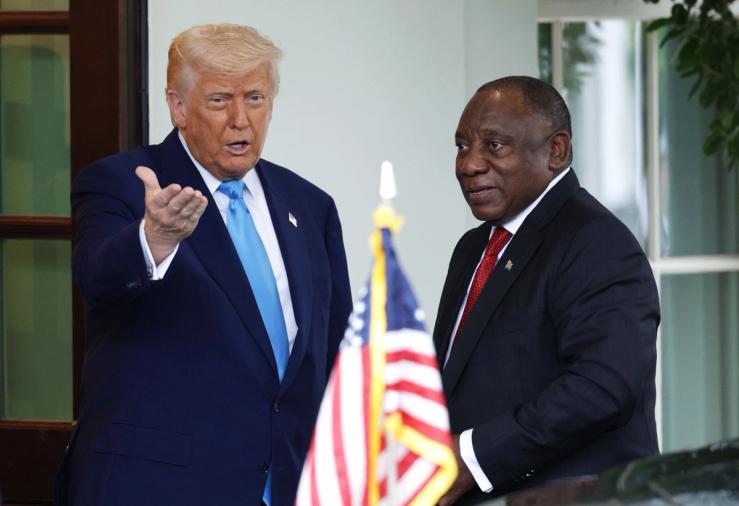
Donald Trump’s second presidency redefined Washington’s relationship with Africa in 2025. From the shuttering of USAID and tariff upheavals, to major diplomatic blowups with South Africa and Nigeria, it was a tumultuous year for many traditional US allies and trading partners across the continent.
Looking ahead, Semafor canvased experts for their predictions on Washington’s ties with African countries in 2026 on a range of topics, from critical minerals to security.
- On critical minerals
I expect to see the US deepen partnerships with African countries at the intersection of critical minerals and artificial intelligence. US competitiveness and security depend on secure, ethical, and reliable supply chains, and while African countries must move from extraction to bankable, value-added industries, they also need to build resilience and foster innovation to claim a strategic seat in global decision-making.
— Ufo Eric-Atuanya is CEO of Rimsom Global, and former senior vice president at the US EXIM Bank.
2. On the cost of capital
I’ll be watching the steps African governments, banks, and others take to push down the cost of capital on the continent. Although the African Union and South Africa won’t be able to use the G20 to achieve this objective under the US presidency, we will nevertheless see African governments pushing the IMF and credit ratings agencies to make more objective analyses of Africa. We will also see the African credit ratings agency come to life and African banks expand cheaper lending by clubbing together and attracting new investment from the BRICS and Gulf countries.
— Hannah Ryder is chief executive of Development Reimagined.
3. On US-Africa policy
I’ll be watching for the whiplash from the contradictions of US foreign policy that will disproportionately hit Africa. The pressure campaign on the continent’s two largest economies — South Africa and Nigeria — will be sustained, undermining investment confidence. The net effect is a harsher environment in which African states must rely more heavily on regional capital, institutions, and political coordination to pursue development goals once partially underwritten by external partners.
— W. Gyude Moore is a former minister of public works for Liberia and a distinguished fellow at the Energy for Growth Hub.
4. On US-led peace efforts
US President Donald Trump will lend his influence to make peace on the continent in much the same way he is now by using development assistance in very tactical ways that advance near-term US interests but ignore deep-seated drivers of violence. Places like Sudan, Ethiopia, and Egypt could see Trump intervene to tamp down or delay new conflict but won’t fundamentally solve them.
— Cameron Hudson is a veteran US-Africa affairs analyst and a former White House official under US President George W. Bush.
5. On advancing AI in Africa
A significant number of efforts towards advancing AI capabilities in Africa will likely stem from an industrialization angle, focusing on building foundational infrastructure through expanded telecommunications, AI-focused data centers, and feasibility studies to understand how mineral reserves can contribute to building local capacity for semiconductor and possibly even GPU production.
— Chinasa T. Okolo is the founder of Technecultura, an AI policy adviser at the U N, and a former fellow at the Brookings Institution.