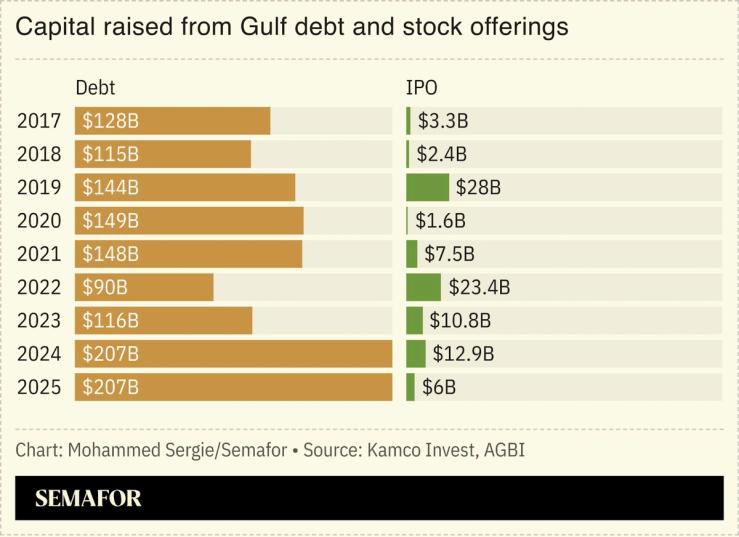
Gulf countries are notable global investors — and, increasingly, major borrowers.
Overall around $207 billion worth of bonds and sukuk have been issued this year, according to Kamco Invest, a Kuwait-based asset manager. That’s about the same as in 2024 — excluding the last 10 days of 2025 — but there have been some shifts within the overall figure. Gulf government issuance fell 21%, while corporate debt sales have grown 19%. Spreads have been tight: In one week in October, Abu Dhabi borrowed $3 billion at just 10 basis points spread over three-year Treasurys while Kuwait raised $11.5 billion in bonds priced at a 40-50 basis point premium.
Sovereign wealth funds have been active. Abu Dhabi’s ADQ raised $5 billion in financing from the Chinese lenders last week — having pushed the total up from a planned $4 billion due to strong investor demand. PIF raised a $2 billion bond in September and €1.65 billion ($1.9 billion) in October.
The health of the debt market is in sharp contrast to that of regional stock exchanges, where indices are lagging the US and emerging markets and the flow of IPOs is drying up.