




The Signal Insight
The advertising giant WPP has had a brutal 2025, with its stock falling nearly 60%. Mark Read, its then CEO, pledged in February that it would be a “year of execution.” Just four months later, he announced that he would be stepping down, after seven years at the helm. The board handed the challenge of reclaiming the ground the UK-listed company has lost to its rivals — to one of its own: Cindy Rose, a WPP director since 2019.
Rose, who spent a decade working with Microsoft’s enterprise customers, said when she was appointed in July that she saw “so many opportunities ahead.” But WPP soon delivered a dividend cut and lowered its profit outlook twice. Its recent performance was unacceptable, Rose told investors in October, promising to reveal the results of a sweeping strategic review early in the new year.
Now, after a 100-day tour of WPP’s leading customers, shareholders, and employees, she says she’s not waiting for that update to change how WPP “shows up” with clients.
Rose, a dual US-UK citizen, worked for Disney, Virgin Media, and Vodafone before Microsoft. Those companies had to transform their businesses in the face of disruption from iTunes, Netflix, WhatsApp, and the public cloud, she recalls, “and I feel well equipped to lead this company down that path.”
In her earlier roles, Rose had firsthand experience of being pitched to by multiple WPP agencies at once. “There’s complexity in our model that makes it very difficult for us to have talent fluidity. And we need to fix that,” she says. But after WPP lost several big clients earlier in the year, she sees recent account wins from the likes of Reckitt, Mastercard, and the UK government as evidence of “undeniable” momentum.
For all the disruption AI heralds, Rose is betting on it making WPP a more valuable partner to brands. She has signed a $400 million deal with Google to gain preferential access to its AI models and tools, and says: “The more complex and fragmented the technology landscape gets, the more interesting the opportunity for us, because our clients will need help navigating a very, very fast-moving landscape, which doesn’t appear to be slowing anytime soon.”
This interview has been edited for length and clarity.
Andrew Edgecliffe-Johnson: Can you go back to the moment where the board turned to you and said, “Cindy, how about it?” How did that play out?
Cindy Rose: A couple of board members tapped me on the shoulder and said, “Hey, this is interesting. You should think about it.” We have talked a lot about how AI is changing the shape of the industry, and how it’s likely to impact our clients, and how it’s likely to impact us. I was playing the role of the technology expert on the board, so I had a point of view on these things. So when the time came, and we decided we needed a CEO who could see around the corner, who had a vision and a strategy about how to play in the new era of AI — I guess I became a natural choice. And then I had to get my head around it.
Do you think we’ll see more boards deciding that an understanding of AI is going to be much more salient in the skill sets that you look for in a CEO?
I definitely think so. Any CEO today needs to understand how AI is going to change the shape of their industry and impact their company, their people, and their customers. This technology shift is happening faster than anything we’ve ever seen before. It’s a generational opportunity. And I always have been a pretty unapologetic technology optimist. I don’t consider AI to be an existential threat. I think there’s never been a better time to be in this industry.
AI is a fundamentally disruptive technology. What does AI disrupt in WPP?
AI, like every other major tech shift in our history, will have some deflationary impact as productivity gains take hold. It will be our job, then, to help our clients optimize their spend on marketing and reinvest what they save into innovation and transformation. It could also disrupt what I’ll call the time and materials business model. Any player in the service industry that is charging on a time and materials basis is looking at how their commercial model evolves in the era of AI, and we are no different. I suspect we’ll [see] our clients transform and move to a hybrid of tech fees, fixed fees, and probably outcome-based fees. But it’s not going to happen overnight.
Why did you agree to do this job?
Marketing and advertising is probably being transformed faster than almost any other industry, and I wanted to lead WPP through that shift. I have always been at the intersection of technology and consumer experience. This is another opportunity for me to find a value accretive path through technology transformation. And I really love that challenge.
Do you think something different is required to lead creative teams from technology teams?
For sure. It takes a modern, empathetic, adaptive leader, which I like to think I am. We’ve got over 12,000 creatives and nearly 10,000 software engineers, developers, AI practitioners, and data scientists. This is a business that meshes these two domains beautifully. [When it comes to] creativity, what I would say is AI is going to automate the ordinary, and massively elevate the value of the extraordinary. In a world of infinite content, there’s a risk that AI will drive to homogeneity, so our creative talent is precious. We could be moving into a world where genuine human imagination, insight, empathy, [and] creativity become the ultimate differentiator. So we have to be excellent at both technology and creativity.
On your first earnings call, you said WPP’s recent performance has been unacceptable. What is your diagnosis [of what went wrong]?
WPP has not gone far enough or fast enough to keep pace with the evolving needs of our clients. Clients tell me very consistently they want us to be easier to work with. All of the friction in our model comes from the fact that we have multiple P&Ls, a very complex operating model where it’s unclear who’s making decisions. And, fundamentally, we need to pivot from being a holding company to an operating company. Our clients want the best of WPP. They don’t want to be constrained by whatever agency door they happen to walk through.
What’s the most important perspective that your 10 years at Microsoft gave you on this job?
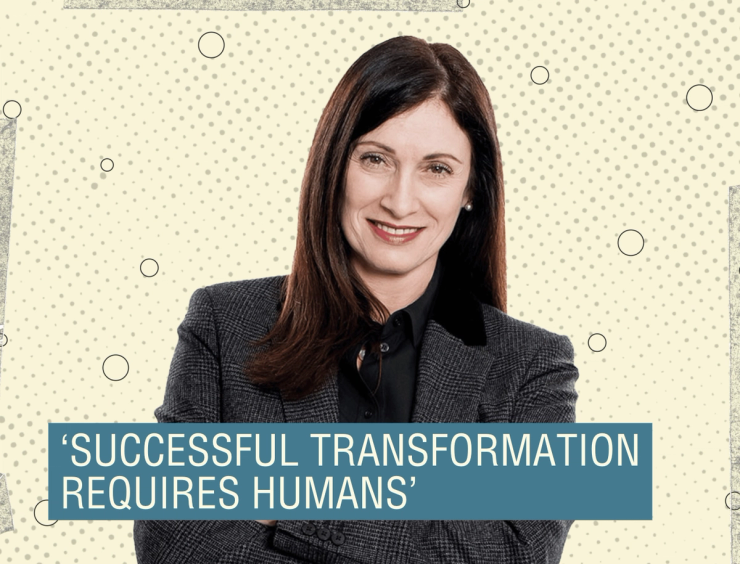
Probably that successful transformation requires humans. The tech, in some ways, is the easy part. Successful transformation requires culture change, and that’s often the difference between successful transformation and unsuccessful transformation. So it does require really strong leadership. And something we talked about at Microsoft a lot was growth mindset. People need to be willing to embrace a new way of doing things, and that’s hard.
I learned in my last role to hire for attitude and train for skill, because it’s very hard to find native AI thinkers. It’s more about what potential do people have to embrace the new with humility and the mindset of a learner. We’re bringing some of those principles into WPP.
What did you learn from [Microsoft CEO] Satya Nadella?
That tone from the top is not enough. It’s about operationalizing it at every layer of the organization, from performance management to how you compensate people to how you talk about collaboration, how you lead by example. Every artifact of leadership needs to support the culture you’re trying to create. He set the tone beautifully, and the leadership around him operationalized it all the way through.

Notable
- Omnicom is cutting more than 4,000 jobs and folding storied agencies including DDB and FCB into other operations following its $13 billion takeover of Interpublic. The deal, which made Omnicom the world’s largest ad company by revenue, is now expected to generate cost savings exceeding the $750 million originally envisaged, executives said.
- WPP has hired McKinsey to advise on its strategic review. Management consultants give executives useful air cover for painful and unpopular decisions, Bloomberg’s Chris Hughes writes, but an activist investor who can “wield a stick to make changes happen at pace” could be more helpful in ensuring tough measures are actually implemented.