




The Signal Interview
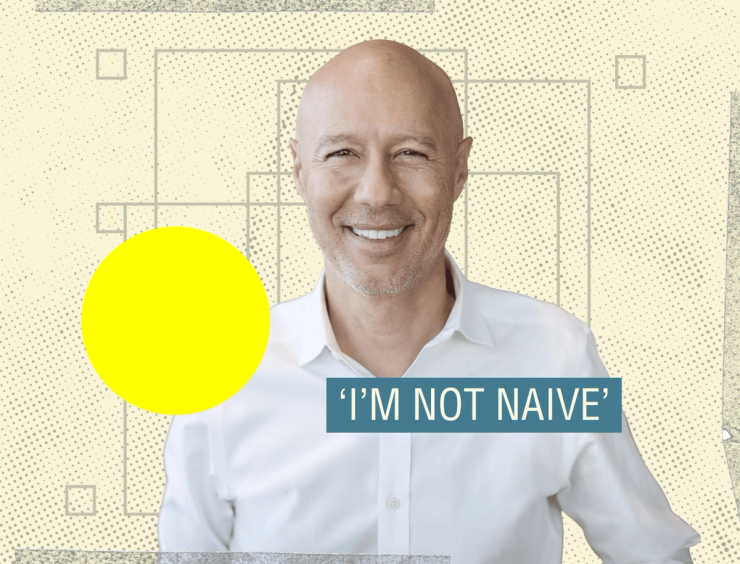
David Risher had been on Lyft’s board for two years when he was asked on Valentine’s Day 2023 if he would apply to be the rideshare company’s CEO. Risher, an early Amazon executive who was running his own nonprofit, discussed the idea with his wife and then wrote out his pitch for the job. It was titled: I want Lyft to lead, and I want to lead Lyft.
Defining what leadership meant for the No. 2 in the US ridesharing market was not obvious, however. Uber, its category-defining rival, made almost eight times as much revenue in the previous year, and Lyft’s chances of overtaking it were remote.
Risher saw the company as a one-time innovator that had lost momentum. He needed to re-energize a rideshare experience that no longer felt “magical” for customers, he concluded, rather than focus on “us versus the other guys.” (When asked why he only ever refers to Uber as “the other guys,” rather than by name, he makes a face and declines to comment.)
Almost three years later, Lyft is still No. 2 to Uber, but a far healthier one. It is reporting record numbers of active passengers and drivers. It has swung from consuming $300 million in cash in the year before Risher took over to generating $1 billion in cash for the 12 months prior to September. It has bought its way into the European market, and it has struck partnerships with Waymo and Baidu to begin offering autonomous vehicle rides in cities from Tennessee to Germany. Its stock has not kept pace with Uber’s, but it has doubled since Risher started.
If customers and investors still see Lyft as the runner-up in ride sharing, Risher says, they’re missing the point. Uber and Lyft may be fighting over a few billion shared rides in the US each year, but there are another 160 billion trips still taken in private cars. “If I’m really thinking about how do I grow Lyft, how does Lyft become successful and relevant to more people, it’s much more about those next 160 billion rides,” he reasons.
The importance of early action
As Risher set out to capture more of that untapped market, he was guided by advice from a former colleague. Joe Galli, who was Amazon’s president and chief operating officer 25 years ago, told him: “You’ve got about two months where this company is wet cement, and then it’s going to start to dry, so don’t waste those first two months.”
So Risher began with a barrage of announcements, aimed at setting new expectations among customers, drivers, and employees. Lyft lowered the prices it charged riders while introducing earnings guarantees for drivers. A new feature called Women+ Connect, which matches riders and drivers who are female or nonbinary, launched soon after.
On his first day, Risher also told employees who were working remotely they should return to its offices. That let him tie a potentially unpopular message to the bigger mission he was laying out for the company: that its purpose is to connect people. “To get people out and together, that matters for society,” he says, “and we can’t do that if we’re all at home ourselves.”
There was a risk of doing too much at once, he concedes. “But my view was, if we didn’t do all those things at the same time, we were going to miss the opportunity to reform the company’s culture and direction.”
An Amazonian obsession
Risher, who had been a general manager at Microsoft, became Amazon’s 37th employee in 1997, when Jeff Bezos’ creation was an upstart online bookseller with a little over $15 million in revenues. As head of US retail, he contributed to Amazon’s sales growing to $4 billion by the time he left in 2002. Bezos sent him off with a tribute to his contributions that he pledged to keep on its ecommerce site forever.
Those years at Amazon drilled into Risher an obsession with the customer, he says. “The internet really is a very, very unforgiving place, because you’re always a click away from something else. If you’re not customer-obsessed, I don’t know how you’re going to win, because your customers are going to go find something else to do.”
Sean Aggarwal, another Amazon alumnus then serving as Lyft’s chair, had invited him to become a director to bring some of that focus to the boardroom. But when Risher became CEO, he felt it had drifted too far from the customer-first approach that he thought was needed to drive profitable growth. Fixing that required rethinking the way the company was organized.
“You have to structure yourself such that you’re broken up in just the right number of pieces,” Risher says. With too many divisions and teams, “everyone’s time is spent negotiating with everybody else.” With too few, “It’s just impenetrable. One person is trying to do too much, and nothing ever gets done. So [getting] that right level of granularity is super important.”
Risher shook up the org chart to focus top executives on specific constituencies rather than functions.
“We now have someone who wakes up every single morning and thinks riders, riders, riders, someone else who thinks drivers, drivers, drivers,” and so on for Lyft’s nascent autonomous vehicles operations and its growing advertising business, Risher says. That kind of change doesn’t automatically increase the pace of innovation, “but it increases the likelihood that the innovation will actually be focused on the customer.”
Lyft has lowered prices for passengers by 10-20%, is picking riders up faster, and has launched new offers like an on-time pickup promise for airport trips. The number of drivers who cancel rides they’ve accepted has fallen by two-thirds.
Risher drives for Lyft about every six weeks, which he says has taught him the importance passengers attach to the partnerships Lyft has struck with points-earning credit card and airline loyalty programs. It has also encouraged him to introduce driver-pleasing offerings like minimum earnings guarantees.
“It’s a little bit like Maslow’s Hierarchy of Needs,” he says, likening his strategy to the famous pyramid-shaped theory of human motivations. “At the base, you just have to provide great service, hundreds of millions of times a year. Right price, right pay. If you don’t do that, you don’t have permission to do anything. Then, on top of that, you have to keep innovating.” Why? Because if you wander around a tech company graveyard, “all the tombstones will basically say, ‘They stopped innovating.’”
Placing bets on an AV future
Only when Risher had addressed those service and innovation challenges could he consider the expansion plans that sit one tier up the pyramid. Lacking Uber’s scale, Lyft had held back from international expansion until this summer’s $197 million acquisition of FREENOW, which took it into nine countries in Europe.
Similarly, autonomous vehicles could shake up Lyft’s market in the coming years. It did not want to stake its future on a single AV partner, nor did it have the resources to make dozens of bets.
So Risher has struck small, selective deals with a tight group of AV partners – Baidu in Germany and the UK, May Mobility in Atlanta, and Waymo in Nashville — after weighing up their technology, their ability to scale, and how well they have won cities over to their offerings. “You have to look at each one of these pieces and basically say, ‘Who has a right to win?’” he explains.
At the same time, he has moved to head off anxieties among Lyft’s drivers about the prospect that they’ll lose their livelihoods as the company offers more driverless rides. Risher’s laptop carries a sticker celebrating the patent application he filed after devising a “driver accomplishment letter.” It’s a certificate the highest-rated drivers can generate automatically, including their star rating and the compliments passengers have paid them, if they need a reference for a new employer.
Risher thinks it would mark “an enormous success” for autonomous driving if it represented 10% of Lyft’s business by 2030, which means that he expects drivers will still have their hands on the wheel 90% of the time. He is pressing ahead with his AV bets all the same, building flexibility into its partnerships in the knowledge that there is still considerable uncertainty about how the market will evolve. It has offered its proprietary fleet management services to Waymo, for example, so that “we get paid, no matter what,” even when a ride is booked through Waymo’s app rather than its own.
It’s about understanding your unique advantage in an ecosystem that is evolving fast, Risher says.
“Our job is, frankly, to work so hard and to be so efficient at what we do that [AV companies] lose interest in doing everything themselves and decide to partner with us more and more. But I’m not naive: they’ll experiment and they’ll do other things, and that’s fine. It’s OK. The only way we can compete is by being better. That’s it.”

Notable
- Uber was once a staunch advocate of government policies that would speed the adoption of electric vehicles. As the political winds have changed in Washington, it has pulled back from the EV incentives it once offered to drivers, Bloomberg reports, and is likely to miss its green targets as its emissions increase.