




Andy’s view
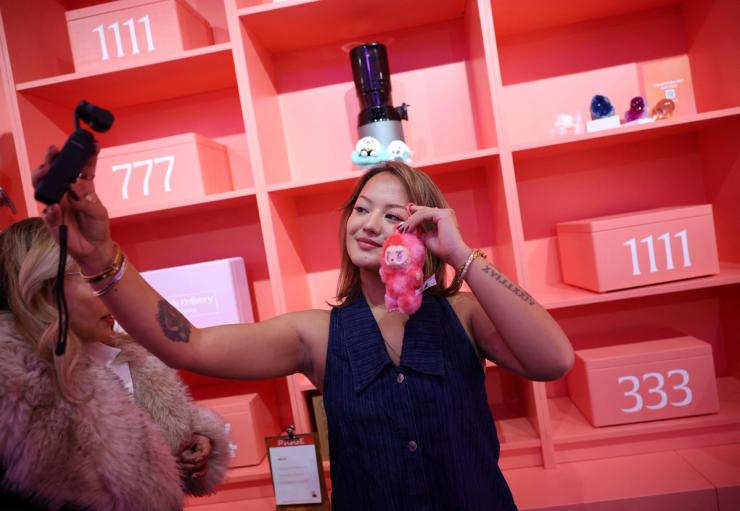
Labubu dolls from China are suddenly an “it” accessory for celebrities; Lisa from the K-pop group Blackpink dangles them from her Louis Vuitton purse. In the world of video, micro-dramas are a hot trend: Tales of romance and heartbreak, in episodes as short as 60 seconds, are big business in China, and now the genre is taking off in Japan, Southeast Asia, and beyond. On TikTok, meanwhile, Western teens and twentysomethings are devouring Chinese “infrastructure porn” — images of spaghetti-like flyovers in Chongqing, glass bridges in Guizhou over plunging caverns, and futuristic Shenzhen skylines.
This is not an anomaly: Chinese culture is going mainstream, like Korean pop and Japanese anime before it.
One can date the phenomenon to 2020, when TikTok exploded in the US during the COVID-19 pandemic. Then, Black Myth: Wukong, based on a 16th-century Chinese classic, became one of the fastest selling video games of all time. And Netflix’s 3 Body Problem, an adaptation of Chinese author Liu Cixin’s sci-fi novels, hit the top spot on the streaming giant’s TV viewership list.
Not all China’s cultural exports identify obviously as Chinese. TikTok, for example, is a US-China amalgam. And Labubu’s success stems in large part from its clever “blind box” marketing gimmick: Buyers don’t know which toy character is in the package until it’s opened, generating suspense. The creator of the snaggletoothed dolls, a Hong Kong-born artist, says the figures were inspired by Nordic folklore.
Still, Chinese state media is gloating over a “cool China” vibe spreading from Los Angeles to Singapore via bloggers, influencers, and live-streamers. In a recent article, the People’s Daily, a Communist Party mouthpiece, claimed that the country’s “more than 1.4 billion people are becoming respected and admired contributors to the shaping of the global process of civilization.”
While that’s an exaggeration, cute dolls and video games have done more to boost China’s global image than decades of state-led efforts featuring wooden broadcasts, Confucius Institutes teaching Mandarin Chinese, and the “Global Civilization Initiative” to promote Chinese values. These are all part of Chinese leader Xi Jinping’s efforts to “tell China’s story well” and address a vexing problem: the glaring mismatch between China’s massive economic impact on the world, and its minimal cultural cachet.
Effectively, the Communist Party is outsourcing its soft power outreach to China’s private sector, the same group delivering tech innovations — EVs, batteries, solar panels, and wind turbines — to the world.
The irony here is that much of this cultural golden era is pouring out of the Chinese internet, the most censored and surveilled digital ecosystem on the planet, existing behind a Great Firewall that’s designed to keep China’s internet users in, and foreign influences out.
But in a sense, that’s precisely why this project is working so well for China.
On the one hand, the black box produces Chinese entrepreneurs with a rare mix of talents: technologically brilliant, politically adroit, commercially tough, and with strong survival instincts. It also ensures that foreigners get only a partial view of China.
Earlier this year, the high-energy American YouTuber and streamer IShowSpeed reportedly added one million followers when he went live from Shenzhen, dancing with a humanoid robot, taking a ride in an amphibious EV, and ordering KFC by drone. “My food is in the air!” he marveled. “China is different!”
True. But like internet surfers in the West, agog over Chinese modernity, he never got a good look inside.

Room for Disagreement
Christopher Walker, the Center for European Policy Analysis expert who coined the term “sharp power” — the effort by authoritarian states to build global influence — argues that China’s approach was working well, even before the Labubu craze. He points to Western colleges that discontinue research into sensitive political topics that upset Beijing, media outlets that run Chinese propaganda, Hollywood producers who alter scripts or cut scenes to ensure their movies play in China. The Party, he told me, is good at “dominating the agenda and inducing censorship in partners.”
Ying Zhu, the author of Hollywood in China: Behind the Scenes of the World’s Largest Movie Market, meanwhile sees a generational difference in perceptions of China abroad. An older demographic around the world still harbors memories of the 1989 Tiananmen Square massacre, while younger people “gravitate toward trendy cultural products and high-tech gadgets.”