



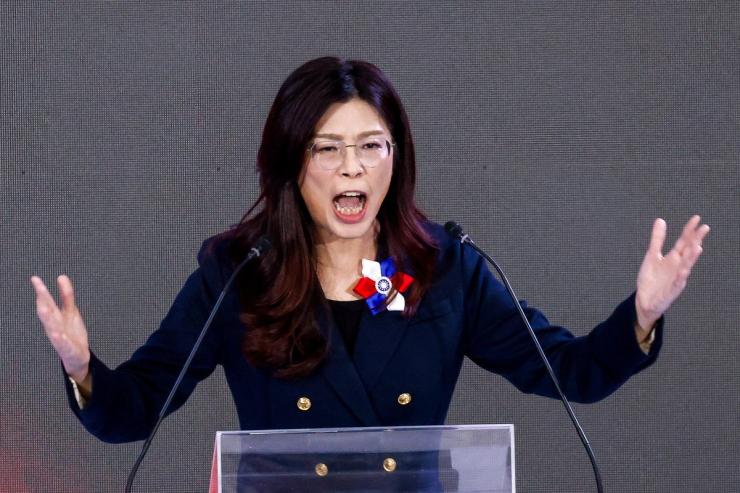
In the late 1980s, Taiwan was in turmoil: Martial law, imposed under Generalissimo Chiang Kai-shek’s White Terror, had recently been lifted and young protesters flooded the streets to demand democracy from the ruling Kuomintang. Cheng Li-wun was one of them.
In one fiery speech, she lashed out at Taiwan’s “despicable rulers” who wanted to “squeeze and oppress the Taiwanese people.”
At the time, I was the Reuters bureau chief in Taipei, and interviewed many students who railed against the Kuomintang with similar vehemence. They saw the Kuomintang as a Chinese occupying force, and yearned to forge a Taiwanese identity. Some openly advocated for independence.
Taiwan today is a vibrant democracy, with a raucous media, boisterous parliamentary debate, and a strong sense of its own history, culture, and traditions. Cheng — now an elegant, Cambridge-educated legislator, lawyer, and media personality — has transformed, too: She’s the new chairperson of Taiwan’s main opposition party, the Kuomintang.
She won a party election in October on a pro-Beijing platform, pushing for unification with China, urging Taiwanese to “be proud to be Chinese,” and even paying her respects at Chiang’s tomb. During the campaign, her Beijing-friendly statements shocked even stalwarts in her own party, which advocates for accommodation with the mainland. One of them quipped that the Kuomintang should change its name to the “Chinese Nationalist Surrender Party.” Another accused Beijing — which regards Taiwan as a renegade province to be incorporated into China, by force if necessary — of manipulating the election.
Cheng’s surprising rise to the top of the Kuomintang speaks to powerful political currents stirring in Taiwan at a grassroots level: She won a convincing victory in a crowded field by appealing to party members who fear that current President Lai Ching-te’s provocations — he dances around the Taiwan independence issue, insisting the island is already a sovereign nation — risk triggering a Chinese military onslaught. Lai’s Democratic Progressive Party has won three presidential elections in a row, and some fear that a fourth victory, in 2028, would convince Beijing that a military takeover was the only option.
I was in Taiwan to cover the first of those elections, in 2016, which swept Lai’s predecessor, Tsai Ing-wen, to power. She crushed the Kuomintang by harnessing the energy evoked by the Sunflower Movement, a revolt among young people resentful of China’s efforts to forge closer economic ties with Taiwan while simultaneously threatening it with invasion. The mood on the island was defiant.
Nowadays, public morale is sinking. Beijing froze Tsai out for refusing to acknowledge its cardinal “one China” principle, and lambasts Lai as a “dangerous separatist” while stepping up a campaign of military intimidation — buzzing the island’s airspace with fighter jets, practising naval blockades, and rehearsing for an amphibious invasion. The psychological pressure is designed to force Taiwan’s capitulation without the need for military action, a strategy that appears to be paying off.
In the meantime, skepticism in Taiwan toward the US is building. Polls show increasing numbers of Taiwanese doubt that Washington will come to the island’s defense in a crisis. US President Donald Trump’s decision to impose 20% tariffs on Taiwan’s exports has deepened those suspicions, along with his push to relocate the island’s semiconductor industry — a “silicon shield” against Chinese attack, as some strategists see it — to the US.
Cheng hasn’t revealed whether she has presidential ambitions, and it’s far from clear she can unify the Kuomintang and revive its flagging fortunes. To do that, she would have to appeal to swing voters, who overwhelmingly identify as Taiwanese. Opinion polls show that just 3% of the population consider themselves purely Chinese, and most would opt for Taiwan independence, although since that would almost certainly trigger a Chinese invasion they are content to settle for the status quo.
Still, Beijing seems to be betting on Cheng; Chinese leader Xi Jinping sent her a congratulatory message on her win, and a meeting between them is in the cards.
Washington has good reason to be concerned: A Kuomintang-led coalition controls the legislature, raising doubts about whether Lai will be able to push through a $40 billion special defense budget intended to appease the White House, which has demanded that Taiwan raise its defense spending to 10% of GDP. Cheng hasn’t said whether she supports the package, although she’s clearly skeptical, telling The New York Times: “Could it be that the United States is treating Taiwan as a chess piece, a pawn to strategically provoke the Chinese Communist Party?”
During the 2016 presidential election, I spoke to one young voter who told me, “You can’t point a gun at our heads and ask us to be friends.” Then, she was referring to China as the bully. Though her compatriots are, by and large, no friends of Beijing, more and more of them might say the same about the US.