



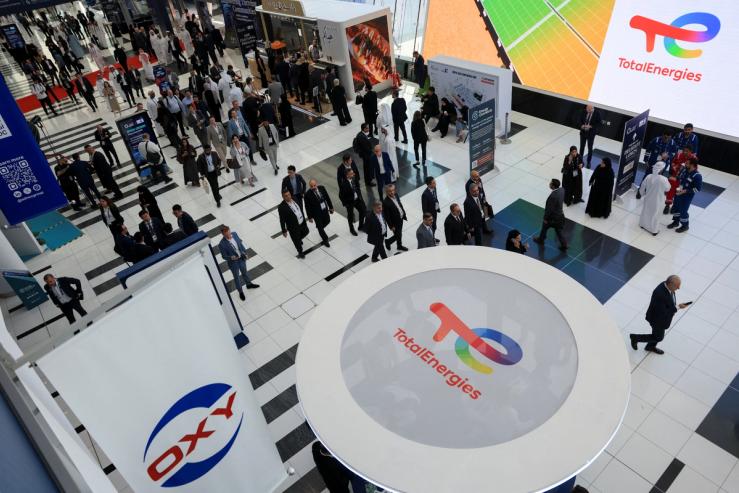

The News
Middle East energy executives are more optimistic about their industry’s future than their peers elsewhere, a testament to their ability to keep oil flowing despite the disruption to the Strait of Hormuz, according to research commissioned by the organizers of ADIPEC, the Abu Dhabi energy conference.
Global demand for energy from all sources is forecast to rise over the next decade, driven by electrification and AI adoption. The International Energy Agency estimates energy investment at a record $3.4 trillion this year: $2.2 trillion in clean energy and grids, and $1.2 trillion in oil, gas, and coal. Almost two-thirds of the more than 1,800 decision-makers surveyed expect the pace of capital deployment to increase by more than a fifth over the next five years.
The upbeat assessment isn’t surprising from producers who can get their product out of the Gulf amid higher prices from the US-Iran war. Most respondents said the energy system passed its biggest “stress test in 50 years” and proved more resilient than expected, thanks to quick adjustments to shocks, continued supply to customers, and the diversification of sources and routes before the conflict.
But a third of executives from consuming countries in Asia — the most vulnerable to the disruptions — said the global energy system proved less resilient than expected.

Know More
ADIPEC, the world’s biggest energy exhibition, organized by dmg events, comes at a moment of unprecedented upheaval for a region that supplies a fifth of the world’s oil and liquefied natural gas. The disruption has pushed dozens of countries to rethink their energy security priorities. While many governments may pursue domestic self-reliance to avert future shocks, those in the industry are betting on a connected system, ranking renewables, source diversification, and infrastructure protection as bigger priorities than self-sufficiency.
The survey showed broad consensus on artificial intelligence, both as a driver of future demand and as a way to unlock efficiencies from the wellhead to distribution. Just 3% of respondents expect electricity demand from AI to be lower than forecast; a majority see the technology as becoming more influential than innovations in renewable energy over the next decade.
AI applications in oil production have moved beyond the pilot phase: One executive said in the report that software “distributes the power on the drilling rig in the exact amount required and stores the unused energy for later use. It reduces the total power consumption of the rig by 25 to 30%.”

Notable
- The Hormuz closure is the biggest energy security crisis the world has faced, according to IEA chief Fatih Birol, who expects it to reshape investment much as the 1970s oil shocks did.
- Asia is rethinking its reliance on Gulf energy. The region is shifting “from just-in-time supply chains to just-in-case supply chains,” one analyst told Fortune.