



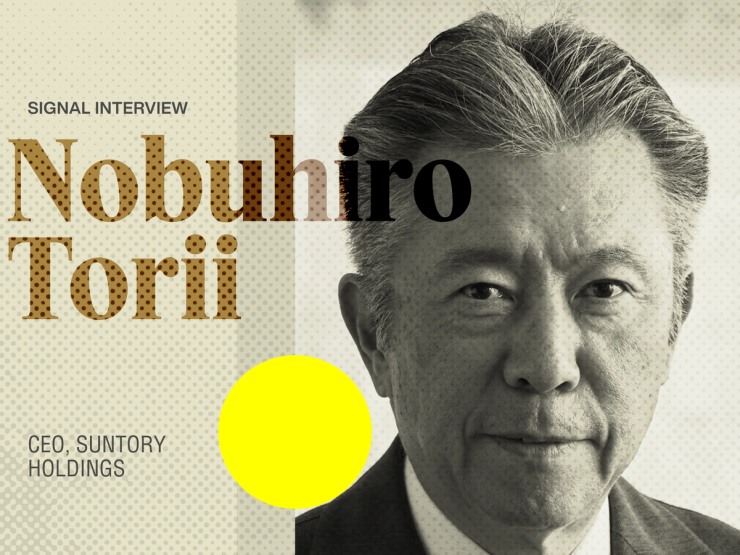

The Signal Interview
Nobuhiro “Nobu” Torii’s appointment as CEO of Suntory last September returned the leadership of the group behind Yamazaki whisky to its founding family, 126 years after his great-grandfather, Shinjiro Torii, set up shop as a wine importer in Osaka. But the younger Torii’s succession was an abrupt and unplanned one.
Takeshi “Tak” Niinami, Suntory’s first non-family CEO, quit after police searched his home for suspected illegal supplements. They found none, and the high-profile executive denied having broken the law. But the board decided that Niinami’s resignation was necessary, and elevated Torii from his role as president, which he’d assumed just a few months earlier.
It was a rare upset in a family business that prizes stability, and Torii’s message in his first interview with a Western news outlet since becoming CEO is that he brings a steady hand and a long-term focus. But he also displays an ambition to turn an increasingly tough market for the alcoholic drinks with which Suntory is synonymous to its advantage.
Niinami was a dynamic, “hands-on” leader, integrating deals like the 2014 acquisition of Jim Beam bourbon while family chairman Nobutada Saji “kept our corporate culture,” Torii says. Torii’s own role combines those two imperatives, he implies: “I don’t have any aggressive strategy, but I really want to keep our corporate culture,” he says. “[The] culture is very important for the further growth of the company.”
The onetime banker’s challenge is that he took the reins as the group’s growth had faltered, with operating income falling last year on almost flat revenues of about $22 billion. Most notably, spirits consumption in Suntory’s largest markets has been in decline after peaking during the pandemic. Companies across the industry have been idling facilities, with Suntory pausing production at one of Jim Beam’s three Kentucky distilleries to upgrade the site while demand is low.
Torii’s task is to find growth in new countries and categories while showing that he can find opportunities again in the core liquor business. The group has predicted a rebound in its profits this year, and its new CEO is projecting optimism.
His family’s willingness to think across generations will be central to Suntory’s ability to achieve its goal of becoming the world leader in whiskies and ready-to-drink spirits, he suggests. “It takes at least five to 10 years to have a good whisky, so the strategy must be long-term-oriented.”
A private company looks for long-term opportunity
Suntory’s history informs Torii’s reticence about making sudden strategic turns. The spirits industry is not a fast-moving consumer goods business but a slow-moving one, he says, recalling how the company misread demand for one of its brands more than 40 years ago. “We believed Suntory Old Whisky would continue to sell more, more, more, more, more, and that was a mistake,” he says. “Once we change the strategy in the whisky business, it will take many, many years to recover.”
Torii’s group has a Tokyo-listed subsidiary, Suntory Beverage & Food, but the holding company itself is private, he notes, allowing it to take a longer-term view of the market. “We don’t have any stock price. So now it’s a good chance for us to strengthen our brands,” he says. Shares in publicly listed spirits companies such as Diageo and Pernod Ricard have been falling for several years, he notes, so “they have to control their stock price by cutting some costs.”
“We are still investing in our brands while our competitors seem not to invest a lot,” he says, describing his rivals’ market behavior as “defensive.”
Torii’s belief in private companies’ superior ability to invest through cyclical downturns echoes that of Sazerac, the US drinks company whose unsolicited bid for Brown-Forman was rejected by the Jack Daniel’s maker this year. But he suggests that Suntory is unlikely to be so ambitious about acquisitions.
More than a decade on from the balance sheet-stretching Jim Beam purchase, Suntory’s financial capacity is “relatively strong,” Torii says, but he notes that interest rates have increased, which would make any purchase more expensive to finance.
“Our first priority now is [to] invest in our brands,” he stresses.
Asked whether he expects further consolidation in the liquor industry, Torii replies with a joke. “Well, it’s already consolidated, and if some spirits company [should have] an interest to acquire us, I would consider [it],” he laughs. But he quickly confirms that the family’s controlling stake would let it block any unwanted transaction.
How demographics and diversification shape Suntory’s strategy
Investors have grown concerned that young consumers are more abstemious than their parents were at the same age. In a speech in New York earlier this month, Torii said people were becoming “more intentional in their alcohol consumption” but also more focused on the quality of the drinks they chose, which he believes will favor his products. “At Suntory, quality is not a department; quality is a philosophy,” he told his audience.
“The biggest difference between my generation and the younger generation is probably this one,” he says, gesturing to an iPhone. His point is not just that more people are socializing virtually rather than in bars and restaurants; it is that the high cost of their electronic devices has made them more selective about other spending.
“We have to educate younger generations to understand the attractiveness of whiskies or other spirits,” Torii says. Still, he sees little evidence that recent inflation gains are making them sharply more cost-conscious about their drinking.
Instead, he thinks that consumers may be acclimatizing to higher prices. Twice in the past six years, Japanese customers raced to stock up on Suntory’s products before the government raised liquor taxes, he says. The third such increase went into effect this month, but this time there was no such rush.
The risk that alcohol consumption will recover slowly strengthens the case for diversification. Already, Suntory makes more than half of its revenues from soft drinks such as Boss coffee and Orangina, and it will explore wider global distribution of its soft drinks, Torii says. The group also has an eclectic portfolio of other businesses, including flowers, health supplements, and skincare brands, but he says every new venture must build off areas where it has historic strengths.
For now, Torii’s most visible diversification bet is a geographic one. He sees “a huge opportunity” in India, he says, because its population of legal-age drinkers is growing by 20 million people annually. That’s equivalent to “one Australia per year,” he notes. Oaksmith, the whisky Suntory blended for the Indian market and launched in 2019, has been gaining market share, while Jim Beam is enjoying double-digit growth in India.
Suntory’s global spread has given it some protection as tariff wars have pushed up the prices of imported spirits. Under Torii it has pursued a more “local for local” strategy, directing more of Canadian Club’s production to a Canadian market that has shunned US bourbons, more Scotch to the UK, and so on.
A family business confronts the cultural communication challenge
Shinjiro Torii’s hope in Suntory’s early years was to adapt Western ways of making wine and spirits to suit Japanese palates. His great-grandson is focused on how to build a corporate culture that suits both Japan, “our mother country” and the source of more than half of the group’s sales, and the diverse expectations of 40,000 employees around the world.
Torii wants the whole company to understand the underpinnings of Suntory’s culture, such as the corporate motto of “Yatte Minahare,” which he translates as a “spirit of challenge” that encourages people to pursue ambitious dreams. But, he adds: “We don’t push the Japanese culture to, say, American people.”
It’s a balancing act that he began learning at the age of 23. “My father didn’t push me to learn the corporate culture or Suntory itself,” he explains. “He only advised me to be able to communicate with different people, different cultures.” So the young Torii moved to Massachusetts to study at Brandeis University, discovering that he “really enjoyed Jim Beam,” which was “quite reasonable” on a student budget at the time.
References to Suntory’s commitment to quality “generation after generation” peppered Torii’s recent speech in New York, but he is not adamant that Suntory’s next CEO should be a direct descendant of its founder. “It doesn’t have to be a family member,” he says, “but someone that will be able to maintain the corporate culture should be my successor.”

Notable
- Asked where he wants Suntory to be a generation from now, Torii replies, “Let me think about that.” But he has one clear ambition in mind: 2037 will mark 100 years since the launch of Kakubin, Japan’s best-selling blended whisky. The country’s whiskies can claim a much larger share of the global market over the next decade, he believes, “so at that time, I really want to see Kakubin become a real global brand.”