



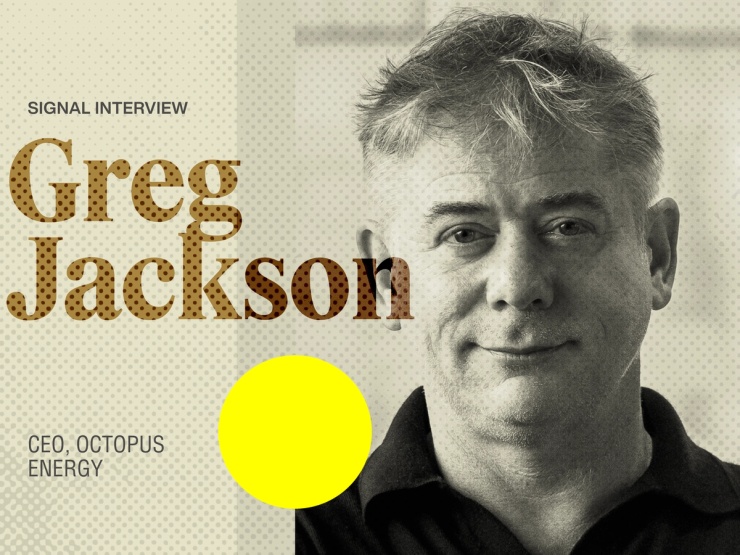

The Signal Interview
In a little more than a decade, Octopus Energy has grown from an outlandish idea into Britain’s largest energy provider. It now powers 12 million homes in eight countries, manages wind and solar farms from Scotland to South Korea, manufactures heat pumps, installs smart meters, leases out 50,000 electric vehicles, and supplies technology to utilities around the world.
The tentacles of this “Octoverse” all lead back to Greg Jackson, a founder-CEO who has built his 13,000-person company without bonuses, HR or IT teams, or a succession plan.
Beyond the walls of the company’s London headquarters, which is filled with thousands of its plushy pink octopus mascots, Jackson’s empire may look like an unwieldy one. It is not, he insists: “The thing that’s connecting it all is the underlying insight: that the technologies of electrification can deliver tremendous cost savings, but only if you build a new system.” And building that new system requires using every tool at his disposal.
“There’s a scene in the movie Apollo 13 where the astronauts are stranded and they’re going to die unless the solution is found. And on the ground, Mission Control assembles … everything there is on the space station, like duct tape and bits of piping, and they say, this is all we’ve got to save their lives,” he explains. “In any business, you choose your constraints, and then how you assemble the stuff you have to create the outcome you want.”
Octopus’ job is “to take all these ingredients and say, how can we outcompete the old world of energy with better products and services with better value?” Jackson says, before reaching back to the beginning of that old world for another analogy.
“When [Thomas] Edison first started building electricity businesses, he didn’t just have to innovate, fund, and build centralized electricity generation, which he did. He also had to invent the grid and distribution model. He also had to invent or sell the products that use electricity, from lightbulbs to music players. And if I look at what we’re doing, it’s almost trivial in comparison.”
How to run a 13,000-person company with no HR department
The growth of Octopus, which had revenues of £13.7 billion last year and a valuation of $9 billion at its last fundraising, poses a challenge for its irrepressible founder: how to transmit to thousands of employees the energy that has powered him since he dropped out of school at 16 to write video games.
Jackson no longer knows each staff member by name, but he still runs his company by the same rhythms with which he started it. Each Monday starts with a gathering of senior executives to review performance data from the previous week. That helps maintain “pace and alignment,” Jackson says. Each week ends with “family dinner,” a Friday afternoon all-hands event at which the company recaps its latest innovations, achievements, and challenges.
The Friday sessions began over beers with a small founding team, and Jackson “discovered that it was the best way of reminding you how great your colleagues were, and re-energizing you on the big picture.” Livestreams have since replaced in-person drinks. But the gatherings help Octopus “start the week left-brain, end it right-brain,” Jackson says, and help him explain to staff what they need to do next “and maintain the energy to feel great about it.”
The company has no intranet or staff newsletters, he adds, so if people don’t tune in to “family dinner,” they won’t know what’s happening. Less is more in internal communications, he says: “The more information you put out there, the less it gets read. What you want to do is make sure the stuff that goes out there is canonical and consumed.”
Octopus also has no central human resources department, devolving people management responsibilities to individual teams unless legal staff need to step in. Still a private company, it gives equity to every employee, but it pays no bonuses outside a few sales roles. Jackson says this is because he’s determined to focus people on the company’s success, rather than their own individual advancement.
Similarly, Octopus sets no divisional performance targets, to keep each division from promoting whatever will make them look best at the expense of others, he adds.
“The most important thing for us is to build trust among our team, so they wake up every morning thinking, ‘How do I drive the company’s mission?’ Not, ‘How do I get myself promoted?’”
Hands-on leadership, from the cockpit to the customers
Even as Octopus has grown to span industries as diverse as renewable power generation and software licensing, Jackson says his job has barely changed. The CEO’s role is still to understand customers and industry economics; set the vision for where the company needs to go; and build a team with the expertise and innovative impulses to get it there.
For a pilot, the view from the cockpit window of a small Cessna is not that different from that of an Airbus A380, he says: “The difference comes when you look back.” If Octopus became a more complex organization, “then I’d get drawn more into wandering down the aisle of the plane than looking forward out the window,” he reasons. “The bit that really matters for me is being in the cockpit, looking forward, however many people we’ve got behind us.” So Jackson is constantly checking that his headcount is not growing faster than Octopus is adding new customers, as he looks to avoid diseconomies of scale and guards against the spread of bureaucracy. Yet he is equally anxious about ensuring that he is not losing touch with customers as their numbers run into the millions.
Octopus was built on a proprietary technology platform called Kraken, which now has an $8.7 billion valuation and will soon spin out as a standalone company with its own listing. Kraken gives Jackson and every member of his staff a “single view” of everything that is happening in the company, from customer service to pricing, energy trading to finance.
Despite that tech-driven transparency, Jackson has maintained a habit of regularly meeting customers face-to-face. In the two weeks before our interview, he met roughly 1,000 customers at three different events, he estimates.
“I stand on stage and talk to them, and then I get off the stage and have beers with them and understand their real experiences. They tell me not what our reports say, but what their real experience of dealing with our team is.”
Everyone who signs up for an Octopus service is given Jackson’s email address. He used to answer each message himself, until Octopus reached 1.2 million customers and he found himself falling asleep at his keyboard at 2 am. Now his chief of staff and a team of five people farm out customers’ complaints and observations to the relevant executives, but he thinks the system still builds a “magic connectivity” with customers.
“We’re not crazy hippies,” he says. “If we genuinely love our customers, they reciprocate.”
How a CEO replaces themself when there’s no succession plan
Jackson may look like the energy source powering everything his company now does, but he maintains he’s “totally replaceable.”
Microsoft thrived after Bill Gates and Apple prospered after Steve Jobs, he observes, and Octopus should be the same. “The most important thing is injecting my DNA into the company, so that if I’m ever not here, [it] doesn’t immediately lose its direction,” he says, noting that everyone on his team knows how he thinks.
Even so, the 55-year-old refuses to talk about who could run Octopus after him, even with his board.
“There was a discussion about succession-planning at a meeting, and I killed it immediately,” he says, because “the moment you discuss succession, you get politics.” Executives start positioning themselves for the top job or worrying that a new CEO will come in from the outside, which erodes the trust an effective leadership team needs, he explains.
All that is not to say that he has not given some instructions for how to replace him. What he told his directors is this: “If I go under a bus, you, dear board, will have to have several meetings, and then everything will be fine.”

Notable
- Octopus is finding ever more value in AI tools, Jackson says, but he wants more controls on this “new species” of intelligence. “We’d be mad not to use what we’ve got today. We’d be just as mad not to be calling for extremely urgent international cooperation to make sure that whatever we build is not going to have the power to cause existential threat,” he says. Humans have never lived with a species more intelligent than themselves, he notes. “The reason we dominate the Earth is we are the smartest. Your cat does not understand how smart you are. It has no idea. And I think there is a risk that humans end up like that with AI.”