



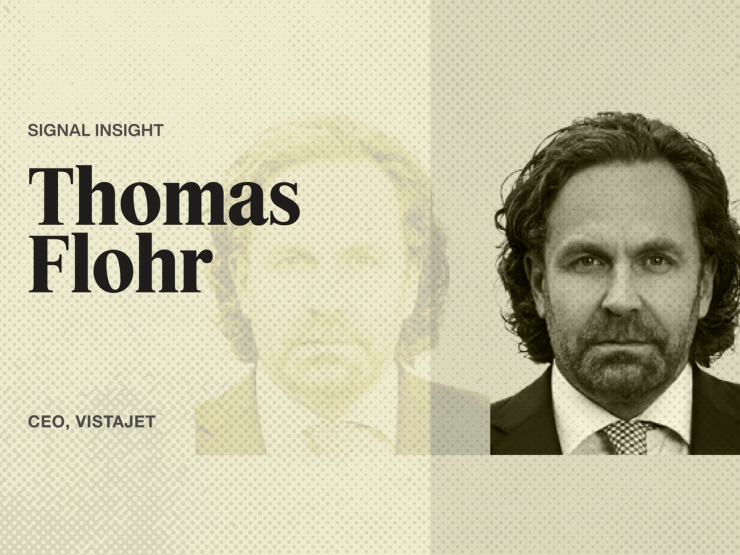

The Signal Insight
Swiss billionaire Thomas Flohr is a World Endurance Championship racing driver who has spent 22 years building VistaJet into a $2.9 billion revenue private aviation business with global reach. He is now weighing a possible market listing that could value his holding company at $10 billion, even as war in the Middle East sends jet fuel prices higher and economists debate how much longer the boom in global luxury spending can continue.
Flohr, with a fleet of almost 200 planes and an order for up to 160 new Bombardier jets over the next decade, doesn’t see any turbulence on the horizon. Vista has seen “an explosion of demand at the top end” of the market for its longest-haul flights, he says, with growth from Asia to Africa driving record sales and 28% growth in flying hours sold in the group’s latest quarter.
Even in the Middle East, where many planes were grounded immediately after the US-Israeli strikes on Iran, Vista’s founder and chairman says there has been “a significant surge” in demand from local clients. Second-quarter sales in the region, measured in hours, were up more than 68% year over year.
Private aviation has undergone “a massive change in perception” since Vista was founded in 2004, Flohr says, shedding its “Hollywood image” as companies prize the ability to move their executives around the world quickly and jets with ranges up to 17 hours bring more locations within reach. In business today, “everything is now,” he says.
Flohr’s company has a subscription model and typically charges between $11,000 and $25,000 per hour for its flights, but he says companies have become more willing to entertain such operating expenses than the tens of millions of dollars in capital expenditure required to buy their own jets. A company-owned aircraft might fly 250 hours a year, but Vista’s fleet averages 1,000 hours, allowing it to recoup its fixed costs faster.
“If you control and own the airplane, you can offer the client ultimately what he wants, and I think that is the key to our success,” Flohr says. “It always starts with the customer because in the end, we’re not paying our own bills. It’s the client that awards you the revenue.”
This interview has been edited for clarity and brevity.
Andrew Edgecliffe-Johnson: How’s business right now? What’s driving the growth?
Thomas Flohr: We see a surge in global demand. Obviously, the tech sector is on fire, and they of all the industries have the biggest global coverage demand. One day, a meeting in South Korea; the next day, a meeting in Japan; then there is a meeting in Abu Dhabi; then everybody is back in Silicon Valley, so they’re zooming around the world. Even if you own your own jet or two of them, you can’t really effectively cover the globe unless you have a global fleet, and they’re very conscious of the time efficiencies that they gain by flying point to point.
You have told bond investors that you’re considering an IPO, possibly this year. What can you say about those plans?
I can’t really say much. We have an obligation to communicate if we’re considering certain alternatives. But considering is one thing, and execution [is another]. We continue to explore our capital market alternatives. It’s prudent in the debt and the equity markets that you always have all alternatives available to you. So you’ve got to be ready for the bond market, and the same is true for the equity markets. If you’re ready, and the right opportunity comes, you can go. That’s what I’m drilling into the heads of my company, that this is always a prudent thing to do, because you never want to be in a situation where you say, “Ah, I have an opportunity. I might need capital. Oh, OK. I need nine months to get there.”
Your headquarters is in Dubai. There was a period where airspace was closed in the Gulf after the Iran conflict began, and then questions about whether the region’s growth story would be interrupted. What’s your appraisal now?
Yes, the airspace was closed for a little while, as it would be in any conflict. But the level of long-term vision and commitment to that region is incredibly strong. It’s like, for us, nothing changed. Today, when you’re actually spending time in the UAE, you don’t feel anything. It’s business as usual. People need to move, and it’s much more difficult for an airline to restart a global logistics infrastructure than it is for us. So our hours signed up in Q2 were up about 50% year-over-year. In a way it sounds surprising, but it’s exactly what happened post-COVID.
What does your experience during the COVID pandemic tell you about how much of that short-term gain you’ll sustain?
In the five-year period from 2019 to 2024, the company grew 3x. I think that’s the answer, really. After about 18 months, the whole thing starts to go back to normal growth levels, but on a much higher level. Think about the psychology: We have yet to find someone who says, “No, I don’t want to fly private.” So, if you have an external event like this, which drives people to private aviation, nobody comes and volunteers and says, “Oh, let me please fly commercial again.” So corporations make the budget available, and it’s part of doing business. It’s not about the champagne or caviar. [That] is just, like, movie stuff. It is all about the time efficiency. The question is to what extent can the C-suite convince the CFO to allow for such a travel budget. But the level of efficiency is undebated.
The president of the United States said [in September] that nobody should buy Bombardier jets any more. You’ve got a big order for 160. Is it going to be affected?
I did very well for the last 22 years to stay out of politics, and I will stay out of politics for another 22 years. That’s really between two countries. It has nothing to do with me. We have a multi-fleet approach, and we have our contract in place, and the rest is really between the two countries to sort out.
You have this racing career as well. Is there a connection? How do you think about those two careers alongside each other?
The one connection is the word ‘endurance.’ In racing, you’re not going to win Le Mans if you do 10 good laps [out of a typical 300 to 400]. And if you can consistently perform at 97% or 98%, you get very far in life. And I think that’s the same philosophy, in endurance racing and in business: Stay humble, stay with your feet on the ground, carefully analyze what is in front of you and what is behind you. Don’t rush, but be decisive, and for the long term.
What about your appetite for risk? This is not a low-risk pursuit.
From the outside, it might look like risk, but I’m rather risk-averse. I’m extremely diligent about preparation. I feel personally more uncomfortable driving on a country road than in a World Endurance Championship. [In a race,] you’re 100% clear. You’re prepared. The safety measures are in place. The support system is right there. The same is true in business. If you have enough information and data and client input, it might sound like a lot of risk from the outside, but that’s how I built the company.

Notable
- Vista Global Holdings, the holding company for Flohr’s VistaJet and XO brands, is considering European exchanges, including Milan and Zurich, for a possible listing, Bloomberg reported. An IPO could raise more than $1 billion for the group, whose backers include RRJ Capital and Rhone Group.