




The News
Saudi Arabia’s auto manufacturing startup CEER unveiled its first cars, two luxury electric vehicles that will go on sale early next year as the kingdom doubles down on a bet that the industry can help drive its economic diversification.
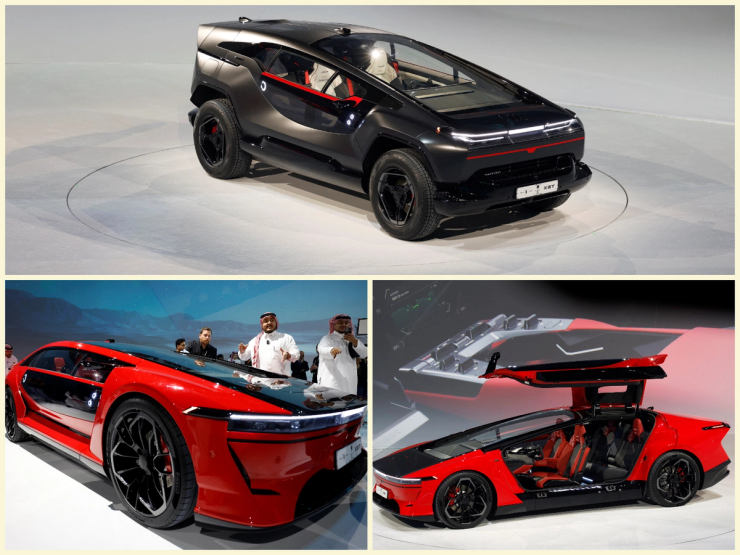
The futuristic Exobot sedan and SUV have gull-wing doors and sweeping windscreens that stretch into the roof, a design that was personally picked by Crown Prince Mohammed bin Salman. Prices were not revealed, but CEER executives say the first models will target high-end buyers. Five more models at lower price points are planned by 2030.
The cars will be built at a new production plant on the kingdom’s west coast, north of Jeddah, capable of producing 240,000 vehicles. CEER was launched by the kingdom’s sovereign wealth fund in 2022 and its plant at King Abdullah Economic City is part of an emerging autos cluster that Saudi Arabia is developing in the hope of creating jobs, diversifying its economy, and boosting non-oil exports.
Production will begin in early 2027 and the first deliveries to customers are expected in March, chief executive Jim DeLuca told Semafor in an interview on the sidelines of the launch event.
“Saudi Arabia has wanted a car industry for a long time, there have been multiple attempts, and it has never come to fruition,” DeLuca said. “Our mission is to ignite that industry.”
In this article:

Know More
CEER is part of a multibillion-dollar bet by Prince Mohammed to establish an auto industry after several failed attempts. Jaguar Land Rover abandoned plans for a Saudi manufacturing facility more than a decade ago and Toyota also walked away from talks in 2019.
The government has since shifted strategy. Public Investment Fund, which controls CEER in a partnership with Foxconn, invested in Lucid in 2018 and got the US EV maker to build the first auto plant in Saudi Arabia. That became an anchor for a wider cluster that includes Hyundai and suppliers such as Italy’s Pirelli, the US’s Lear, Korea’s Shin Young, Germany’s Benteler, and China’s Fangxin. Stellantis is also studying building a manufacturing facility in the kingdom.
CEER will initially be sold in the kingdom before expanding into other parts of the Gulf in 2028. It will face stiff competition as Chinese EV brands have been rapidly gaining market share in the region. CEER’s launch also comes at a time when many of Public Investment Fund’s other big projects have been facing budget cutbacks and a new focus on raising outside capital to help limit how much state funding they require. The fund aims to instill financial discipline and a more commercial mindset to boost returns.
DeLuca said CEER has not had any changes to its funding from PIF. “We are fully funded,” he said, declining to comment on how much has been invested so far or when the company expects to become profitable. “This plan to launch seven products between now and 2030 was developed and funded in 2023.”
The Exobot was supposed to go on sale in November, but supply chain disruptions from the Iran war caused a delay, he said, adding that no further impact from the war is expected.
PIF is also working on new deals to bring more suppliers into the autos cluster. That will help lift the local content in CEER cars from around 18% to 45% by 2034.

Matthew’s view
CEER’s first cars are definitely unique. The company’s origin story is that the Saudi Crown Prince steered them into designing something unlike any other car. In that sense, they have delivered.
At Monday night’s launch, several people compared the cars to a sci-fi movie. Car nerds in the audience broke out into applause as CEER unveiled 1,111 horsepower, a 670-km range, and zero to 100 km/h in 2.1 seconds for the top trims.
While that will undoubtedly make the models conversation starters, the key question will be whether that translates into sales. CEER executives are not giving away anything on the price yet, but given a combination of high-tech features and a complex design that may prove challenging to build in volume, it seems likely to come in at similar price levels to Lucid’s luxury EVs.
Lucid is a cautionary tale. The company has missed delivery targets, is losing more than $100,000 per car, and has required several new cash injections since PIF invested. More money will be needed.
CEER will have the advantage that being private keeps its finances out of public scrutiny. And as a strategic initiative for Prince Mohammed, CEER is likely to receive strong state support. But the management team will have their work cut out over the next few years to ensure that the kingdom’s sci-fi vehicles will hit the roads, at scale.