




Wael’s view
Saudi Arabia’s deepest crude discount since the pandemic points to deeper divisions within the world’s most important oil group, and potentially to Riyadh’s mounting anxiety about losing market share.
Saudi Aramco has priced its flagship Arab Light crude for Asian buyers at its widest discount since June 2020: $2 a barrel below the Oman/Dubai benchmark for September. It comes as the UAE exits OPEC, Iraq seeks more capacity, Venezuela tilts toward Washington and Hormuz remains impaired.
It is a strange price signal from a market still living within the constraint of Strait of Hormuz six months into the Iran war. Discounts usually suggest too much oil chasing too few buyers, not a supply corridor operating far below normal levels. Aramco’s move does not prove that Saudi Arabia has begun a new market-share war. But it does suggest Riyadh is unwilling to surrender Asian customers while the immediate disruption at Hormuz obscures a looser underlying supply outlook.
The next price list, expected around OPEC+’s September 6 meeting on next month’s output, will test that interpretation. If Aramco trims its discount, traders may conclude September was a one-month accommodation for disrupted shipping and weak demand. If it extends or deepens the discounts, the message will be clearer: Saudi Arabia is prepared to defend market share in Asia even as OPEC+ tries to maintain a common supply policy.
This is OPEC’s problem in 2026: not simply too much oil, but too little willingness among its members to manage it together.
The decisive break came on April 28, when the United Arab Emirates announced it would leave both OPEC and the wider OPEC+ coalition, ending a membership that dated to 1967.
The UAE’s departure didn’t make OPEC irrelevant, but it weakened the organization’s claim to manage the market. OPEC accounted for about 35% of global crude output with the UAE and roughly 31% without it. The broader OPEC+ coalition falls from about 46% to 42%.
The precedent matters more than the numbers. The UAE was not a marginal member leaving a troubled club. It was a capacity-rich Gulf producer deciding that the upside of producing more oil outweighed the political value of adopting Saudi-led restraint.
The fiscal asymmetry between the Gulf countries helps explain the break. The UAE can balance its budget at a much lower oil price than Saudi Arabia, according to the IMF. Riyadh, with far larger domestic spending commitments, has more reason to support prices; the UAE, on the other hand, has an incentive to maximize output to turbocharge its economy and global investments.
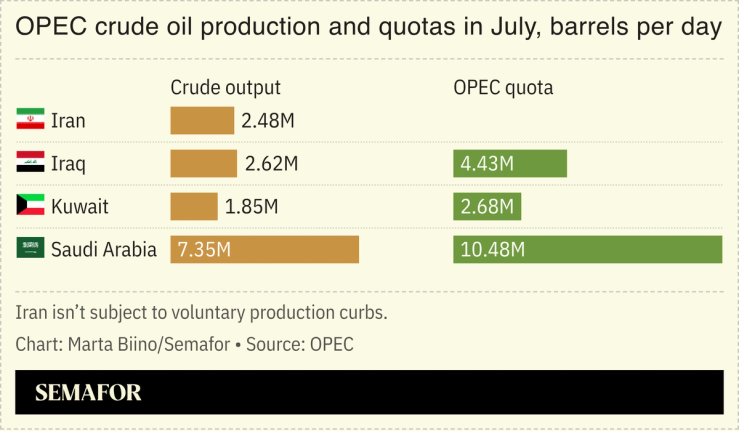
Iraq has drawn the obvious lesson. Baghdad spent the summer seeking a larger quota as it targets production of 8 million to 10 million barrels a day within six years. Its September quota was 4.431 million barrels a day. In June, Iraqi officials briefly raised the prospect of leaving OPEC before pulling back. The message was unmistakable: the UAE had shown that exit could be used as leverage.
Iran adds another complication. If a political settlement eventually enables a sustained recovery in Iranian exports, OPEC will confront a familiar problem in a newly fragile market: how to accommodate returning Iranian barrels without forcing other producers to surrender market share.
Venezuela is still another test. It remains an OPEC member, but its oil industry is now linked to Washington’s priorities. US officials say more than 500,000 barrels a day — around half of Venezuelan production — is going to American refineries. Caracas and Washington have also announced a long-term energy agreement aimed at boosting Venezuelan output.
That gives Washington greater influence over the pace and destination of Venezuelan barrels just as OPEC has less room to accommodate additional supply.
In the end, the bill still lands in Riyadh. When other producers resist cuts, demand larger quotas, or leave the arrangement altogether, Saudi Arabia remains the only member with the spare capacity, market reach, and political weight to keep the system together.
But that role is becoming more expensive. OPEC+ has completed the rollback of a 1.65 million-barrel-a-day layer of voluntary cuts agreed in 2023, including a 188,000-barrel-a-day increase for September. The group now faces a 2027 capacity review at precisely the moment when its members disagree over how capacity should translate into quotas.
The kingdom isn’t carrying this burden out of charity. The country is more vulnerable to an oil slump than many other producers, making its defense of prices and preservation of OPEC’s relevance a priority.
OPEC has survived defections before, and there are no signs of an imminent collapse. It still sits atop a formidable share of the world’s lowest-cost reserves. But Riyadh is no longer simply managing the familiar cycle of too much or too little oil. It is trying to preserve a bargain that more members now see as optional — while bearing a growing share of the cost itself.
The September meeting can decide next month’s barrels without internal tensions spilling out. But the 2027 capacity review is the harder task: deciding who gets to produce more, who must wait, and whether those being asked to wait still believe the bargain is worth accepting.
Wael Mahdi is an independent commentator specializing in OPEC and Saudi Arabia’s economy, and co-author of OPEC in a Shale Oil World: Where to Next?

Notable
- OPEC+ is likely to keep quotas unchanged next month, with many members unable to boost production further because of war-time disruptions and “capacity deterioration,” Bloomberg reported.