



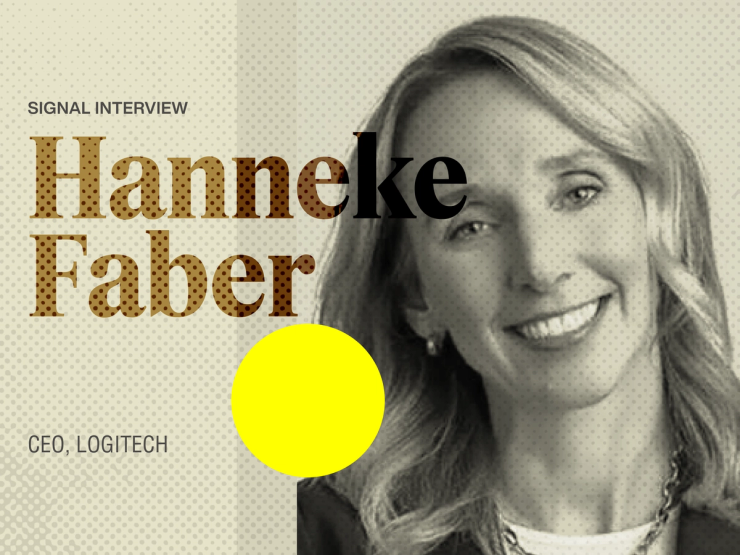

The Signal Interview
“Hardware is hard,” Hanneke Faber says, repeating the Silicon Valley truism about how much more difficult it is to design, make, and sell physical products than software. It’s harder still when you’re pitching computer mice, keyboards, and webcams to office workers and video gamers — the kind of mid-priced consumer electronics that low-cost Chinese manufacturers have mastered.
That challenge defined the task Faber took on when she became CEO of Logitech in December 2023. Sales at the Swiss-American group were falling after a brief pandemic boom, when consumers had rushed to equip their home offices, and one of its co-founders had publicly voiced concern about the company’s future. And Faber, a Procter & Gamble-trained branding expert who had been running Unilever’s nutrition business, was an outsider to the electronics industry.
The former Dutch springboard diving champion is not easily intimidated by such tests. “Diving is a scary sport,” she says; it puts any fears about the CEO’s role in context. When people ask her whether she feels nervous before an earnings call or a media interview, she asks: “Have you been up on the 10-meter platform and done a back two-and-a-half [somersault]? That is scary.”
Faber’s time as CEO has featured “a whole bunch of body blows,” from tariffs to semiconductor shortages to wars that have disrupted supply chains. But she has delivered 10 consecutive quarters of revenue growth, record margins, and a debt-free balance sheet.
She has done so by accelerating the pace of investment in new products, while cutting costs and repositioning Logitech as “the eyes, ears, and hands of AI.” The most virtual of technologies is driving a hardware renaissance, she says. “In the age of AI, hardware is very sexy again.”
Nowhere is that more visible than in China, she says. And Logitech’s own renaissance would not have been possible without rethinking its approach to the export powerhouse that strikes fear into the hearts of many Western manufacturers.
If you can make it there…
“There’s 500 manufacturers of mice and keyboards in China. There’s three in the rest of the world combined,” Faber says. Logitech shifted some production to Vietnam, Taiwan, Thailand, Malaysia, and Mexico in response to US tariffs, but China remains an important manufacturing base and an increasingly vital consumer market.
Logitech is a market leader in most of its categories, even in China, but the intensity of the competition meant that it was losing market share there “hand over fist” when she started as CEO.
Her response was to rethink the group’s strategy for the country, moving new resources into Shanghai and creating a “China for China” team of designers, engineers, marketers, and salespeople, with a single-minded focus on Chinese consumers. The result is that, for the past several quarters, China has been Logitech’s fastest-growing market.
She has also overhauled the group’s marketing approach, using AI agents to assess which of its thousands of pieces of content are working best on fast-moving social commerce platforms like Douyin and PDD, and allocate budgets accordingly. “In China, you can move and learn very quickly,” Faber notes.
China is where the AI-driven “hardware renaissance” is most visible, she says. On each of her four visits this year, she has noted the proliferation of voice-activated AI wearables, like clip-on earrings. There’s more talk than evidence of such devices taking off in the West, but “China is, in this respect, absolutely the future,” she says.
The pace at which China’s consumer electronics market moves has made it a valuable laboratory for the global group, says Faber. Logitech traditionally launches 30 to 40 new products a year, releasing all of them on the same day. It now adds another eight to 10 products designed only for China, which has the largest gaming market in the world.
Within two or three months, it can see which ones have taken off. And “if they hit in China, they’re going to work in the rest of the world, too,” she says. Products like the G316 X gaming keyboard have sprung directly from this Chinese “testing ground.”
“Having to compete in China is critical to win in the rest of the world,” Faber argues, likening the market to a gym that keeps companies fit.
“The trends there are ahead of the trends in the West, and people react really fast,” she says. “If you’re winning there, then you can win anywhere. It’s like the song about New York.”
Rethinking physical products for an AI-driven world
A Western company can still succeed in China with a strong brand and “design-led innovation,” Faber says, and she has been pushing to “up the tempo” on innovation across the global group. A profitable company with a robust balance sheet “should be spending a little more” on research and development, she says, and some of the 6% of sales that Logitech steers to R&D is now devoted to inventing “new form factors” beyond mice, keyboards, and cameras.
She will not say what those include, or whether ear-worn AI assistants are among them, but she notes that voice has become “a more important modality” at a time when office workers are talking to their AI agents and coders are speaking commands rather than typing them.
That trend has been good for Logitech’s headset sales, she says, and has even opened new markets for the pedals it usually sells to video gamers for braking and accelerating in racing simulators like Gran Turismo. “Some coders, because they want to go so fast with voice, code with our gaming pedals,” Faber says.
Even so, Logitech’s existing product categories remain her first priority, she says, “because it’s hard to change human habits,” and because it continues to find growth by adding new features to them. Last quarter, its global mouse sales were up 14%, and it is managing to charge premium prices for videoconferencing equipment that automatically keeps users in-frame or creates “digital cocoons” for meetings in noisy open offices.
As Logitech marks its 45th anniversary this month, Faber is looking to its history to explain its right to win in an AI ecosystem that is dominated by technology companies many times its size. Her company’s “Swissness” already allows it to work simultaneously with tech rivals like Apple, Google, Meta, and Microsoft, she notes. “And we’ve always, over 45 years, been the connection between the human and technology.”
Making hardware sexy again
Logitech was, for years, a consumer-focused business whose customers bought its equipment on Amazon or in shopping malls. Since the pandemic, when companies suddenly had to equip their remote-working employees’ home offices, the share of its revenues coming from businesses has grown to 40%.
Faber sees further opportunities to reach under-penetrated industries like healthcare, education, and government, and she is drawing on Logitech’s consumer brand to help her.
Faber, who started her career overseeing P&G’s Vicks VapoRub business in the Benelux region, describes herself as “a brand girl at heart.” When she took over as CEO, Logitech was using different brands for different markets, but she unified all of its products under one identity, which she says has strengthened its pitch to new customers.
Gaming is where she sees the Logitech brand having its strongest appeal, and its research suggests that more than 80% of IT procurement executives are regular gamers. That gives it a foot in the door at far more companies than rivals with which buyers have fewer connections, Faber believes.
“This brand has really broad shoulders. I can [sell to] the 15-year-old gamer and the CIO, [and] it turns out those two targets are actually not that different,” she says.
“We could be a little sexier” still, she says of the brand, but she is heartened by the response she has had from some of her youngest customers. “Teenage boys come up to me in various places,” she says, telling the story of a fan who asked her to sign two new gaming mice at an event in Houston. “I have never been as popular with 15-year-old boys as in this job.”

Notable
- HP’s Enrique Lores told The CEO Signal last year that he’s tried to channel AI enthusiasm into showing how his company’s hardware improves office workers’ lives. “We have realized that we need to move from just selling products to explain the experience customers will be getting, and to do that in a physical way.”