




Amena’s view
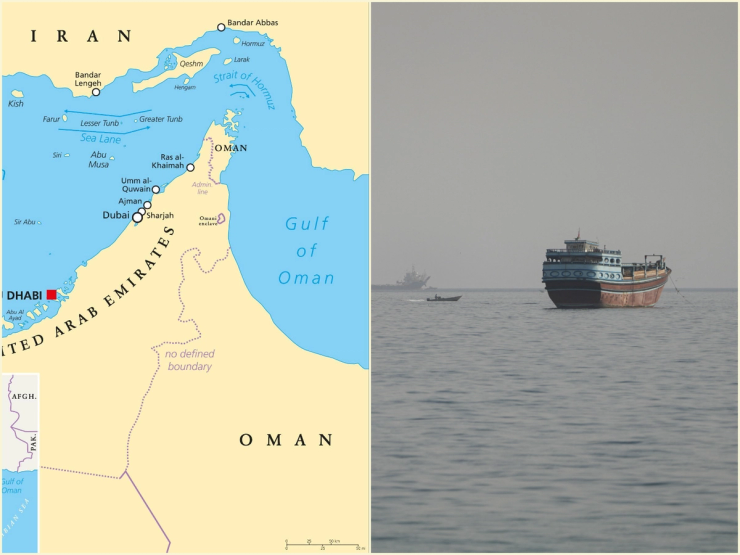
More than 170 days into the war between the US and Iran, one thing has become clear: Tehran is not prepared to let go of its leverage in the Strait of Hormuz. President Donald Trump may claim that the US controls the waterway, but oil flows remain far below prewar levels and even further from anything resembling consistency. While the lack of transparency about the status of the strait is a concern, the bigger risk is that uncertainty becomes the new reality.
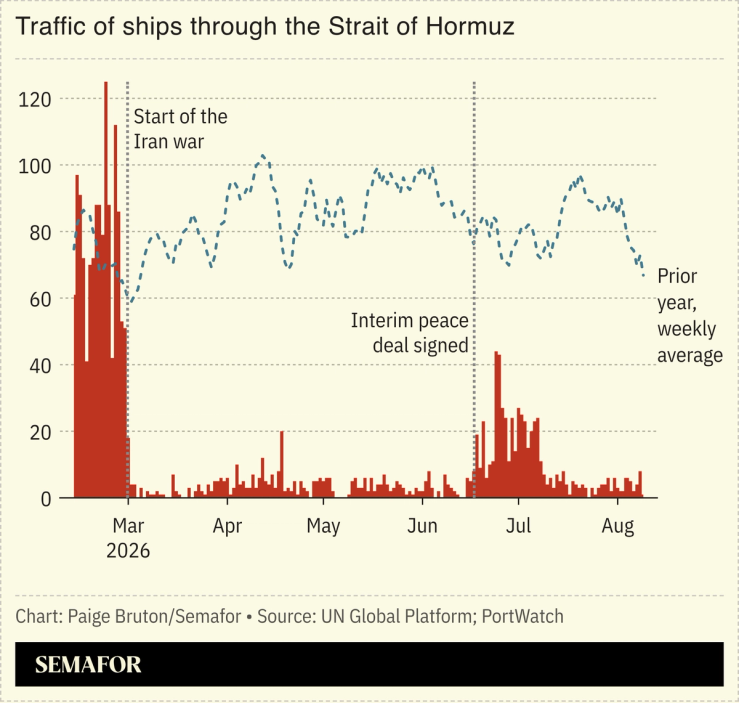
A pattern has emerged since the war began, with bursts of supply whenever there is a brief period of calm followed by sharp contractions as tensions return, according to data from Kpler, the energy research firm where I work. Much like the conflict itself, the strait is stuck in limbo, neither fully open nor fully closed.
This gray-zone reality should not be accepted as the new normal. A partially functioning Hormuz is better than a full closure, and while this could become a durable way to keep the global economy running, it will never provide the energy security the world needs. Barring a full reopening of the strait and a resolution to the conflict, both energy producers and consumers will have to contend with continued uncertainty. That’s why there needs to be a greater push toward finding a durable diplomatic solution.
“The region cannot remain indefinitely in a state of neither war nor peace; its stability and the future of its peoples require clarity in vision and direction,” Anwar Gargash, a diplomatic adviser to the UAE president, posted last week.
Oil flows through Hormuz were running at around 9 million barrels per day (b/d) until the week ending July 13, according to Kpler data. Since then, they have fluctuated between 3.7 million and 6.4 million b/d as attacks on commercial vessels have intensified. Houthi attacks on Saudi vessels in Bab el-Mandeb have further heightened export risks, spreading the threat beyond Hormuz and making prolonged disruption increasingly look like the base case.
Meanwhile, most Gulf states reject the idea of Iran imposing a toll on vessels transiting Hormuz. But mounting pressure on countries without alternative export routes may eventually force them to reconsider.
Markets are also adapting to this strange equilibrium. Traders have to keep one eye on Trump’s posts. His bearish signals have largely been borne out, but they are increasingly difficult to reconcile with the physical market. The disruption has knocked out around 2.5 billion barrels of supply from the region so far, and industry executives don’t see a full recovery for at least 18 months.
For oil producers, however, supply is only half the equation. Demand will clearly take a hit this year, although a strong rebound is expected in 2027.
The International Energy Agency now estimates that global oil demand will shrink by 1.5 million b/d this year to 103.3 million b/d. OPEC is more bullish: Although it has revised down its forecast, the group still expects consumption to grow by about 600,000 b/d this year. This divergence reflects the difficulty of forecasting demand during the worst oil supply disruption in history.
There is greater agreement on what comes next. The IEA sees demand growth of 2.4 million b/d next year, Kpler around 2.1 million b/d, and OPEC roughly 2.2 million b/d.
The bigger factor to watch in the coming months, however, is China. Sitting on a cushion of reserves that Beijing shrewdly accumulated over the past 18 months, China has effectively been playing OPEC, but on the demand side. It has reduced imports, drawn down stocks, and, crucially, refrained from using its leverage with Iran to push for the reopening of the strait.
That gives Beijing considerable optionality. When China decides to boost imports again, the impact is likely to be felt in oil prices, particularly if Middle Eastern supply remains constrained. We are already seeing refinery runs recover. Kpler estimates China’s crude intake will gradually rise by almost 1 million b/d to 13.54 million b/d by October.
China’s return to its pre-war energy consumption levels may be timed to reduce pressure on global supplies. But that is largely up to Beijing. It has acquired a geopolitical chit because it can determine when it wants to tap the market.
It remains to be seen whether this card will be played. A decision by Beijing to raise imports during the US midterms would certainly be one signal worth watching.
But the larger issue goes beyond China, Trump, or even Tehran’s next move. The danger is that governments and markets grow accustomed to a Strait of Hormuz that functions only intermittently and misinterpret the stopgap as a resolution. At some point, the billions of barrels of lost supply in the physical market will show up in prices.
Amena Bakr is the Head of Middle East Energy & OPEC+ research at Kpler, an independent global commodities trade intelligence company.

Notable
- The “cushions that helped the world manage” the US-Iran war energy shock are now “threadbare,” making a prolonged closure of Hormuz more damaging to the global economy than the past six months of conflict, Jason Bordoff and Meghan O’Sullivan write for Foreign Affairs.