




The News
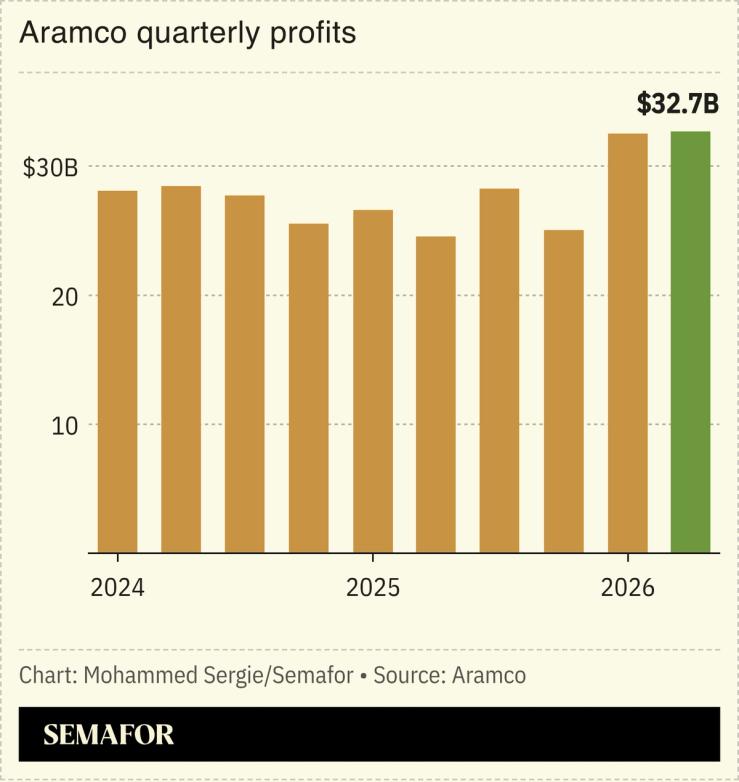
Saudi Aramco’s second-quarter profit increased 33% from a year earlier, as higher oil prices and strong refining margins helped offset lower export volumes.
Thanks to decades of investment in energy infrastructure, the world’s biggest crude exporter has been able to keep oil flowing, despite disruptions to the Strait of Hormuz — and more recently the Bab el-Mandeb Strait — as well as repeated attacks on Saudi energy facilities.
Amin Nasser, Aramco’s chief executive officer, said the company’s East-West pipeline, storage facilities, and Red Sea export terminals allowed it to maintain operations. Export volumes were still lower than prewar levels, however, because the company has been unable to divert all the Saudi crude that used to flow through Hormuz.
Aramco benefited from higher prices caused by the US-Iran war, while some other Gulf producers saw shipments collapse. Brent crude averaged almost $97 a barrel during the quarter; Aramco captured an additional premium of nearly $11 a barrel by boosting exports of higher-margin refined products, such as diesel and jet fuel.
The performance allowed Aramco to maintain its base dividend at $21.9 billion, with most of the payout going to Saudi Arabia’s government, which owns almost 98% of the company. Oil receipts account for about 55% of state revenue; if Aramco is able to maintain contributions, it will help limit the government’s borrowing requirements at a time when the kingdom’s wider economy is being damaged by the war.
Aramco acknowledged that some energy facilities were targeted in attacks last month, but said there was no material impact on operations.

Know More
The second-quarter results do not fully reflect the latest disruption from Houthi threats to close the Bab el-Mandeb route. Saudi tankers are already sailing from Red Sea terminals through the Suez Canal and around Africa, a detour that adds nearly 25 days to shipments to Asia, Nasser said. The company is studying ways to expand export capacity, including potentially increasing the size of the East-West pipeline, to build greater “optionality” against future disruptions.
Nasser said the reopening of Hormuz is essential to meeting future demand. Global oil inventories are being depleted, but demand is expected to increase by about 2 million barrels a day in the second half of the year as stockpiles are replenished. Flows through Hormuz remain at roughly one-tenth of prewar levels. If the waterway returns to normal, Aramco could restore production to prewar levels within three days, he said. Rebuilding global inventories would take about 18 months, even before accounting for new storage facilities that countries are planning as part of their energy security strategies.
Aramco has no plans to slow domestic or international investment, sticking with annual capital spending of $50 billion to $55 billion, excluding investment in Saudi Arabia’s AI company HUMAIN, Chief Financial Officer Ziad Al-Murshed said.