




The Signal Insight
The AI-powered surge in demand for data centers has transformed the fortunes of a 55-year-old optical technologies company from Saxonburg, Pennsylvania. Coherent’s stock has risen 350% since it named Jim Anderson as its CEO in June 2024, taking its market value above $60 billion. Without the photonics technology that Coherent specializes in, scaling AI would not be possible, Anderson says. In recent months, he has secured a $2 billion investment from chipmaker Nvidia, plus a letter of intent from Washington for up to $50 million in CHIPS Act funding to expand capacity at its manufacturing facility in Sherman, Texas.
“We have never seen growth at this rate,” he says, and “we’ve never seen the adoption of new types of technology this fast.”
Anderson, arriving with a $101 million compensation package, required a crash course in the science of photons. But keeping pace with that growth has been his biggest challenge. The company he walked into was “messy,” he says, with 24 different business software systems and a “very spotty” record of operational and financial execution.
“What I was trying to do is take the operational execution engine up to the same level that the technology was,” Anderson says. There is still more work to be done, he adds, but this is how he has approached that task.
This interview has been edited for clarity and brevity.
Andrew Edgecliffe-Johnson: What is the role of the photon in a data center?
Jim Anderson: The photon is the basic particle of light, and almost everything we do is about generating a photon, detecting a photon, or somehow directing a photon. In data centers, you’ve sometimes got millions of processors working on the AI workloads. In order for them to all work together, you have to have really good communication links between them, so that’s where photons come in. We use light, basically, to transmit the data back and forth between processors. We make the products that generate the light on one side of the fiber optic cable, and then detect it on the other side, and convert that back into electricity.
Everybody is fascinated by constraints on data centers. To what extent is your piece of the puzzle struggling to keep up?
It’s constrained. For optical networking, the primary constraint is indium phosphide, a specialty semiconductor that’s used to make the lasers that generate the light and the detectors that detect the light on either end of the fiber optic cable. Because we’ve seen this incredible growth so quickly, as an industry, we ran out of indium phosphide production capacity. So we are trying to fix that problem as quickly as possible. At our plant in Sherman, Texas, we’re quadrupling the capacity by the end of next year, and even that’s probably not enough.
You’ve said the culture of Coherent is defined by innovation. What do you think differentiates the culture?
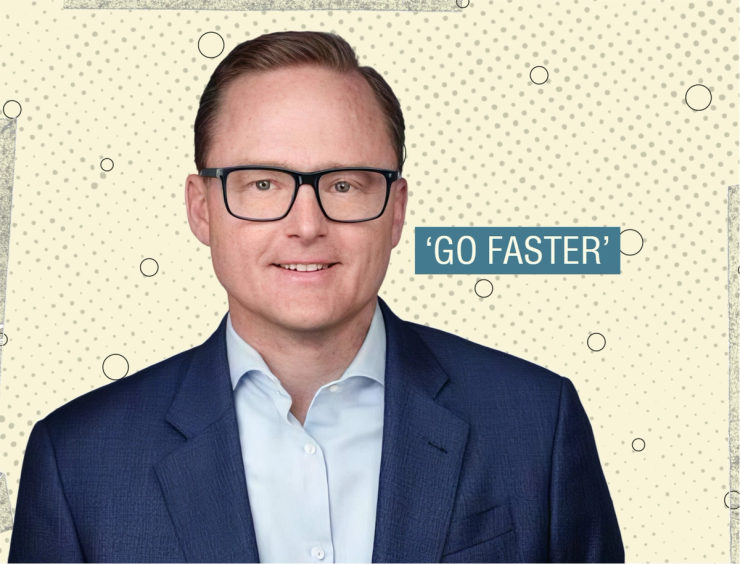
When I joined, there was a good part of the culture and a not-so-good part of the culture. The good part was the innovation part. But we were risk-averse, very conservative, very slow-moving. What I’ve tried to do is nurture the innovation part of our culture, but then [say], “Let’s speed up, let’s be willing to take more risk.” We did a leadership conference for the top leaders in the company, and on my very last slide, I said, “Look, if you can only remember one thing that I said, this is all you need to remember.” And all it had on there was, “Go faster.” In the tech industry, innovation is critical, but it’s often the faster company that wins, not the bigger company.
In between leadership meetings and slide presentations, how do you make that happen?
You have to allow room for failure. Speed and greater risk-taking means we’re not always going to get it 100% right out of the gate the first time. So I had to give room to the team to not always hit every goal. Because if you’re so averse to any sort of failure, that makes you much, much more conservative and much slower-moving. Now, we’ve got to succeed more than fail, obviously, but we’ve got to open the aperture a little bit.
What was the first thing you did to encourage that?
One of the easiest examples is called risk production. If I want to take the safe route [with a new product], I will wait until [my customer is] done with their testing before I start production, because I don’t want to waste any material. The more aggressive stance is to assume success, start the production six months earlier, and by the time the customer is done, you’re able to ramp revenue much faster. Risk production is something that the company never used to do. Nobody ever wanted to take the risk that we might be wrong. And what I started to instill is, “Hey, if we’re really sure that this product has been done right, if we’ve gone through all of our checks, if we have high confidence, then we ought to be willing to take the risk, because the reward is we get to market faster than our competition.” When we’ve had to go back and rework material, the team that was responsible for that didn’t get hammered for that. We didn’t beat up on anybody.
In 2024 you were the highest-paid CEO in corporate America.
Was I? Nobody mentioned this! Someone should tell my wife that. Finally I’ll get some respect at home! If you look at the details of that compensation package, over 90% is tied to shareholder return, and that’s the way it should be. I should only do well if the shareholders do well, that’s fair. But also I was leaving Lattice Semiconductor, and I had significant equity there. So part of it was Coherent matching the equity that I had earned at the old company, and that’s a one-time thing. If you look at the most recent proxy, the compensation [at $3.7 million] was very much in the median of other companies that are similar to us.

Notable
- Coherent’s deal with Nvidia includes a commitment from the chipmaker to spend billions of dollars on its products. Among them, Anderson says, is a new technology the companies are developing together called co-packaged optics, which will allow for faster data rates at better power efficiency. And that, he adds, will help Coherent replace the last copper wiring in data centers — the connections within racks of servers — to optical technology.