




The Signal Interview
When Bruce Van Saun was asked in 2013 to become CEO of Citizens Financial Group, he recalls, the US super-regional bank was “a little orphan runt” with returns on equity that were roughly half those of its peers.
Citizens at the time was an offshoot of Royal Bank of Scotland, where Van Saun served as finance director through a turbulent few years after the global financial crisis. The American-born banker seized the chance to scratch his “CEO itch,” but as he worked on the 2014 public listing that gave Citizens its independence from RBS, he found that he would need to address years of underinvestment in technology, risk management, and people.
Almost 13 years later, Citizens is outperforming its regional peers while finding ways to go “toe-to-toe” with industry leaders like JPMorgan Chase and Wells Fargo in areas from mid-market commercial banking to wealth management, he says. Its return on equity has grown from 5% to almost 14% and, after a 43% rally in the past 12 months, its stock “is finally catching up with where we’d like it to be.”
Getting to that point has required a strategy of determining where Citizens could compete against far larger rivals, continuously pursuing efficiencies, and taking an opportunistic approach to deals, such as its 2022 acquisitions of HSBC’s retail business and Investors Bank.
“If you stay strong, you have a strong leadership team, and you have a strong capital base, there are going to be opportunities,” Van Saun says. JPMorgan CEO Jamie Dimon “has made a career out of having a fortress balance sheet, and when things fall out of bed, he’s ready to jump in. I’m a smaller version of that.”
Fighting complacency with a team that knows ‘what good looks like’
The Citizens that Van Saun joined had a credo focused on three Cs — customers, colleagues, and community. But, with a distant owner and none of the scrutiny that a public listing brings, he jokes that another two Cs had crept in — “comfort and complacency.”
From the start, Van Saun told his team that the bank’s ambition should not be “just to make it back to the pack and be mediocre.” Raising its sights higher meant recruiting growth-minded executives who had “seen what good looks like at other places,” he says. It also required building a collaborative culture that was fully focused on meeting customers’ needs.
Van Saun talks of bringing “thought leadership” to Citizens’ commercial customers by working in teams with “no sharp elbows and no silos.” For example, before a client meeting, the client’s relationship manager will pull in colleagues who can offer up M&A ideas, working capital solutions, or ways to mitigate interest rate risks.
“You’re going to have a meeting with another banker tomorrow, and they’re not going to be prepared, they’re not going to have done their homework,” Van Saun says, explaining how this approach helps differentiate his bank. “They won’t be giving you five different ideas to make you more successful.”
A “One Citizens” initiative, in which commercial bankers are encouraged to open doors for the bank’s fast-growing private bank and wealth management business, and vice versa, has generated 400 referrals in the past year, he adds, and Citizens’ customer satisfaction scores are now in the top quartile of its peers.
How to compete from ‘the middle of the river’
Asked how Citizens goes up against smaller local banks and more powerful global lenders, Van Saun says he has overcome his initial concerns that a regional bank was destined to be “in the middle of the river.”
“You want to be on one [side] or the other and not get caught up in the turbulence that can happen in the middle of the river, but actually I kind of like the space that we’re in,” he explains. Citizens is not so large that its regional presidents cannot know its customers as well as community banks do, he argues. Nor is it so small that it struggles to afford the technology investments that it needs to defend against cyberattacks and harness AI opportunities.
Still, Van Saun needed to define where Citizens could find its best chances of distinguishing itself in a country with almost 4,300 FDIC-insured banks.
“For me to go up against JPMorgan [by pitching to] a Fortune 500 company wouldn’t make a lot of sense,” he admits, given the resources and global reach of Dimon’s bank. Instead, he has focused on mid-market companies — those with revenues of $500 million to $3 billion — which he thinks larger lenders are unlikely to prioritize.
“Then the big guys have to come down into our space, and are they going to put as much effort into that?” he asks. “Oftentimes [one of their bankers] may just have a meeting and drop their card and say, ‘Hey, if you want to do something and you need an execution, call me, because I’m the best at execution,’ but they’re not doing that thought leadership that we do.”
It is a pitch Van Saun has also made to individual bankers he has sought to lure away from larger banks, including the scores of private bankers from First Republic who moved to Citizens after JPMorgan beat Van Saun’s bank in the auction for the collapsed California lender’s operations in 2023.
Talented recruits won’t “get lost” or stuck in a silo at Citizens, he says. “They know everybody in the shop, they’re important to our success, and they’re going to get the attention that they need to grow.”
Finding efficiencies beyond the low-hanging fruit
Early in his time as CEO, Van Saun canvassed all 18,000 of his employees, looking for suggestions on how to run the bank better. About 5,000 responded, yielding about 1,000 ideas worth pursuing. Together, they generated about $200 million in cost savings and new revenues, so Van Saun turned the callout into an annual initiative called TOP, or Tapping Our Potential.
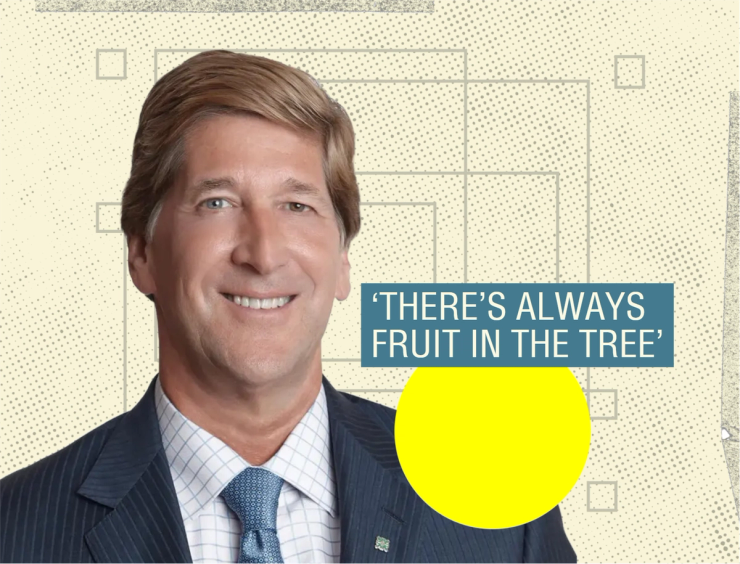
As the program delivered about $125 million in benefits, year after year, it became something of a running joke with Wall Street analysts, Van Saun says. “They would say, ‘Isn’t the fruit in the tree getting pretty high up? [Are you] renting a cherry picker to get this?’ I said, ‘You know what? If you’re intellectually curious and you constantly push yourself to embrace innovation and new ways of doing things, there’s always fruit in the tree.’”
Last year, however, Van Saun decided to shake up the TOP program. Rather than pursue something incremental, he told his team to “go big,” with a three-year push to see how AI could improve each of the bank’s core activities, from fraud prevention to onboarding customers. The new program, incorporating consultants’ advice on how leading companies are deploying AI, has spawned 50 initiatives.
Van Saun’s executives are supervising the teams in charge of those projects, but in a way that he likens to an airport’s control tower. “We’re trying not to be smothering,” he says. “You want to know what’s going on, you need to request information from the teams, but you don’t want the teams spending two of their five days of the week preparing reports so they can tell the control tower how things are going.”
Citizens has told investors that the initiative should deliver $100 million in annual benefits this year, $250 million in 2027, and $450 million by the end of 2028. “We tend to do this,” Van Saun says, stretching his neck as if to put it on a chopping block. “We have our neck out on the guillotine a little bit, but that focuses attention when you put a public target out there. The market knows that Citizens doesn’t miss.”
At 69, Van Saun hasn’t set a date for his retirement, but he has identified Brendan Coughlin, the bank’s president, as “the obvious candidate” to succeed him. For now, he is focused on proving himself and his bank right to investors who doubted many of his early strategic moves before they paid off.
“We have enough organic growth that what we hear from investors right now is… ‘Bruce, we love everything you’re doing, just don’t F it up and go do a deal,’” he says.
And delivering that growth consistently will be the key to his legacy, he suggests.
“Every quarter, I want another proof point,” he says. “If people can see those proof points, quarter in and quarter out, they gain confidence and they start to give us the benefit of the doubt.”

Notable
- Citizens is winding down its financial relationship with two private prison companies that have US government contracts to help run immigration detention centers, following public pressure from advocates and left-leaning city governments. The bank said business reasons drove the decision, not politics.
- Citizens is closing at least 100 of its supermarket outposts, replacing about half with standalone, full-service branches. The strategy should “create a nice lift in the deposit trajectory” without the risk and expense of opening new branches outside the bank’s current footprint, Van Saun told analysts.