




The Signal Interview
There were 326,000 Americans working as financial advisers at last count, and at least a third of them are expected to retire in the next decade. Those two numbers add up to a challenge for Penny Pennington, the managing partner of Edward Jones, one of the largest wealth management firms in the US.
Nine million clients have entrusted $2.4 trillion of assets to her St. Louis-based group, and there is already “a prevailing scarcity” of the kind of advice they need, she says. Edward Jones is selling expertise, but many of its most experienced people are about to leave.
That backdrop is leading to a very different conversation in Pennington’s industry about AI’s implications for employment from the one happening in many other sectors. For CEOs such as Pennington, the technology looks instead like a solution to an all-too-human problem: that the skills she needs most are in increasingly short supply.
Pennington is three-quarters of the way through a maximum 10-year term at the helm of the private partnership, which has about 55,000 employees. Her task now, she says, is about “crossing a bridge” to a future where Edward Jones’ business retains its “decidedly human-centered, relationship-based” character, but infuses it with AI-enabled insights.
Reaching that point has meant “dramatically” changing Edward Jones’ approach to talent and technology, Pennington says, while redesigning a business model that had long relied on largely independent advisers operating out of one-person offices. The industry’s ticking demographic time bomb means that “we know that we have to enhance our financial advisers’ ability to provide advice efficiently, effectively, and at the time of need.”
How AI can soak up and share in-house expertise
For the past few years, Pennington has been giving advisers the option to leave their individual offices and team up in multi-generational practices where veterans can share their knowledge with younger peers. Now, she is turning to AI to achieve something similar on a much greater scale.
Edward Jones’ advisers hold about 100,000 conversations with clients each day. It now asks advisers to share digital notes on those calls and meetings, so it can use AI tools to garner insights that will help other members of the partnership anticipate their own clients’ needs.
“We have about 55 million interaction notes and counting every day,” Pennington says. “We will use those insights to improve and speed up our advice model, and we will proactively push to our financial advisers insight about what we’re seeing.”
It is a simple way of soaking up and centralizing expertise from across the Edward Jones network, and then redistributing knowledge that might otherwise be lost when partners leave. But companies have learned that they cannot simply demand that their employees upload everything they have learned in exchange for nothing in return — especially when some of those people fear that they will be empowering machines that may replace them.
In Edward Jones’ case, Pennington frames her knowledge-pooling push as a natural extension of its partnership ethos.
“Our culture is one of peer-to-peer support,” she says. “This is why our financial advisers are entering those notes: because they’re helping themselves in their own practice, but they know that they are spreading this knowledge, this aptitude, this insight among their fellow financial advisers to help millions more clients.”
Each adviser who contributes is benefiting from their peers doing the same, Pennington says. “It’s a mutually reinforcing network effect that accelerates the process of gaining insight and putting insight to work.”
Using the insights from 55 million conversations
Analyzing the themes that recur through 100,000 conversations each day helps Edward Jones spot trends in what clients need help with as they emerge. At the moment, for example, its advisers are fielding a large number of questions from baby boomers who are thinking of relocating to be closer to their children.
“What we can see is exactly where it’s happening and when in the decision arc of the relationship the conversation starts, so that we can put that back in the hands of our financial advisers,” Pennington says. If clients are quietly wondering how a move would affect their retirement savings or their plan to transfer wealth to their grandchildren, “we can use that insight to preempt that conversation.”
The other emerging trend Edward Jones has seen is “generalized anxiety” about job dislocation, which now features in 20% of all conversations, up from 16% a year ago. The trigger is not typically a specific threat to someone’s career, but broader angst, Pennington says, based on her AI tools’ analysis of the emotional tenor of the conversations.
“One of the competitive advantages of this huge network of human advisers is that we can see into the emotional and psychological context that we’re dealing with among our clients today,” she says. “That builds trust and helps us advance advice to them more quickly to give them confidence and clarity. And when that happens, they go tell two friends, who go tell two friends that this is a place [where] they got reassurance [and] they got good advice.”
The case for human advice in an agentic future
Pennington is keenly aware of the role that emotions play in her clients’ investment thinking. One of Edward Jones’ stated goals is to help its clients improve their sense of “financial fulfillment,” yet a poll it conducted with Gallup earlier this year found that just 16% of Americans feel financially fulfilled.
That underpins Pennington’s confidence that her customers will still value human financial advisers even as technology becomes more sophisticated at anticipating their needs.
“Our firm belief is that a relationship with a human being is going to continue to be essential in getting good advice and guidance and financial planning,” Pennington replies. “There is a place for AI and machine learning, and all of that. But as humans, we want the experience of reassurance from other human beings, of judgment, of ethics, and of integrity, especially when it comes to those things that matter most to us,” from finances to faith, she says.
Decades after the launch of the medical information website WebMD, she notes by way of comparison, Americans still turn to their doctors for more serious health concerns. And Pennington rejects the idea that in-person advice will become a premium service “only for rich people.” Instead, she argues, technology will make it more viable for her firm to serve customers with more modest means.
Why AI may not level the investment industry’s playing field
The tech tools that Edward Jones is marshalling are available to all of its peers, and to startups and individuals with far smaller resources. Technologies that promise to level playing fields can be threatening to large incumbents, raising questions of how it can maintain its competitive advantage.
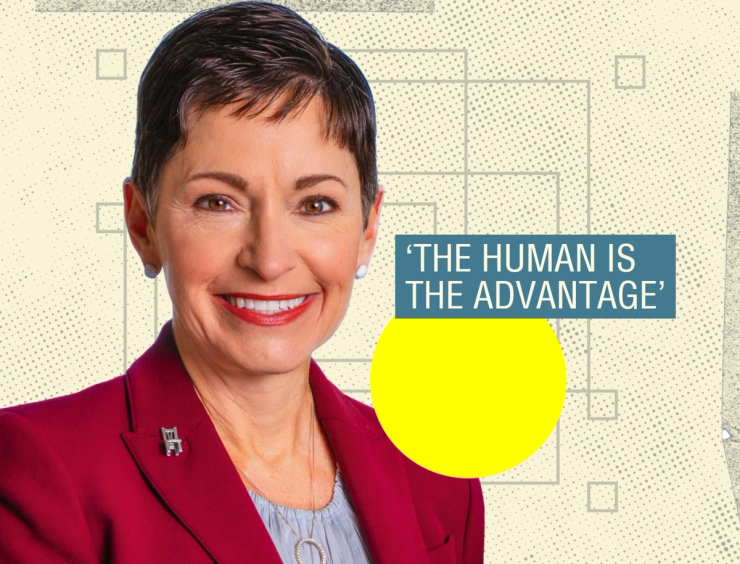
“Fundamentally, the human is the advantage,” she says. “As one of my predecessors said, we will not win based on technology; we will surely lose without it, but it will not be the primary determinant of winning.”
Size is an advantage, too, she adds, both because of the growing cost of AI budgets, and because smaller rivals cannot draw on as deep a network to understand how customers’ needs are changing.
CEOs “get asked all the time, ‘What about the upstart company that plugs in technology and agentic AI and grows like mad?’” Pennington observes. “Well, sure, there will be those. But an incumbent company like ours, with trillions of pieces of transaction data, and now millions and millions of pieces of emotional, psychological, and trust-based insight — we will be able to combine those at a scale that no one else can, and feed that insight back to our financial advisers in order to serve our clients better.”
Pennington is also using her firm’s resources to turn some of the AI upstarts from rivals into allies. Edward Jones Ventures, an in-house venture capital arm funded by the firm’s general partners, has backed 15 small businesses since its launch last year. Its investments have let Edward Jones experiment with innovative tools in areas like estate planning, while offering those startups access to its vast network of advisers and clients.
“We’re able to invest in those upstart companies, those founders, and bring them into our environment. So then you’ve got the marriage of the large legacy incumbent and the vitality of a newly invented solution,” Pennington says. “This is a strategy that only a large incumbent can employ.”

Notable
- Crypto evangelist Anthony Pompliano has attracted $40 billion in assets to Silvia, the AI-powered platform with which he is challenging the wealth management industry. He’s betting on digitally native, higher-income investors who are deeply skeptical of gatekeepers, he told Semafor’s Compound Interest. “If you were a Google engineer, do you think you’re smarter than the average financial adviser? 100%” yes, he said.