




The Signal Insight
From his 49th floor office in lower Manhattan, Henry Fernandez just helped Elon Musk get a little closer to Mars. MSCI, the index provider the onetime Nicaraguan diplomat has led since 1998, confirmed last month that it would include SpaceX in its indices 10 days after Musk’s rocket launcher went public, all but guaranteeing that large, passively managed investment funds would buy the stock.
Fernandez has built MSCI from a unit inside Morgan Stanley to a standalone provider of benchmarks against which $21 trillion worth of assets are measured. Its rulings on which countries’ markets count as developed, emerging, frontier, or standalone are watched from Bulgaria to Indonesia, and its offerings now span risk management tools and climate and sustainability data.
For Fernandez, the SpaceX decision was all about the consistent application of rules designed to ensure that MSCI’s indices accurately reflect the markets they track. But that ruling shows the growing influence of the business he has created, at a moment where the rise of private markets and AI tools is reordering the investment landscape.
Here’s how Fernandez describes how and why he leads MSCI after 28 years.
This interview has been edited for length and clarity.
Andrew Edgecliffe-Johnson: I saw your statement on why SpaceX qualified for early admission. Did you get a call from Elon Musk?
Henry Fernandez: No, no, no. Thankfully not. In order to create an index that reflects the market, you have to include almost everything, but you need to make it investable, and therefore you need to put a few filters for investability. If it’s a large company, you’ve got to include it as close as possible to the IPO, because you will not be reflecting the market if you don’t. So we came up with a rule of 10 trading days many years ago. When the SpaceX IPO came, there was no reason to change. If you understand the method, the philosophy, you will understand almost every single decision we make.
MSCI has moved into several new areas that you didn’t have expertise in initially. What have you learned about how to do that?
First, you’ve got to create the vision of what you’re trying to achieve. Then, you’ve got to be humble enough to know that you cannot simply take your usual colleagues and say, “Go retool yourselves.” It doesn’t happen, it’s too hard. Then you’ve got basically two ways to hire expertise, either person by person, or through an acquisition. [But the new people can’t be] second-class citizens. Our philosophy is like on Wall Street: You’re only as good as your next trade. So I tell everyone: “You’ve been here a long time, but you’re as good as what you are going to do in the future.” That creates an environment where new people and old people can coexist, because both are being judged on what they are doing then, and in the near future, as opposed to the past.
How do you do that? Because people who’ve spent 20 years here probably feel they own the place, and people who’ve been here five minutes probably feel they’re outsiders.
We play a team sport, we don’t play as individuals. A few months ago, [someone] said, “Henry, you keep saying, ‘We play soccer here, we don’t play singles tennis.’ Tell me, what is it that you mean?” So I said to this fellow, “Let me ask you a question. How many times in a soccer game [does] one player pass the ball to another player? How long does one player keep the ball before he passes to the other player? Five seconds, 10 seconds?” Imagine the level of coordination, the level of alignment. We play soccer to win the championship. There are many, many companies that are made up of single tennis players. They want to take the trophy, they want to be the big guy. We have instilled a culture where, when we bring in one more player, it’s going to be equal, it’s going to help us win the championship. You will win the championship, you, because we brought in that other player, and the next player, and the next player. And as long as we treat them the same as we treat you, you’re going to like that.
How do you maintain an entrepreneurial culture in a company that has now been around for a few decades?
You’ve got to start with a mission that goes beyond money, position, power, prestige. Our mission is to help link the users and providers of capital with transparency, with data, with models, so that capitalism flourishes. When you go to a cocktail party, and you say, “We want people to make more money,” people start running away from you. But you’ve got to frame that into not money, but what money can give you: retirement savings for people, second homes, education for their children, passing on some wealth to the next generation. The second part is team playing. The third part is, you’ve got to aspire to innovate and change as much as you can. Because otherwise it turns into one more job that doesn’t impact anything. And in order to do that, you need to take risk, you need to be bold, you need to be ambitious. So I go around saying to people, you’re doing great when I have to rein you in. You’re not doing great when I have to push you. Hey, can you work harder? Can you think more creatively? Can you be more aggressive? Can you work a little longer, for Christ’s sake? We’ve got a lot of stuff to do here.
You have done this for three decades. What has enabled you to maintain that level of energy, and to still be the right person to run this company?
Mission and passion. I grew up with a generation that was involved in a political revolution in Nicaragua. The revolution triumphed in the summer of 1979. In the summer of 1978 I spent two months in Eastern Europe and two months in Western Europe, and I came to the conclusion that the communist-socialist revolution was not going to lead to any long-term success. So I parted ways with my friends that were part of that, and I decided to emigrate to the US.
A lot of what I studied in college was political revolutionary movements, and the attempts of individuals to create a new society, to create something new that would usher their societies into a better place. So, when I came into Wall Street eventually, I always tried to put myself in the middle of that. So I was part of the securitization revolution. I was part of the emerging market revolution. I love what I do, and as long as I have health, and as long as I’m contributing, as long as I’m not retarding the progress of the company, I’m going to be there.
You talk about “relentless, AI-fueled product innovation.” What does that look like?
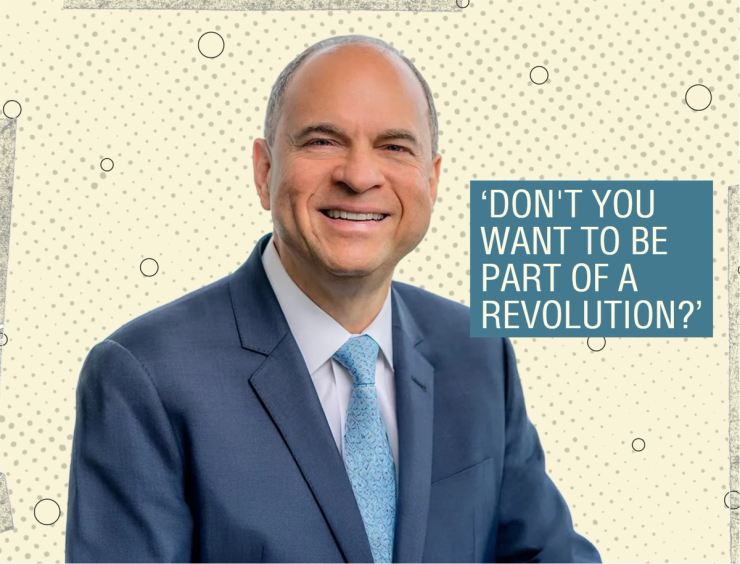
We’ve got 6,400 employees at MSCI who happen to be humans. I can hire 60,000 more employees. They’re digital agents. Imagine that. And the cost — so far, you know it’s going to increase — is a lot lower. They’re smart. Fortunately, they don’t have a lot of emotions, they work 24/7, but you need to train them, you need to manage them, you need to check their output, just like any other group of talent. That’s the opportunity for MSCI, so we’re embracing it like there’s no tomorrow. It’s a revolution. Don’t you want to be part of a revolution? Young people like that, you know. I’m a little older, but I still like it.

Notable
- MSCI is buying First Street, a $120 million climate risk modeling company, to help companies meet rising regulatory and reporting requirements. Investors talk less about climate change than before, Fernandez says, but he sees it accelerating over the next decade, to a point where “the populations of the countries of the world are going to be so demanding from their elected officials that they will have to be prescriptive in telling us what to do, where to live, how to commute, what to wear.”