




The Signal Interview
The rare disruptions that insurance companies struggle to factor into their calculations aren’t so rare anymore, Oliver Bäte observes. “I always tell my kids I’m already 100,000 years old,” says the Allianz CEO, “because I’ve had so many events that only happen every 20,000 years.”
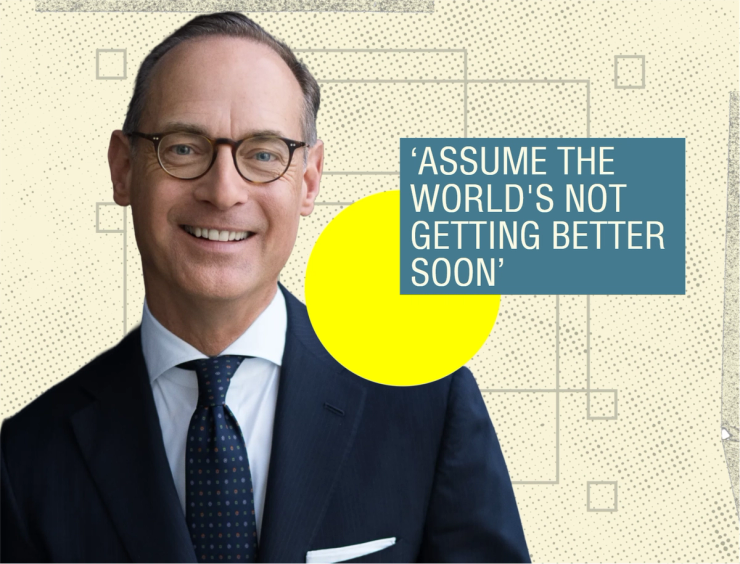
Financial markets don’t like to put realistic prices on the risk of wars, pandemics, and all the other crises Europe’s largest insurer has weathered since Bäte joined it in 2008, “because it would make certain investments rather prohibitive,” he notes. But “we should assume the world’s not getting better soon.”
That is not an expression of pessimism. Allianz’s market value has risen 150% in the past four years to $180 billion, despite the pressures of inflation and wars in Ukraine and the Middle East. Instead, it reflects the urgency with which the former McKinsey consultant is trying to reshape his company, which manages around €770 billion on its customers’ behalf, for a future marked by accelerating and threatening changes.
“We insurance companies are known by [management scholar] Henry Mintzberg to be the perfect example of a machine bureaucracy, which is not an insult. It’s actually a perfect organization form for things that are highly complicated and stable,” Bäte says.
Insurers are still complicated, but the technological, macroeconomic, and geopolitical strains on them mean that they are no longer stable, he warns, and the typical organizational response to that combination of forces is extinction. “When you look into biology, these organisms die; they’re called dinosaurs.”
That analysis defines Bäte’s task at the 156,000-person German group he has led for 11 years: keeping a firm grasp on the essentials of risk management while adapting to markets that are changing at unprecedented speed. And he is doing so at a moment when he must filter through more noise than ever to find the signals by which to steer Allianz.
“I’ve never seen anything like it,” he says. As supposed “black swan” sightings become more common, “the ability to create huge havoc is rising very fast.”
The fighter pilot playbook for preparing for the worst
Those circumstances have changed boardroom decision-making completely, says Bäte, who once studied with Olivier Sibony, a professor specializing in strategic thinking. Leaders cannot base decisions on experience anymore, Bäte argues. Instead, they must be guided by the real-time facts of each situation, measure their key performance indicators carefully, and weigh the probabilities of different possible outcomes.
Mathematicians have proven that “consensus decision-making in areas of high uncertainty is by default the wrong answer,” Bäte, a former statistician, says. But he also believes that the biggest risk is making no decision, so it is better to make choices, monitor their outcomes, and “reverse them very fast” if they prove to be wrong.
By way of example, Bäte notes that Allianz did not fully foresee the speed with which interest rates rose after Russia’s full invasion of Ukraine in 2022. Allianz is one of the world’s largest investors, so what mattered was its ability to react.
“We had parts of the organization — thankfully the larger ones — that were prepped in a way like fighter pilots are prepped,” he says. When bullets pierce a jet’s cockpit, he explains, “you don’t start deliberating, you start executing.” But most companies run scenario-planning exercises, only to rehearse their debates about what to do once a crisis hits.
“Where we had huge problems is where we were analyzing again what decision we should make,” Bäte says of the inflation spike. “The point is not about getting the analytics right, but making sure an organization does react — not just can react — when it has to react.”
The way to do so, he says, is not just to consult your experts at the scenario-planning stage, but force them to prescribe the course of action the company will take if that scenario happens — and then stick to it. The company cannot wait for the CEO to make every decision.
“People become more risk averse if all the variables move at the same time,” he adds. When crises strike, “a lot of people very quickly turn their heads and say, ‘Boss, what should we do?’”
The affordability challenge in a Besitzstandswahrung world
Bäte is not one to mince words. Over the course of an 80-minute interview, he takes swings at (unnamed) “stupid” politicians, warns that risk in private equity portfolios has been “massively” underpriced, and says German healthcare costs are so high because “people overconsume bullsh*t.”
That latter point, about the growing unaffordability of the things Allianz insures, has become a defining issue for his strategy. Hourly rates at German car repair shops have risen 50% since 2017, he told the company’s last annual meeting, while the country’s medical spending has been rising at 6% a year.
Bäte knows the details of his business, rattling off stories about the growing subsidence problems of shoddily built English houses, or the soaring costs of nasal surgery for aging French bulldogs, but his anecdotes are in service of a broader point: that Europe “cannot afford all of the options” that its citizens expect.
The EU has 6% of the world’s population and represents 18% of global GDP, he says, but it accounts for 25% of the world’s social spending. And that, he believes, is unsustainable: “You need to explain to people that they’re living in a balloon world.”
Cutting spending that people have grown used to is politically unpalatable, Bäte knows, referencing the German word Besitzstandswahrung, which he translates as “once I have something, you cannot take it away from me; protect mine.” That means that the task of addressing affordability challenges falls increasingly on companies like his.
How companies can use their size on their customers’ behalf
“You could say, why the heck do you care? You’re not a socialist,” Bäte says, before explaining that his worries about the cost of surgery or windshield repairs relate directly to his business model. His concern is that, even if Allianz prices its offerings competitively, customers will find them unaffordable, hitting his retention levels. And, he adds, “if insurance becomes too expensive, we have an individual problem that becomes a societal problem.”
That worry is far from theoretical for companies like his, he adds, mentioning the 2024 killing of UnitedHealthcare CEO Brian Thompson. Insurers have been “pretty mediocre in giving customers great value,” he says, and if customers think that “you, as an industry, suck … this can cost you your life.”
Bäte’s response has been to try to reposition Allianz as more of an ally to its customers, by using its negotiating power to get hospitals, body shops, and spare parts manufacturers to lower the prices of medical treatments and car repairs.
“You have to have scale in order to be relevant to the providers. You have to have the know-how, and you have to have the purchasing power,” he says. But if Allianz gets this right, “we can become problem-solvers.”
That insight informs the branding of one of Bäte’s initiatives: Solvd, a platform that combines AI-powered assessments of accidents with car part pricing databases and Allianz-partnered networks of repair shops, has reduced claims costs by up to 30%, he says. “We are targeting specific garages and telling them: If you work with us, you have to accept lower prices, but we’re giving you much higher utilization.” The garages aren’t happy, he admits, but they are taking the deal.
The scale advantage in AI
Allianz’s AI spending is “very small at the moment, but it will be very big,” Bäte says. That prediction stems in part from his expectation that technology companies will crank up their prices as their products become more essential to companies like Allianz. “Everyone is sort of being provided with the drug, and this is for free for now, and then the moment you are hooked on it, [AI companies are] going to start slowly, but surely, pricing for it,” he says.
When that happens, he believes, his company will be better placed than smaller rivals to realize AI’s potential. Allianz spent more than $7 billion on technology last year, and Bäte believes that the AI revolution will power companies with those resources “much more than anyone else.”
His confidence is not complacency. AI represents “a change that is so fundamental that the rules that we’ve had … don’t work anymore,” he says, predicting that his industry will be “massively disrupted.”
Part of that disruption will fall on the insurance workforce, where Bäte expects to see “a lot fewer” actuaries, accountants, and administrative staff. And the risk aversion for which insurers are known means that getting Bäte’s employees to take full advantage of AI adoption is a “huge” challenge, he says. Allianz is investing in training for its staff, to build their trust in the technology, but “convincing people to train the very machines that may make [them] redundant is … a tall order.”
Layoffs in Germany can depend more on works council negotiations than on the wishes of CEOs, and Bäte says it is “unlikely, but possible” that Allianz’s own headcount will grow. As an industry, though, “we’ll have … a lot of people leaving.”
The cyclical reality awaiting ‘naive capital’
Allianz is far from the only insurer to have prospered through recent upheavals. Cheap financial capital has flooded into the industry, lowering the cost of protecting against disasters, but Bäte thinks the trend cannot continue forever.
“I still have some peers [who] say ‘No, no, no, the cycle will never come back,’” he says. “It’s just ridiculous. Unfortunately, I think we’re becoming more cyclical as naive capital will go in.” The industry does not yet have the strict discipline it will need, he believes, but that will change when the market turns.
“People only know one language: losing money,” he says. For now, though, “there’s so much money being printed and so [many] Ponzi schemes out of tech being created that people feel rich … so these things keep on going until it breaks.”
Allianz has cut its allocation to equities — “other than defensive ones that have real cash flows and real earnings” — to its lowest level on record, but Bäte is not sure that markets are close to a breaking point. “I can give you many reasons why I think these things are mispriced,” he says, but “it doesn’t matter; I cannot make money against the market.”
In the meantime, he says, Allianz cannot blame external forces, nor wait for them to change. “I’m disappointed with some of the things, but I always say, ‘What can we do?’ We have tons of things that we can do better.”

Notable
- Allianz kick-started 2026 with its strongest first quarter ever, with a 6.6% year-over-year rise in operating profits to €4.5 billion ($5.14 billion), signaling that Bäte’s three-year plan is ahead of schedule.