



The Scene
Power International Holding, the Qatari conglomerate that grew to touch nearly every aspect of daily life in the run-up to the 2022 men’s soccer World Cup, has made the pivot few analysts would have predicted for a contractor: expanding beyond its domestic market after Qatar’s sports-centered infrastructure boom ended.
The company — whose interests span agriculture, construction, dairy, healthcare, hospitality, telecommunications, and real estate — has emerged as one of the largest investors in Kazakhstan, with interests in Algeria and plans to expand to Ethiopia. One of its biggest bets is Syria, where the Al-Khayyat family originated. Since the toppling of the Assad regime, PIH has won agriculture, aviation, energy, and tourism projects in the country.
Its work on a new terminal at Damascus airport is underway, with the exterior largely complete. The existing facility is a relic of communist-era architecture worn down by decades of neglect.
What distinguishes PIH’s approach is the other tools it brings, in addition to construction expertise: The company is using its access to capital and other networks to ensure there are planes to use the new terminal, providing $250 million in financing for Syrian Airlines to acquire up to 10 Airbus A320 aircraft, according to Chairman and Group CEO Ramez Al-Khayyat.
“Part of our contract is to have a certain amount of money available for them in order to buy the planes,” Al-Khayyat told Semafor in an interview in Doha. Building an airport designed to handle 31 million passengers a year does not work without aircraft, and Syrian Airlines has only a handful in operation. “We look at the whole ecosystem. This is our strength,” he said.
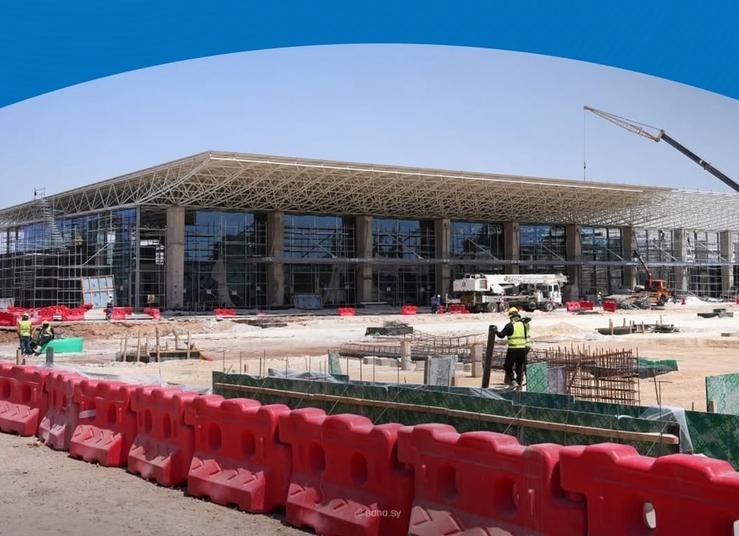 Courtesy of Syrian Arab News Agency
Conglomerates are often punished by public markets. This hasn’t deterred the Al-Khayyat family from pursuing the kind of vertical integration and empire-building associated with an earlier era. After leaving Syria at the start of the civil war, Ramez and his older brother Moutaz won government contracts in Qatar, starting with what they knew best — construction — and soon expanding into hospitals, hotels, restaurants, and entertainment venues. Most famously, they airlifted in thousands of cows to provide fresh milk after Saudi Arabia and the UAE imposed an embargo on Qatar in 2017.
As they worked on World Cup projects, it was clear that the Qatar government’s spending spree would not last beyond the tournament. What was once an almost exclusively Qatari enterprise began looking elsewhere, Al-Khayyat said. The company that emerged now operates in 25 countries.
Kazakhstan is its largest foreign market, with approximately $17 billion invested across telecoms, infrastructure, power generation, pipelines, and industrial projects. The Al-Khayyat family has also partnered with Jared Kushner and Ivanka Trump on a resort in Albania, which has been the subject of local protests and controversy.
In this article:

Know More
Syria was always an aspiration, but few could have predicted how quickly the Assad regime would collapse or how rapidly the country would shift from an Iran-Russia orbit toward one increasingly aligned with the West and Gulf states. That transition — and Iran’s closure of the Strait of Hormuz — has elevated Syria’s importance as a logistics corridor for trade, oil and gas, data cables, and as a geopolitical buffer that Gulf states hope will keep Iranian influence out of the Levant.
Al-Khayyat said his team had been preparing for an eventual return to Syria for years, maintaining an internal plan that was constantly revised. “We had a document that we kept updating,” he said. “Every few weeks or a month, we would discuss it.”
Syria’s political transition provided the opening, and Qatar — which supported the Syrian opposition for more than a decade — developed the closest ties with the new leadership in Damascus. Emir Sheikh Tamim bin Hamad Al Thani was the first head of state to visit the country after the transition. US envoy to Syria Tom Barrack, a longtime friend of President Donald Trump who previously managed money for Qatari royals, has attended signings of several PIH agreements, giving the projects greater political weight than a purely commercial transaction.
While the airport is perhaps the most visible project, the largest commitments are in energy. Syria needs roughly 10,000 megawatts of electricity, but currently has only around 5,000 megawatts available on the grid, according to Al-Khayyat. “All the 5,000 megawatts are under construction as we speak,” he said.
The company is also bidding for a telecoms license alongside Doha-based operator Ooredoo and has invested in local banks. Agriculture is another priority, beginning with an effort to revive Syria’s cotton industry, once among the largest in the world. A proposed $3.3 billion initiative is part of a broader agricultural strategy that Al-Khayyat said could create 200,000 jobs.
“The main question always is how many jobs you’ve created in the country,” he said. “This is the direct impact.”

Mohammed’s view
I was familiar with the family’s business when I moved to Doha in 2014. They kept a low profile, but had developed a reputation as capable contractors. Their restaurants were already popular. Then the embargo happened.
I wrote the first stories about the “flying cows” in 2017, which turned the Al-Khayyats into a symbol of how quickly Qatar was able to mobilize capital and logistics during the crisis.
 Naseem Zeitoon/Reuters
The brothers, now billionaires and longtime naturalized Qatari citizens, always maintained a strong affinity for Syria and are putting money into projects that most investors would consider too risky.
Many Syrians are suspicious of their intentions. The optics of deals being signed in the presidential palace, combined with ties to the Trump family, raise concerns that a new elite is being built on the ruins of a weak and devastated state. The Al-Khayyat family prospered under the previous regime, and some relatives were sanctioned for supporting the government and profiting from the war.
These are not trivial concerns. They highlight how business and politics increasingly overlap. While this blending is common in the Middle East, many Syrians who supported the revolution fear replacing one privileged class with another.
When I posed these questions to Ramez Al-Khayyat — as someone who has visited Syria repeatedly over the past 18 months and seen the scale of the destruction firsthand — it became clear that we share a pragmatic view. The investments are necessary, but risky, and there are very few takers for projects of this size and complexity.
The reality is that many Syrians can benefit if Al-Khayyat — who is 41 and built his career during one of the largest infrastructure booms in modern history — brings his experience, and capital, home.
The questions around political access, favoritism, and governance should be monitored by both the public and a transparent legal system, which Syria does not yet have. This interregnum could be rife with abuses. But if no one steps in, there will be no development. Syrians will continue spending their nights in the dark.

Step Back
The Al-Khayyat family’s rise traces back to an unlikely opportunity in 2006. When Qatar began sponsoring development projects in Syria, the family won a contract to build the Palmyra Camel Race Track. “They gave us a mission impossible,” Al-Khayyat said.
The company delivered the project in six months. That was a “great achievement that we exceeded expectations and this is how we built trust with the Qataris at that time,” he said.
The contract led to more work, an invitation to Doha, and eventually a central role in Qatar’s $200 billion infrastructure boom ahead of the 2022 World Cup.
Al-Khayyat attributes the company’s success to a combination of serendipity and execution. Meeting the Qataris was luck; delivering was what mattered.
“We have not been selected because we have a connection,” he said. “We have been selected because we are the best and we can deliver.”

Notable
- This Bloomberg profile estimates the family wealth at $7 billion, which includes “a 19th-century mansion in central London once owned by John Pierpont Morgan Sr.”
- Another brother, Mohammed Al-Khayyat, has proposed a Trump-branded resort in Syria. More on the family’s business history and its ties to the Trump family are reported in this New York Times article.