




The Signal Interview
When David Cordani hands over the title of Cigna CEO to Brian Evanko on July 1, the triathlete will be ending the longest leadership run of any of his industry peers. In his 17 years in charge, the US health insurer’s annual revenues expanded from $18 billion to $275 billion, as its customer base grew from 40 million people to 180 million.
Cordani will be sticking around, keeping oversight of his company’s thorny government relations agenda as executive chair, and he argues that longevity has its advantages. Seeing multiple business cycles builds familiarity with how to approach challenges, he says. Even so, he admits, “the last 18 months have been pretty challenging.”
The December 2024 shooting of Brian Thompson, CEO of UnitedHealthcare, set the industry’s executives — and their staff — on edge. The reaction of parts of society was as shocking as “the horrific event” itself, Cordani says, nodding to the support some people voiced for Luigi Mangione, the suspect in the murder.
Polling suggests that the American public has lost trust in health insurers as healthcare costs have grown above inflation. In that context, Thompson’s death “challenged all of us to attempt to pause our current belief set,” says Cordani, who oversees almost 70,000 employees. Cigna was abruptly presented with two options: to hunker down, or to “lean in and actively listen” to what was driving “the societal outcry.”
Cordani chose the latter. The objective was not to validate Thompson’s killing, he emphasizes. Instead, his goal was to turn “the shock of the event, and the horror, and the shock of some of society’s reaction, into a call to action to actively listen in the most comprehensive way with the most comprehensive tools we have.”
A need to shift perspective
Asked whether he used that moment to look back and understand what Cigna or its industry had done to reach that breaking point in trust, Cordani replies: “Not really.”
He does not mean to be dismissive, he says: “We sought to deliberately acknowledge that we are proud of what we’ve delivered, why we delivered it, and in the environment we delivered it in, but to pause it … and say there’s a different tomorrow.” The task was not “to explore and rationalize,” he says, but to identify the barriers to improvement, and “the accelerants we need to create for success.”
The outcome of that process was a pledge to improve patients’ experiences, launched in early 2025 and dubbed Commitments to Better. Covering five areas, from affordability and transparency to easier access to care, the plan explicitly set out to build or repair trust with millions of patients. At its core was an attempt to flip the perspective underpinning Cigna’s decision-making, and push the company to “stand in the shoes” of its customers.
“We strive for perfection, knowing that you’ll never get there, but you’ll touch excellence along the journey,” Cordani says. A 98% success rate might look exemplary in other companies, but it’s “not good enough here,” he notes, “so let’s do the math of what 2% of moments that matter might look like for Jane Doe or Bob Smith.”
The challenge was to filter everything through customers’ experience at such moments, “and work our way back from that,” Cordani explains. Doing so “created a positive catalyst in our organization out of this horrible event, to move us forward at a pace that probably would not have transpired previously,” he says.
In its first year, the new approach led Cigna to cut prior authorization requirements for tests and procedures by 15% and make changes to reduce patients’ out-of-pocket expenses, the company reported.
Such initiatives have not silenced health insurers’ critics: Cordani was among several industry CEOs who were accused of putting profits over patients at a congressional hearing earlier this year.
“The facts belie the statement,” he says, noting that Cigna’s profit margins hover around 4%.
“We don’t make more money by keeping people from having access to care. Our model is the antithesis of that,” he adds, positing that the growth in Cigna’s customer base is evidence that “people see us as a force for good.”
The lessons of triathlons
Cigna’s Commitments to Better plan is just the beginning of “a multi-year journey of acceleration,” Cordani says. He is fond of running analogies, having completed more than 125 marathons and triathlons, including many in which he runs alongside and guides veterans and athletes with disabilities.
Running builds resilience, he says, and guiding amputees through a race highlights the human mind’s ability to achieve seemingly impossible goals. Some of Cordani’s most clarifying insights about his work have come to him while training, he adds, because “you have to take your mind somewhere else; if you take your mind onto the discomfort of the moment, it will eat you.”
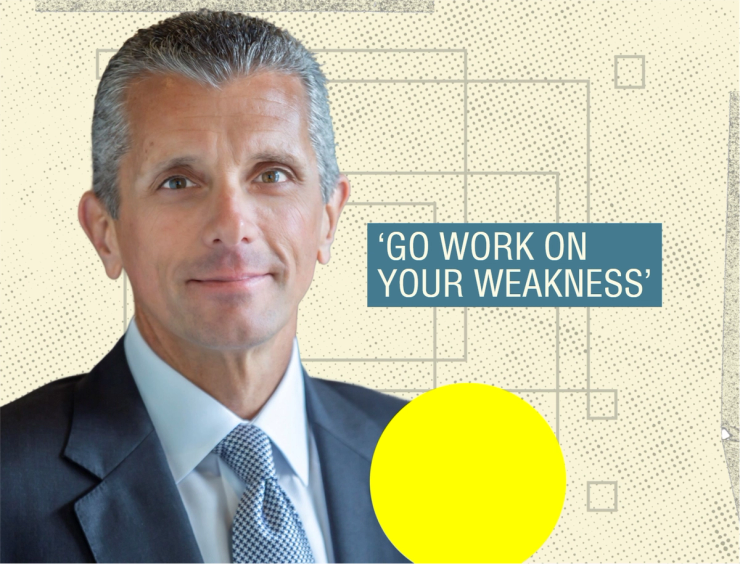
Endurance races have served him well as a CEO in another way. “In triathlon training, most people will spend disproportionate time doing the third of the events they like the most,” he says. But expert triathletes have advised him to do the opposite: “It’s having the discipline to go work on your weakness.”
He has applied that lesson to his own career. His training was in finance, but he sought exposure to skills he was unfamiliar with, from sales to client management, even as some people advised him to double down on his existing experience.
Your career can look like the Leaning Tower of Pisa or the pyramids of Egypt, he says. “The Leaning Tower of Pisa is an amazing architectural marvel, but it has a weak foundation because it’s not built broadly. The pyramids are amazing; they have a broad, durable foundation, and hence they’re tall and powerful, but they’ve stood the test of time.”
The 100-day pie chart
Cordani brought a similar discipline to how he allocated his time as CEO. Much as triathletes favor their strongest sport, “we all give in to the urgent or the most energizing [and] intellectually stimulating,” he notes, but “the urgent drives out the necessary.”
That observation led him to draw up a succession of pie charts, with segments representing the time he intended to spend over the next 100 days on people, strategy, governance, operations, and “field interaction” — being out on the road with customers, regulators, and investors.
Cordani shared his pie charts with his assistant, with the instruction that they should guide his calendar. But designing such a program is only half the battle, he says: “Then you’ve got to have the discipline to look back and say, ‘How well did we do?’ Because you’re never going to do it perfectly.”
The idea, he says, was to focus his efforts on where he could have the most impact on the company. A CEO’s task, he believes, is to create “the bigger-picture bond” of a company that is driven by both purpose and performance, and then “to tap into the infinite discretionary energy of those I have the privilege to lead, to have a catalyst and multiplier effect.” If you can do that, he says: “Boy, the catalyst of that is off the charts for good.”
Passing the baton
Cordani saw his role evolve over his 17 years at the helm. “The role of a CEO is very much today to me much more of a coach, an adviser, an enabler, a facilitator than of a decider, operator, leader,” he says. He uses similar terms to describe what his role will be as executive chair once he hands the baton to Evanko, a 28-year Cigna veteran and his current chief operating officer.
“I go into a support role, in terms of a sounding board, a coach, a situational problem-solver — behind closed doors, where necessary,” Cordani says. “I’ve got a lot of cycles under my belt; with cycles come learnings and scar tissue, and the opportunity to share not the answers, but thought processes and reflections, and ask open-ended questions. That’s how I could be most helpful to Brian and his new team.”
He is keeping responsibility for Cigna’s government affairs “for a period of time,” just because of “the active nature of that role.” And he will still be running marathons and triathlons.
Asked how he finds the time for the hours of training that entails, he shoots back: “The pie chart, the pie chart, the pie chart!”

Notable
- Cordani told Fortune he hopes he’s “somewhat forgotten” after handing the reins to Evanko, because his successor will be so effective that he won’t be needed.
- Evanko recently announced that Cigna would leave the Affordable Care Act market for the 2027 plan year, saying that the business was small, and had been shrinking for several years.