



Wael’s view
Nine minutes into the 2026 World Cup’s opening match at the Estadio Azteca, Mexico’s Julián Quiñones controlled a loose ball and drove it past the South African goalkeeper. The crowd erupted. What most of them probably didn’t know was that the man who had just set the world’s largest sporting event alight plays his club football in Saudi Arabia — where last season he was the league’s top scorer with 33 goals, ahead of Cristiano Ronaldo.
Quiñones was born in Colombia, arrived in Mexico as an 18-year-old, and became a naturalized citizen before earning his first national team call-up. That profile — outsider, migrant, adopted identity, ascent to the top tier — is, without much exaggeration, the story Saudi Arabia is trying to write for itself in world football.
What makes the symbolism sharper: Quiñones doesn’t play for a club merely sponsored by Saudi money. He plays for Al-Qadsiah FC, owned by Aramco, the kingdom’s crown jewel. When his shot crossed the line, Aramco was literally on the pitch as well — the company is a FIFA sponsor. In a way, the first goal of this tournament was a Saudi production.
The standard accusation against Saudi Arabia’s sports investment is that it is simply “sportswashing” — that the billions flowing through the government’s Public Investment Fund into boxing, football, Formula 1, and golf are a reputational laundry service for a country with a troubled human rights record. Crown Prince Mohammed bin Salman, in a 2023 Fox News interview, gave that argument the shrug it perhaps deserved, saying: “I don’t care. I have 1% GDP growth from sport and I’m aiming for another 1.5%. Call it whatever you want — we’re going to get that other 1.5%.”
That quote reframes the debate. Saudi Arabia is not investing in sport just to look good. It is investing because sport, over time, can be an important economic sector — generating revenues from player transfers, broadcasting rights, and tourism receipts, and attracting private capital. Sport’s contribution to Saudi GDP had nearly tripled between 2016 and 2019, before the most significant investments had been made. PIF committed more than $6 billion across 900 or so sponsorship agreements between 2021 and 2023. In the summer of 2023, Saudi Pro League football clubs spent $957 million on player transfers — a figure Deloitte said was a record for any league outside Europe.
That summer brought Ronaldo to Al-Nassr, Benzema to Al-Ittihad, and Neymar to Al-Hilal. The league has since moderated its spending, but the ambition remains.
This World Cup has validated the Saudi Pro League’s growing stature. A total of 47 players across 18 national teams competing in the tournament play their club football in Saudi Arabia — more than any league outside Europe’s top five. Attendance at Saudi league games reached around 2.5 million spectators in 2023-24, in a further sign of a league that is building genuine weight.
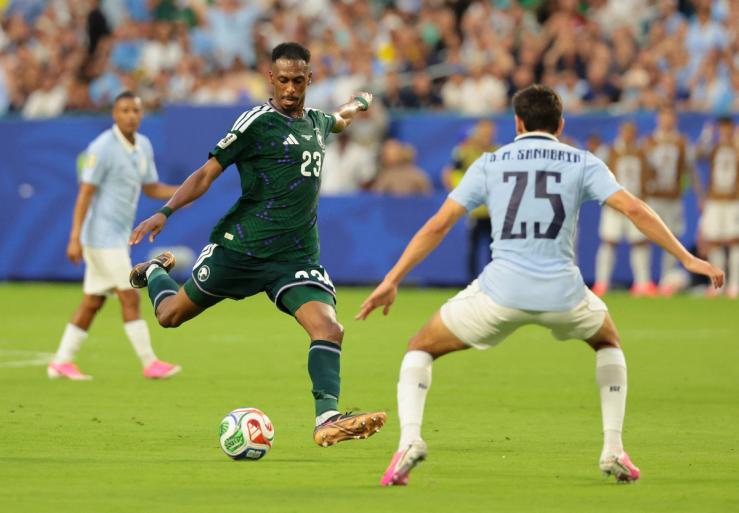
None of this has translated to the national team. Saudi Arabia qualified for the World Cup but it is ranked just 61st in the world. Its group stage games — including ones against the reigning European champions Spain — could expose the gap between Saudi football’s commercial profile and the abilities of its own team. The Green Falcons have a chance to advance after their impressive draw against Uruguay on Monday, but they will still need some luck.
This is a fundamental tension for the project. Imported galacticos don’t build a national pipeline. The country’s ranking has barely moved despite years of investment in the league around it. Commercial ambition and competitive development run on different clocks.
PIF’s ownership of Newcastle United is the most visible but least resolved piece of the football portfolio. The club finished a disappointing 12th in the English Premier League this season, a result that isn’t what many in the northeast of England hoped to see four years on from the initial Saudi investment. Compare that to what Qatar has built at Paris Saint-Germain — a Champions League infrastructure and a global brand — and the gap between ambition and results is clear. The comparison may not be entirely fair in timeline, but the French club offers a benchmark the project will inevitably be measured against.
The most instructive recent move was not the purchase of a club, or even a player transfer. In April 2026, PIF sold 70% of Al-Hilal — Saudi Arabia’s most decorated club — to Prince Alwaleed’s Kingdom Holding for 840 million riyals ($224 million). Al-Hilal had revenues of $340 million for 2024-25, the highest ever for a Saudi sports organization.
PIF said the exit from domestic football was planned from the start. The fund’s role was to build the asset and then hand it to private capital. Other clubs are set to follow a similar path. The logic is that once clubs are well run, the state can step back. Revenue from player transfers, media rights, and matchday income should be self-sustaining. Football has to become a money-making sector, with clubs buying and selling players as a business model, not as a government directive. That transition won’t be complete before 2034, when Saudi Arabia is due to host the men’s World Cup, but that event is a deadline that everyone has in mind.
Quiñones didn’t arrive in the Saudi league because he had nowhere else to go, but the Saudi league offered him the conditions to become the most prolific scorer in Asia. The first goal of this World Cup is a small symbol of what the Saudi investment drive has bought: A league that matters, a stage that attracts world-class talent, and an earned presence in global football.
The kingdom has bought its seat at the table. Now it has to learn to compete at the elite level of the game — and that part, as Quiñones’ own story makes clear, can take a long time.
Wael Mahdi is an independent commentator specializing in OPEC and Saudi Arabia’s economy, and co-author of OPEC in a Shale Oil World: Where to Next?

Notable
- Saudi Arabia’s engagement with international sports is designed to accelerate economic diversification and enhance its global influence, but the scale of investment required has raised questions about the long-term sustainability of the strategy, writes Amnah Mosly for the Gulf Research Center.