




The Signal Interview
Honeywell CEO Vimal Kapur read Elliott Investment Management’s public letter calling for a breakup of the industrial conglomerate just before he was about to address 200 of his top executives.
Many of them had flown to Charlotte, North Carolina, in October 2024 from around the world for his speech, Kapur recalls. “You can’t say, ‘The meeting is suspended because we have this letter and we don’t know what to do with it.’” Canceling would have signalled that “some crisis is coming.”
Activist investor Elliott paired its case that “tremendous” value could be created by splitting Honeywell’s aerospace and automation divisions with a warning: The company’s recent record had been one of “uneven execution, inconsistent financial results, and an underperforming share price.”
Kapur had only been CEO since June 2023. But, a little more than 18 months after that Elliott letter, his position is unchallenged, his activist shareholder has been publicly complimentary of his performance, and Honeywell Aerospace is on track to launch as a separate company on June 29. Kapur will end up in charge of Honeywell Technologies, an automation business with a new, AI-powered growth story.
That moment will complete the latest breakup of one of the conglomerates that defined US industry for decades. Honeywell is following in the footsteps of 3M, Danaher, GE, and United Technologies — companies that once preached the virtues of a diversified portfolio but have concluded that value now comes from focus.
Kapur seems an unlikely figure to preside over such a split. An engineer by training, he has spent 37 years with the company — in his native India, the UK, and the US. But he says the end of Honeywell’s conglomerate era is driven by his own conviction, not by shareholder pressure.
What Elliott did not know in 2024, Kapur says, is that his team had already begun working on the breakup the investor was agitating for. A month earlier, Honeywell had announced its intention to spin off its smaller advanced materials business, but it was quietly doing “a lot of preparatory work” on a more radical restructuring.
“You do the small one first, to get practice a little bit before you do the big one,” Kapur explains. But as far back as 2022, when board members began interviewing him for the CEO role he secured in 2023, he was telling them: “We’re too complex.”
When an activist’s letter lands, Kapur admits, “you obviously have the moment of uncertainty.” But once he met Elliott’s representatives, he soon discovered that both sides agreed on the direction Honeywell should go in. “The question was how to go there.”
A separate team to oversee a separation
Instead of ignoring Elliott’s letter, Kapur used it to explain his plans, reasoning that transparency would build trust with his leadership team. If he was going to avoid causing “chaos” by wavering, he adds, his argument would have to be based on his personal convictions. So he anchored it in two core beliefs: that industrial companies grow fastest when their strategy is aligned with powerful market trends; and that “simplification always creates more value than complexity.”
Deciding on a split that would let Honeywell’s businesses better exploit trends like AI-powered automation and the energy transition was just the start of Kapur’s task, however. And the advanced materials spinoff had taught him valuable lessons about how to pursue the separation of Honeywell’s aerospace division, from how many consultants he should hire to how long it would take to get regulators’ approvals around the world.
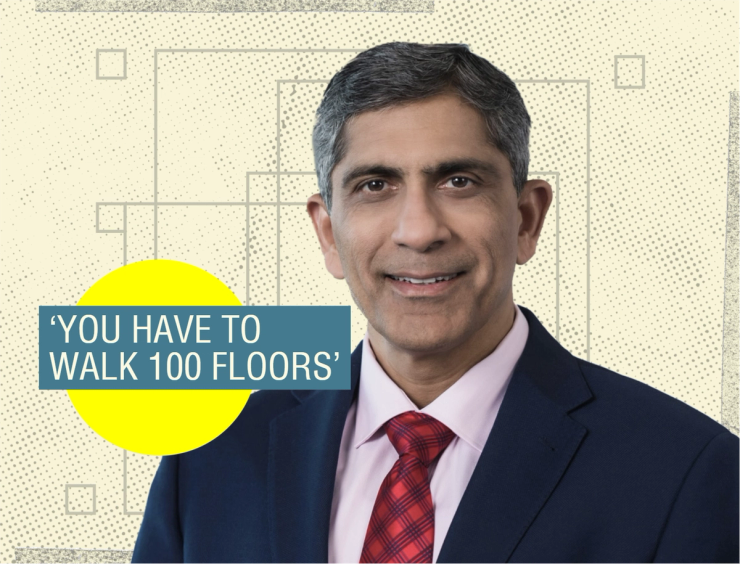
“Separation is an act of program management. It’s just a lot of tasks, too many tasks. You have to do all of them, but there is no creativity in this,” he says. “You have to walk 100 floors. That’s just the brutal truth. And you have to keep walking. If you stop, it will slow down.”
Something like cleaving a payroll system in three has to be done flawlessly, for example, so staff still get paid on time. “You can’t say, ‘Oh, they almost got paid,’” he observes: “There’s nothing called ‘almost.’ Everything has to work.”
Kapur gave oversight of the process to a separate group of people, many of whom had worked on the earlier, smaller split. “You have to dedicate a team to do this,” he says. Honeywell’s “separation management office” reports to former general counsel Anne Madden, who reports to Kapur and checks in “all the time,” in a relationship designed to balance autonomy and accountability.
Madden’s team is making the vast majority of the detailed, “programmatic” decisions about the split, Kapur says. That leaves him room to make the biggest calls, such as who should lead Honeywell Aerospace when it becomes an independent company. “I don’t want to put my foot in the door in every little thing; it will slow down the whole thing,” he explains.
Kapur believes in delegating and inspecting, empowering his team while holding them accountable. Even so, he adds, “I don’t go too far away.”
How M&A helps maintain momentum
Even as Kapur unravels a business that took 141 years to stitch together, he has continued adding to it, spending $14 billion on acquisitions over his time as CEO. A breakup can’t distract you from the need to keep refreshing your portfolio of assets, he says, and you shouldn’t wait two years to dispose of parts of the business that are growing too slowly or no longer fit the strategy.
“You can’t lose momentum, even a single day,” Kapur says, and his latest acquisitions will be critical for driving growth and profits in four or five years’ time. “You have to [plant] those seeds,” he says. Failing to do so risks rendering your portfolio “obsolete,” and the next generation of your company’s leaders “will not pardon you for your lack of action.”
Besides, he adds, it is management’s job to put shareholders’ capital to work. Honeywell has bought back “modest” amounts of its own shares, Kapur notes, but he tells investors, “I don’t think you pay me for telling the CFO to do share buybacks.” A company’s leadership adds value by knowing enough about its markets and customers to place the right bets to build its portfolio, he says, “which is very hard.”
The point of being publicly listed is to have the access to capital and the “brand presence” to make target companies want to agree to merge, he adds. “If you don’t use that power of a public company to invest into [your] portfolio, you’re wasting your time.”
Why revenue growth starts with customers
Kapur prides himself on knowing Honeywell’s products in enough detail that he can demo them. Staying close to customers as he rose through the ranks helped him learn what problems they were looking to Honeywell to solve, but it also shaped his thinking on what will drive faster growth at an industrial company like his.
From 2005 to 2020, Honeywell concentrated on improving its profit margins as it sought to boost its bottom line, he recalls. But that focus on operational excellence and cost controls turned executives’ attention inward, so they were looking at internal processes rather than scouting for new sources of demand.
Companies that focus on top-line growth “have no choice” but to listen to their customers, he says, because they cannot bring in new revenues without understanding what buyers need, what frustrates counterparties about their products and service, or what their competitors are doing better.
Discipline on costs and operations is still “table stakes,” Kapur says, but it should not be the primary concern of a CEO who is looking for a larger share of their market. “Spend seven hours in a day thinking about growth, and spend three hours on how you drive execution,” he advises.
Honeywell Technologies will be “singularly focused on this new growth-oriented model,” Kapur says, predicting that his team’s work over the past few years will give it the differentiation and the scale to keep it ahead of its competition for a few years.
But, he adds, “we have to always look around and be conscious that there’s more to do here. This is a very difficult journey to win.”
The conglomerates give way to an era of specialization
Honeywell’s breakup is unlikely to settle the decades-long debate about whether diversification or focus is the better long-term strategy for corporate success. But Kapur does not see the conglomerate coming back into fashion for many years to come.
Conglomerates’ world-spanning scale benefited them in the age of globalization, he says, because they could buy smaller companies and open new markets for them. But that era has ended: A world order that once appeared stable has fragmented and more companies know how to manufacture in Asia or manage global supply chains, “so those capabilities have become highly replicable.”
As conglomerates began to span multiple sectors, scale turned into complexity and “that value creation got maxed out,” he says. Now, we are in a new cycle where “simplification is better.”
Kapur thinks multinational conglomerates are more responsible for the economic growth that came with globalization than many people think. “Governments enabled it, or they created the structure. But in the end, the work was done by an ABB or Siemens or a Johnson Controls or Honeywell; these companies actually did all the work,” he says. “They did not get credit for it. Now, when the headwinds are coming, they have to deal with it individually, based on their own capabilities.”
Even so, he thinks “this era of specialization” may last for another 10 or 20 years, and it will take some similarly large change for conglomerates to come back in style. “How will that take shape? I will be watching on the other end, because I won’t be working by that time, for sure.”
This story was updated to clarify the details of the separation management office, given updated information from the company.

Notable
- Quantinuum, a Honeywell-backed quantum computing firm, debuted on the Nasdaq earlier this month. The firm sold 28 million shares for $60 apiece, raising $1.68 billion in its initial public offering as investors’ appetites for quantum computing grow.