




The Signal Insight
When Spencer Rascoff wanted to know how Tinder customers would react to a new feature on the dating app that makes recommendations based on musical tastes, he asked Abby, a bookish 19-year-old from Indiana. Instantly, she replied with an emoji-laced stream of consciousness.
“So, music? Wait, okay, I have two completely different reactions at the same time,” the introverted student wrote. “What exactly would it show? Like, exact songs or just vibes, because exact songs feel more personal, but also more ‘OMG, don’t judge me’ energy.”
The message on Rascoff’s screen came not from a person but from an AI-powered “persona” dubbed “Abby the anxious romantic.” The use of avatars representing different types of users sits at the heart of Rascoff’s strategy for engaging more of the world’s 250 million active daters, as he seeks to drive the parent company of Tinder, Hinge, and OKCupid back to growth at a time when much of the online matchmaking industry is suffering from “app fatigue.”
Rascoff, who co-founded the real estate technology company Zillow, stepped up after almost a year on Match Group’s board to become its CEO in February 2025. He quickly concluded that the world’s largest online dating company needed a clearer understanding of its core users’ desires, concerns, and motivations.
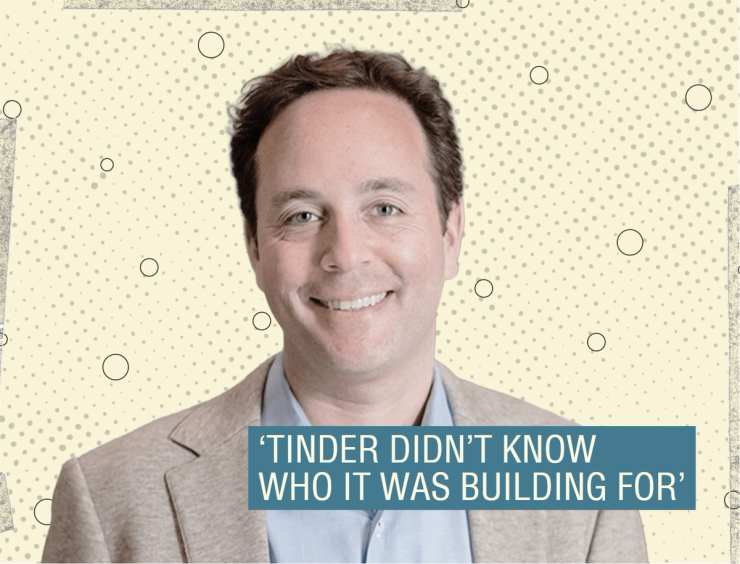
“Tinder didn’t know who it was building for,” he says in a Match Group office in New York, where the walls are plastered with wedding invitations from couples who met via its apps. So he pushed his team to shape their development around personas like Abby, “Jasmine the joyful butterfly,” and “Noah,” an earnest Christian nurse from Atlanta.
At the same time, Rascoff has overhauled the group’s boardroom, matching directors with senior executives to try to deepen the expertise on which his team members can draw.
Match Group’s first-quarter earnings, released earlier this month, suggest that his turnaround strategy is showing some results. Revenues grew 4% as Tinder saw its first year-on-year increase in new registrations for two years, and net income jumped 42%, helped in part by lower employee costs after Rascoff laid off 13% of its staff last year. The group’s stock is still almost 80% below its 2021 peak, but it has rallied in the past year while the likes of Bumble and Grindr have fallen further.
“We like the team that’s on the field, and we feel like the score is gaining momentum,” Rascoff says. “The game’s not over, though.”
This interview has been edited for clarity and length.
Andrew Edgecliffe-Johnson: Did you already feel you had a clear idea of what the company needed when you were sitting on the board?
Spencer Rascoff: I had an idea, specifically that we needed to re-spark innovation in a company that was a couple decades old, but I didn’t know the half of it. As I dug deeper once I became CEO, I diagnosed other challenges and opportunities, including the organizational design, which had to be reworked to shift from a siloed organization to one of transparency and collaboration between business units. I also had to bring new talent into the company, bring some fresh perspectives into the boardroom, and make some bold moves regarding investments to improve the user experience of our apps, as well as to expand into emerging categories.
Having sat on the board, what were you trying to do as you remade it?
I think most employees never really think about who’s on the board of directors of their company. But boards matter, and I wanted to bring some fresh perspectives into the boardroom. Since I’ve started, we’ve added five new directors [and] I’ve paired each of them with different direct reports of mine to really be like coach-mentors to them. That’s how I built the board at Zillow, being intentional about the chemistry between [each] board member and a direct report of the CEO, making sure that they spent time together outside the boardroom. A good director’s value far exceeds what they contribute in four four-hour board meetings a year. Those meetings are just a tiny fraction of what a great director should contribute. We [pay] board members $300,000 to $400,000 a year [in cash and stock]. That’s very high-level compensation. I want them to contribute like an executive, and I set that expectation when I recruit board members. Obviously it’s not a full-time job, but it should be more than 16 hours a year. And it certainly is here.
You’ve also tried to change how people think about who they’re building for. Tell me that story.
At Zillow, many years ago, a marketing executive told me, “We need personas.” I’d never heard the word before, [but she explained] it’s a tool that product-driven organizations use to create archetypes of their users. We paid an outside agency and that was the best $150,000 Zillow ever spent. We developed “Beth” the buyer, “Susan” the seller, “Harriet” the homeowner... 20 years later, they permeate the Zillow product and marketing culture.
When I got to Match Group, I found there were a lot of pockets of consumer insights, and quite a few consumer researchers that had a lot of knowledge about the users of our apps, but that knowledge was siloed among the researchers. So I decided that we needed a personas approach. Now you’ll see employees reference them, even far from marketing or consumer research. You know that personas have taken hold when you’re sitting in a financial planning analysis forecast meeting and a junior financial analyst references Abby. And one of the ways that it comes to life is through custom GPTs, which every employee uses.
What powers those?
It’s ChatGPT, but we have uploaded into a custom GPT reams of data about [these personas] and their mindset. I mean, just thousands of hours of interviews and focus groups with these users, social science research, white papers about Gen Z and young women. We’ve trained the GPT to also go out and acquire the world’s knowledge about people like this. At my desk in LA, I have three monitors: I have my main work monitor that has Slack and other things. Then a second one is my email, mostly. And my third one is a series of browser tabs with all these GPTs.
Are AI agents going to become our matchmakers? They’re going to know so much about us all. Do they need you in the middle?
I think in this particular area, people still want to be in the driver’s seat, because it’s such an important decision: their time, money, and safety and who they choose to connect with. So I don’t foresee people outsourcing that entirely to AI, like they probably will in other categories like shopping, but I think we have an opportunity to improve product efficacy by bringing AI into our products.

Notable
- Gen Z daters desperately want to meet new people in real life, Rascoff says. They just don’t want dates to feel as stressful as job interviews. So Match Group is pushing into offline events that encourage users to go for walks or dinners immediately after matching online, or to attend gatherings of other singles. “We are embracing this trend of meeting people IRL … rather than hiding from it,” he told Business Insider.