




The CEO Signal
A low-key museum in Becton Dickinson’s rural New Jersey campus highlights the early inventions that made it one of the world’s largest medical devices companies. Display cases feature the glass syringes that founders Maxwell Becton and Fairleigh Dickinson pioneered 129 years ago, alongside the first vacutainers, the vacuum-sealed tubes that transformed blood collection in the 1940s.
As BD’s CEO since 2020, Tom Polen’s task is to maintain the pace of innovation at a company that now makes more than four devices for every person on the planet each year. But, having taken the company’s reins when it was heavily indebted after two large acquisitions, he also needed to drive a new level of efficiency, productivity, and responsiveness to its customers.
To do so, Polen has sought to pair a “lean manufacturing” model developed in the middle of the last century with AI and automation tools that are evolving by the day. Since 2023, his BD Excellence program has rolled out the defect-eliminating principles that Toyota first championed decades ago, from BD’s supply chain operations and manufacturing facilities, to its R&D and sales teams. At the same time, Polen is automating more processes in its facilities using AI and robotics in pursuit of greater productivity.
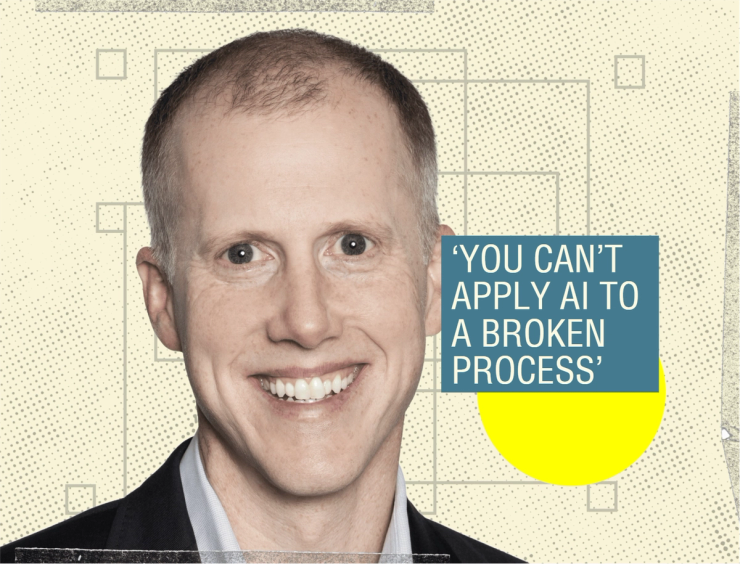
Those two approaches must go “hand in hand,” he says, because “you can’t apply AI to a broken process.”
Pairing technology with human problem-finders
Polen shares a lean manufacturing instructor (his “sensei”) with Larry Culp, the GE Aerospace CEO who has been one of corporate America’s most ardent advocates of the waste-minimizing industrial philosophy. Yukio Katahira, who studied under Taiichi Ohno, the engineer who created the Toyota Production System, has helped BD train more than 15,000 of its staff.
Those employees now conduct about 2,000 kaizens, or continuous improvement exercises, each year. At one of them recently, Polen watched a team use AI “vision systems” to study a production line. “It’s watching the directions in which people’s arms are bending and how often they’re moving, and it’s then determining where there’s risk of ergonomic errors,” he recalls. The technology suggested how BD could get products flowing faster, more efficiently, and more safely by adjusting the heights and dimensions of sections of the line.
At another plant in Singapore, Polen says, BD had been discarding about 200 needles each shift, for 50 years, because they’d get clogged in the sandblasting process used to remove metal burrs. A kaizen exercise that suggested spinning the grinding wheel in the opposite direction reduced the scrap rate to zero.
“No one had actually had the time to step back and say, ‘That’s abnormal. That shouldn’t happen. What do you do to fix it?’” Polen says. The approach he is now championing is about creating space to ask those questions, and teaching employees to be “not just great problem-solvers, but great problem-finders.”
Celebrating behavior you want people to follow
Polen describes his teacher Katahira as “a very special person,” but he believes that you can’t simply teach employees the benefits of lean manufacturing; you need to show them.
“We don’t train people on it in classrooms as much as we go do” real-world exercises, he says, “and every single process starts with someone being challenged [to do] something that they believe is theoretically impossible.” Team leaders will challenge employees to double the productivity of a manufacturing line by the end of the week, for example, and will typically hear that the goal is impossible. Yet, “almost every time, people find ways to achieve it.”
Challenging people to get results they thought were out of their reach teaches them new approaches to solving problems, and turns them into lean manufacturing converts, Polen says: “There’s religion after that.”
The BD Excellence program has placed new demands on the company’s leadership, but it has also empowered many in the 65,000-person company who have been working on manufacturing lines for years without ever having been asked how they could run better, he says. “When we have 65,000 problem-solvers, we can achieve pretty much anything we put our mind to.”
Polen also encourages his leadership team to both measure and reward the gains their kaizens produce. “We measure a lot of things, but we also say you not only get what you measure, but you get what you celebrate,” he explains. “Whether it’s having a big party at the plant afterwards, or it’s an announcement of why someone got promoted, that’s a celebration of someone’s behavior,” he says, and “people will follow what they see an organization celebrate.”
Positioning for a future beyond syringes
Less than three years in, Polen says the BD Excellence initiative has yielded “significant” benefits, generating an 8% productivity improvement in its latest quarter and record quality and customer service levels. Only one other medtech company (he didn’t say which) has expanded its profit margins more in that period, he adds.
The impact on BD’s share price has been less obvious, though: The stock has outperformed rivals including Medtronic and Abbott Laboratories over the past year, but it has lagged the wider US market since 2023.
That underperformance attracted the attention of activist investor Starboard Value, but by the time news broke last year that Starboard had taken a stake and was pushing BD to divest its life sciences division, Polen’s team was just days away from announcing a plan to separate the unit.
It completed that spinoff in February in a deal that gave BD $4 billion in cash — and, Polen argues, repositioned it for a new phase of growth.
“We’ve put ourselves right at the forefront of some of the most significant trends reshaping the future of healthcare, while we’ve preserved our presence in those medical essential products that we make 35 billion of a year,” he says.
Beyond the syringes, vacutainers, and catheters that nine out of 10 of the world’s hospital patients encounter each year, BD is now developing AI sensors that can, for example, anticipate when a hospital patient’s blood pressure is about to drop, and infusion pumps that autonomously dispense medication to keep the patient stable.
Polen is also investing heavily in technologies that will help bodies regrow natural tissue, replacing the need for plastic mesh or implants after hernia surgeries or mastectomies. And he is seeing strong interest in AI-powered solutions like pill-dispensing robots.
Most countries are struggling to contain healthcare budgets or recruit enough personnel to care for aging populations, he notes, “so we’re really focused on solutions like pharmacy robotics, AI-driven medication management, and other technologies that help reduce costs and help improve workflow for nurses so they’re spending more time with patients, not time looking for medications or managing alarms.”

Notable
- Large medtech companies are absorbing hundreds of millions of dollars in new annual costs from President Donald Trump’s “Liberation Day” tariffs, MedTech Dive reports. Unlike in the pharmaceutical industry, their primary response has not been to reshore manufacturing. Instead, most are accelerating efforts to drive down their own costs, rather than raising prices or cutting R&D budgets.