




The Signal Interview
When Kris Licht next leaves Reckitt’s UK headquarters to see how its brands are selling in the Chinese market, he may not set foot in a single shop. “Store checks in China today don’t make a lot of sense, because there are not that many people shopping in the stores,” the consumer goods group’s CEO explains.
It’s not that business is bad for Reckitt in the world’s second largest economy; the company behind Durex, Lysol, and Finish just reported its 11th consecutive quarter of double-digit growth in China, lifting its revenues there to almost £1 billion. Instead, phone screens are rapidly replacing stores as the place where Chinese consumers buy their condoms, disinfectant, and dishwasher detergent.
That change has been driven by a surge in “social commerce,” where users of platforms like TikTok (Douyin to locals) are making their purchases after watching video demonstrations of what the products can do. What Licht calls “the most profound channel shift I have seen in my career, in any market” has demanded sweeping — and rapid — changes in how Reckitt markets its brands.
Just six years ago, ecommerce accounted for only 30% of Reckitt’s sales in China. Now, ecommerce and social commerce sales combined make up 80% of the total — a transformation that Licht describes as “an early sign of where the rest of the world may go” in time. Reckitt estimates that 800 million Chinese consumers now watch an average of 1.5 hours of TikTok each day.
From studios in Shanghai, Reckitt is now pumping out round-the-clock explanations of the science behind its products and their use cases in what Licht describes as a contemporary version of the TV shopping channels of decades past. But creating that much content is only half the battle; watching how people respond to it matters just as much.
“Consumers are liking and commenting and buying and clicking, so we have live feedback, [in] real-time,” Licht explains. “We can run thousands of pieces of content until we find the one that really hits.” Getting this new market right is about “very quick iteration, and then measurement of impact,” he says.
Testing, learning, and then pivoting hard
Licht, who joined Reckitt in 2019 after working for McKinsey and PepsiCo, has overseen a much broader restructuring since becoming CEO in 2023. But the remaking of Reckitt’s business in China has become a symbol of his push to make the whole company move faster.
“We talk about China speed inside the company, and that’s a whole new benchmark for how we expect functions to work with the China business,” he says. Reckitt had no sense five years ago that the Chinese market would change in the way it has, and lacked the capabilities to become a 24/7 content producer, but it was guided by its people on the ground. When executives in the country saw the beginnings of the social commerce trend and reported back on how meaningful it might be, Reckitt’s head office encouraged them to dip their toes in the water.
Licht and his senior executives didn’t wait to debate their strategy at the next formal meeting, he says: “We agreed, let’s test and learn. Let’s start small, see if it works.” And once it saw the popularity of this new route to market, it scaled up its efforts aggressively, funding the growth from savings in traditional distribution channels.
“One of the things that’s helped us in China is we have really pivoted,” Licht says: “We didn’t shift a few percentage points of our resource allocation. We pivoted hard.”
He is taking that message to the rest of the company, telling employees that the future will require more and faster collaboration, fewer silos, and greater agility. “We are spending a lot of time right now on this idea of teaming up to go fast,” he says. “You can’t deliver excellence at speed unless you have a very high degree of collaboration and connective tissue in the organization.”
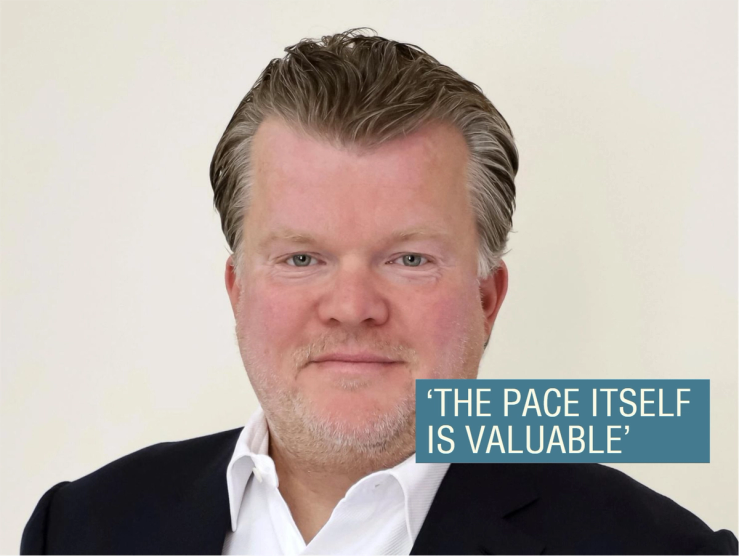
The consumer products industry has not been known for speed, Licht notes, “so we have to really lean into this, and be very mindful that the pace itself is valuable.”
Reckitt will have to reshape many things about the way it works in the coming years to deliver better products, more quickly, to the people who are most likely to need them, he predicts. “I think it’ll just make the company better. I worry about not going fast on this. If we don’t go fast on this, I think there’s a real chance that we will be left behind.”
Accelerating AI deployment with time and motion studies
Licht’s drive for urgency is also informed by the disruptive potential of AI. But he attributes the early success it has had in deploying AI tools to a “first principles” approach that borrows from a management technique popularized in the late 1800s — the time and motion study.
When Reckitt was looking at how to deploy AI in its marketing team, for example, it started by asking: “What do our marketers do today?” It found they were doing a large amount of tedious, unproductive “busywork” alongside the creative parts of their jobs. Rethinking the design of core functions and processes has been critical for reaping AI’s benefits, Licht says.
“The technology is already so powerful that we could spend 10 years just implementing what’s already existing and see enormous gains. The real trick, as we’ve come to understand it, is: How do you do it? How do you deploy it in your organization? How thoughtful [do] you need to be about what you want to have at the end of your process?”
Simply giving people AI tools doesn’t work, he adds: Understanding how to deploy them and having clarity about what results you are looking for are bigger drivers of returns on AI investment.
Reckitt is now taking its AI experiments beyond marketing to research and development, where it has fed its decades of scientific knowledge and consumer data into a proprietary tool designed to generate concepts for new products. “We have created the rules that guide the tool, but the tool can now do things that we couldn’t do before,” Licht says.
Those concepts are now testing more positively with consumers than “human-only” innovations it has come up with in the past, he adds. The first AI-devised product, most likely under the Finish brand, will hit the market “soon.”
A restructuring branded as fuel for future growth
The pace at which Reckitt is now moving is the result of “a lot of heavy lifting” in the first three years of Licht’s time as CEO, he says. The “Fuel for Growth” restructuring program he announced in 2024 included a 35% reduction in Reckitt’s management ranks, a sharper focus on its “power brands,” and a new organizational structure for emerging markets.
Licht is also shedding some brands in his desire to simplify the company: For example, it is reviewing options for Mead Johnson, an infant formula business that has faced significant litigation, which it now classifies as “non-core.”
Like many of its peers, Reckitt also expects to feel the fallout of a Middle East war that has pushed up oil prices and disrupted supply chains. Right now, Licht estimates its exposure as $130 million to $150 million. “We have mitigated larger shocks in recent times successfully,” he notes — even as he acknowledges that the conflict’s ultimate impact remains “highly uncertain,” and depends on how consumers respond to higher gasoline and energy prices.
Inside Reckitt, he says most of the restructuring work is done. “Now it’s about running that new engine and connecting the different elements of AI, digital channels, and new demand generation,” he says.
He expresses pride in the speed at which his team delivered the goals of his overhaul, but admits that phase was very demanding. “It’s not exactly always fun to go through that kind of change. This stuff is much more energizing.”

Notable
- Reckitt kept operating in Russia after Moscow’s 2022 invasion of Ukraine, but staying there is becoming “progressively more challenging,” Licht says. Last month Reckitt told Reuters that it was developing new products to replace most of its hygiene portfolio in the country in response to harsher EU sanctions, even as it keeps working to transfer ownership of its Russian business. “We continue to believe that we are on the right side of this,” Licht says: “Our products are critical to care and must remain available.”