




The Signal Interview
Walking through the Conrad Hotel with Chris Nassetta takes a little time. After more than 18 years as Hilton’s CEO, he seems to know half the staff in the group’s Washington, DC flagship, and he pauses to shake hands and exchange a few words with most of them.
Nassetta says Hilton had lost its “family culture” by the time Blackstone bought the company in 2007 and brought him in from Host Hotels & Resorts to run it. Rebuilding that spirit, to the point where Fortune named Hilton the world’s best workplace last year, was his first priority, he recalls. But it has required relentless focus.
When other CEOs ask for tips, Nassetta tells them the playbook is easy, but executing it is really hard: “You’ve got to work at it and work at it and work at it till you think you can work no more.” It took Hilton 14 years to first claim the top spot in Fortune’s workplace ranking, he notes, which is more than twice as long as the tenure of the average S&P 500 CEO. “It’s not for the faint of heart.”
Inspiring people by connecting to your roots
Companies build culture from the top down and the bottom up, Nassetta says. In Hilton’s case, the bottom-up part started with the first staff survey that most workers could recall taking, and implementing the recommendations they came up with that would have the biggest impact.
The top-down part meant reconnecting with Hilton’s origins, to “reclaim our rightful spot in history.” The company was the first to launch an airport hotel, the first to combine a hotel and conference center, and the first to open Western-style hotels in Tokyo and Istanbul after World War II, he observes. “We were the pioneers … and we had lost our pioneering spirit, and lost our connectivity to the origins.”
Nassetta dug into Conrad Hilton’s background, reading his biography multiple times and combing through an archive of old notes to rediscover the founder’s vision: that the company should “fill the earth with the light and warmth of hospitality.” People doing hard jobs “need to feel like they’re part of something bigger,” Nassetta notes, and an authentic purpose is more powerful than any slogan he could have asked his marketing department to devise.
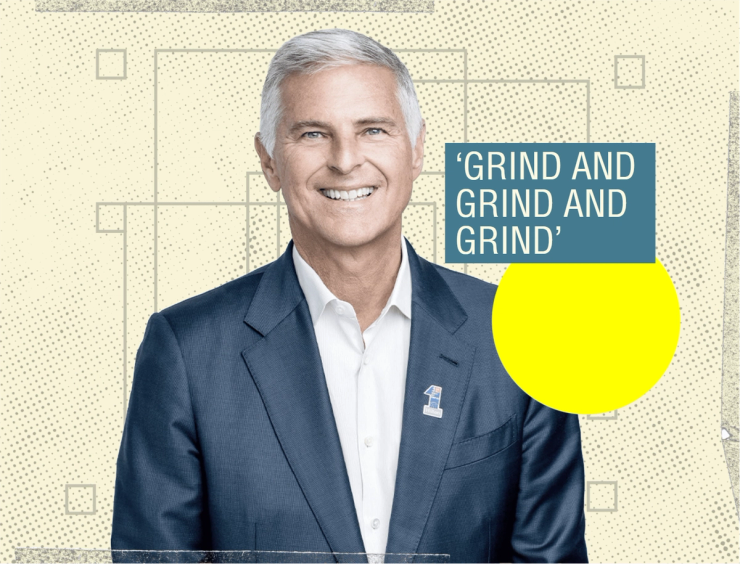
Even so, he adds, Hilton management has had to “grind and grind and grind” to connect that purpose to the messages it shared with its people each day in the hope of inspiring them. “We had to create stories, and tell the stories … in a way that would translate into hundreds of thousands of people’s lives in countries all over the world and languages all over the world, so that when they showed up [to work], they thought: ‘It’s cool to be part of Hilton.’”
Why leaders shouldn’t jerk the wheel
Nassetta has grown used to disruptions, from AI to a conflict in the Middle East that has left it “way, way off” its goals for the region, its best-performing market for the past three years. But he has learned that a CEO needs “to be steady enough to not jerk the wheel all around.” Hilton has about half a million people working across its owned, managed, and franchised properties, he notes, and “you’ve got to get those 500,000 people to follow you into the flames. And if you’re all over the place, they are not able to do that.”
It’s easy for CEOs to get pushed by boards, customers, and shareholders to chase after each new “shiny object,” Nassetta warns, but “I’m not going to pivot the whole company globally to something on a whim.” Instead, he sends small “SWAT teams” to explore whether each new idea is worth pursuing at scale, telling them to learn, test, and iterate before he sends the whole company in a new direction. “Erratic behavior” from the top scares people, he says, and it’s a CEO’s job to reduce their uncertainty. This is one reason he is not an “AI alarmist,” and has been saying instead that the “amazing productivity tool” will create jobs at Hilton. “If I were freaking out about AI, everybody’d leave the company.”
Be restless about reinventing your team
Nassetta has expanded Hilton from nine brands to 27, and from fewer than 3,000 properties to more than 9,000. It now has more rooms under construction than any other hotel company — roughly one out of every five that are being built in the world. But in his mind, he says, “I wake up every day the underdog.”
He thanks his “loving but tough” 93-year-old mother for that “insecurity,” which he has channeled into a determination to avoid the complacency that can come with corporate success. The complacency of previous Hilton leaders got him his job and helped Blackstone make a $14 billion profit on its investment in the company, he says. When a company is “king of the hill,” it stops pushing itself, he says, so “I’m always pushing myself, I’m always pushing my team.”
One way that has expressed itself is in an overhaul of his leadership team over the past decade, Nassetta says, because “what gets you from A to B is never going to be what gets you from B to C.” Those personnel changes are uncomfortable, he admits, but it’s a common flaw for CEOs to think that the tactics that led to success in the past will do so again. “You rinse, repeat, rinse, repeat, but the world has changed.”
Tune out short-term ‘noise’ to focus on long-term trends
Agility comes with experience and confidence, Nassetta says, and it is more important than ever when there is always a “crisis of the day.” But so is a willingness to “lift above the noise” to look for longer-term trends. When he cuts through the daily headlines about conflict and technological turmoil, he sees a downward trend in inflation and interest rates, business-friendly US tax and deregulatory policies, a huge AI-driven investment wave, and “a golden cycle” of productivity gains.
That combination, he believes, points to the biggest trend of all: that we are at the beginning of a phase of middle-class real wage growth that will give more people the resources to stay at hotels like the ones Hilton operates. The “K-shaped” economy, in which free-spending wealthy consumers diverged from the belt-tightening middle classes, is turning more “C-shaped,” he argues, as the spending by middle-income consumers picks up. This insight into what he calls “the convergence economy” has persuaded him to expand Hilton’s offerings for mid-market travelers, who he sees driving the bulk of the hotel industry’s growth over the next 10 to 20 years.
Even as Nassetta calculates the setback to Hilton’s growth plans in the Gulf, he expects the effects of the conflict to be short-lived. “It will take some time, but it will recover much faster than people think,” he says. “It is amazing to me how quickly people get past things.” And the Middle East is just one region where he feels Hilton is just at the start of its expansion. From India to Latin America, its footprint is “teeny” compared to the customer base it could one day attract.
Reaching back into Hilton’s pioneering history, Nassetta says its expansion plans will one day take it back to three countries that previous moments of geopolitical turmoil forced it to leave. The company is “already talking to people” about a return to Venezuela, where it once had 12 hotels before several properties were nationalized by the government of Hugo Chávez, and Cuba, where Fidel Castro seized the Havana Hilton in 1959. “Some of our hotels that used to be with us, they want to come back,” he says.
He is looking, too, across the Strait of Hormuz from the Gulf properties that are now uncommonly empty. “The [Royal] Tehran Hilton was a famous hotel. It’s still there, not with us,” he notes of the building that was renamed and taken over by the state after Iran’s 1979 revolution. Asked whether he expects Hilton to reopen in Caracas, Havana, or Tehran first, he says it’s “a close race between Caracas and Havana,” with Caracas currently in the lead. “Tehran will take some time,” he says, but “I think we’ll eventually be in all of them.”

Notable
- Reversing the slide in the number of international travelers choosing to come to the US over the past decade would generate “massive amounts of incremental economic activity and millions of incremental jobs,” Nassetta said last month, as he called for a more frictionless process for incoming visitors. “We were 10% of inbound global travel 30 years ago,” he said. “Now we’re 5%. I don’t think we should accept that.”