



The Scoop
Gulf sovereign wealth funds maintained their pace of investments in the first quarter, despite nearly a third of the period taking place during the war, according to data by consultancy Global SWF first seen by Semafor, but the outlines of their strategy going forward is far murkier.
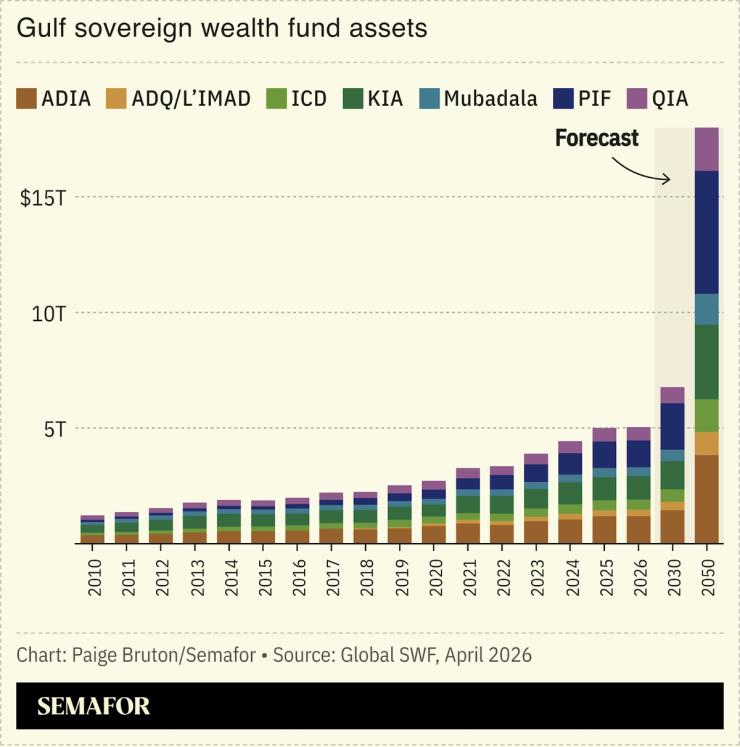
Saudi Arabia’s Public Investment Fund (PIF), Abu Dhabi-based Mubadala, and Qatar Investment Authority combined for almost $25 billion in new investments in the quarter, a pace that — without war — would portend a banner year for the state investors. The resilience, in part, reflects Gulf funds’ extraordinary size: currently $5 trillion across the largest ones in Kuwait, Qatar, Saudi Arabia, and the UAE, a figure that is expected to rise to almost $18 trillion by 2050.
But the pace of overseas investment will likely slow if the war drags on, Diego López, founder and managing director of Global SWF, said. For what comes next, he said strategies deployed during COVID-19 could provide the playbook.
Some funds — such as Abu Dhabi Investment Authority and Kuwait Investment Authority — may be used to support government budgets and slow investments in private markets, López said. Others could shore up industries affected by the war, such as aviation, and provide financing for domestic military companies like EDGE in the UAE, SAMI and SAFE in Saudi, and Barzan in Qatar, he said. Both strategies would reduce the capital available for investments abroad and to drive domestic economic diversification plans.
In this article:

Mohammed’s view
Where will Gulf money go? Beyond the immediate energy supply crunch, this is a central question occupying government officials and investors gathering in Washington this week for the spring meetings of the World Bank and IMF.
The Iran war has exacted a human, emotional toll in the region, and energy disruptions are already having a global economic cost. The concurrent risk is whether Gulf sovereign funds change their focus, and how this will impact countries the world over.
So far, as many Gulf officials have repeatedly stressed and Global SWF data confirm, it’s been business as usual. Where this goes depends on how the war ends. If the conflict lasts a few months and energy and trade flows return to normal, Gulf states will once again run large surpluses. Then they will face the same problem that created sovereign wealth funds in the first place: where to put the money.
It may be fashionable now to suggest that sovereign funds will signal their governments’ anger at the US for starting the war by trimming investments. The reality is different. Gulf investors aren’t going to redirect tens of billions of dollars into Anthropic and OpenAI competitors outside the US — because they don’t exist. The depth of America’s public and private markets, its technological advantage, and deep ties in defense, energy, and finance make a quick pivot unlikely.

Room for Disagreement
While it won’t be surprising to see flows slow, some funds may accelerate capital deployment to pursue distressed assets. “We may see funds … act opportunistically, identifying bargains in certain geographies and segments,” López said, adding that Saudi Arabia’s PIF did that during the pandemic and “we now see Mubadala as a well positioned SWF to take advantage of the market dislocation.”

Know More
Unlike previous crises, Gulf wealth funds are confronting a shock that is not driven by lower oil prices or a global credit crunch: the region itself is under attack and, because of Iran’s effective closure of the Strait of Hormuz, much of its oil wealth is trapped.
The World Bank now expects Gulf growth to slow to 1.3% this year, from 4.4% in 2025, while Gulf officials estimate tourism losses of as much as $32 billion. The Kuwaiti and Qatari economies are expected to contract by more than 5%, according to the World Bank.
Despite this stress, sovereign wealth fund deals are still closing along the prewar pattern. Almost 60% of Gulf sovereign funds’ foreign investments have gone into financial services, infrastructure, and technology over the past five years, with the US taking a growing share, according to Global SWF. Recent transactions — including investments tied to OpenAI, Anthropic, Electronic Arts, and Paramount Global — suggest Gulf investors aren’t pulling back from previous commitments.
Private capital is also being deployed. Last month, companies linked to Abu Dhabi Deputy Ruler Sheikh Tahnoon bin Zayed Al Nahyan joined a new funding round for the $10 billion fitness band startup Whoop and agreed to buy Oklahoma-based pipeline company Traverse Midstream Partners for $2.25 billion. And last week, another Sheikh Tahnoon-led firm bought a majority stake in a UK-based hospitality group, reportedly valued at more than £1 billion ($1.3 billion), that includes brands such as The Ivy restaurant chain and private members’ club Annabel’s.

Notable
- Gulf economies are under pressure, and governments will have to make adjustments. Sovereign wealth funds, for example, may “take longer to make allocation decisions” as defense, stimulus, and reconstruction take priority, writes Karen E. Young, senior research scholar at Center for Global Energy Policy at Columbia University.
- The war may disrupt the flow of Gulf sovereign investments, but deals struck during the conflict show the region’s wealth is too vast to stop flowing into the world’s largest economies, The Wall Street Journal reported in an article profiling some of the Gulf’s biggest SWFs.