




The Signal Interview
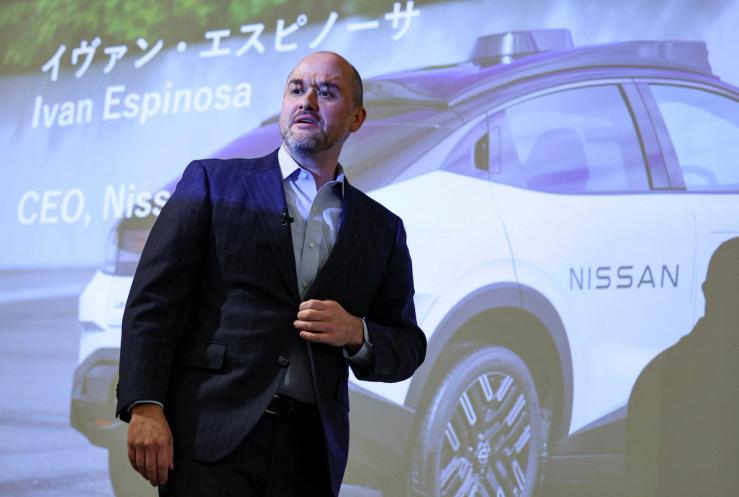
Ivan Espinosa, the CEO of Nissan, has been in the job for almost exactly one year now with a mandate to turn around the storied Japanese carmaker when it seemed in freefall.
Nissan’s global vehicle sales, which peaked at 5.8 million in 2018, slumped to 3.2 million last year. Prior to Espinosa’s appointment, the company’s share price had tumbled to $6, a third of its January 2018 high of $18. Espinosa has moved quickly to roll out a restructuring plan and to gain trust.
“When the job offer came, at first I was surprised, very honestly, because I’m relatively young for a CEO in Japan. I’m not Japanese. At the beginning, it was a bit of a shock,” he said.
This interview has been edited for clarity and length.
Clay Chandler: Does the fact that you’re not Japanese and that you’re younger than a lot of other executives hinder or help your ability to lead?
Ivan Espinosa: I think it helps. I’ve worked in many different roles — planning, marketing, sales, development. So I understand the company inside [and] out. I have worked in many different locations as well: Southeast Asia, Europe, Mexico and South America, of course. And I’ve worked in Japan for more than 10 years. So I have a very deep understanding of Nissan, its strengths and weaknesses.
People know me. I have a broad network. That plays to my advantage. People trust me because I’ve worked hand in hand and side by side with so many of them. They know that I understand the company well, that I understand what has to change. And that’s why I was able to put in place a plan in a matter of weeks. I knew exactly what had to be done.
The industry is entering this very technology-driven phase. I consider myself to be sitting in between two generations — a generation of more digital people and a generation of car enthusiasts that understand the value of cars in a more traditional way.
In that initial six weeks, how did you make your to-do list? Nissan had been through major restructuring plans previously that had failed to get traction. How did you determine on cost-cutting how far to go, to make sure that it would be meaningful?
Back in 2014 or so, the strategy of the company was trying to hit sales of 8 million cars. It never happened. We peaked at 5.6 million.
The whole company was structured to accommodate sales of 8 million cars. Previous teams were trying to increase the volume at any cost because we had such a big structure that had to be absorbed. But we couldn’t. We needed to face the reality that we cannot grow our top line at the speed that we need to absorb the structure. So we said, OK, what is the appropriate breakeven point for our company, assuming that we cannot grow volume? Let’s admit that we are a 3.2-3.3 million-car company and resize our structure to bring the breakeven point to something that makes sense. We decided it was 2.5 million units, excluding China. That’s how we made the decision to move from 17 plants to 10 plants.
But cost-cutting alone isn’t a strategy.
What we’re doing in the plan is optimizing capital expenditure without touching future investments. We’re moving into a more efficient way of developing cars. We asked the engineering team: Based on what we’ve learned from our partner in the China market, how can we make our development process quicker? We moved from having a process that took us 54 months to develop a car to 37 months. This is saving a huge amount of engineering resources without having to cut future product investment.
You just announced that you’re working with Wayve and Uber on a robotaxi project in Tokyo.
We started working with Wayve to develop our autonomous drive strategy. We have two initiatives. One is business-to-consumer, where Nissan will be providing Level 2+ [autonomy]. You get into the car, you set the route, and the car will drive all the way from your driveway to your destination without you having to intervene. And this is what we will be offering in partnership with Wayve to our consumers in 2027.
And then, when we announced that, Uber said, “Hey, why don’t we do something on robotaxis?” We announced just a couple weeks ago we will have robotaxis on the road this year.
What about electric vehicles?
We were the first company to produce a mass-market EV, which is a Leaf. We launched the third generation of it a few months ago. Nissan has a deep strength in understanding EVs. We have so many EVs on the road and we have learned so much from customers, from the way batteries behave [to] the way customers are charging their cars. That puts us in a very unique position. We think the EV market is here to stay. We see that once customers make the jump to EV, they hardly ever go back to other technologies.
There’s a big contrast in the takeup of EVs in the US versus China, where EVs account for about half of auto sales. Will the US ever reach those levels?
It’s a matter of time.
The China EV market is incredibly competitive. Many foreign automakers have struggled in the last couple of years. At Nissan, you went from a peak of something like 1.6 million vehicles to now in the hundreds of thousands.
650,000.
Do you see that reversing and how can you turn it around?
Last year we launched a car called N7. We made a conscious decision to change the way we develop and bring cars to China. We used to bring cars that were internationally developed and then we were just adapting them for China — so, the same product that we were selling in the US, we adapted a bit and we were offering it in China.
That stopped working the moment you started to have local manufacturers making cars uniquely for China with the Chinese customer at the center. When we noticed that, we said, “OK, let’s create a product that is really centered around Chinese customers with their needs in mind, designed, engineered, and manufactured in China.” And the first car in this new way of developing cars is the N7, which we launched last June. And from June onwards, we started to see some year-over-year growth.
We just announced an SUV called NX8, and last year we launched a plug-in hybrid model called N6. So we have a series of products developed and planned in the way the N7 was. And it’s showing that our brand is still relevant in China, even in front of very competitive local manufacturers. We can still sell cars [and] make some money, and we want to use those products also to defend ourselves outside of China.
We are going to start exporting some of these cars to South America, Southeast Asia, the Middle East. We also want to export the learnings to our global engineering centers. The ecosystem in China is different. The way they develop cars, the speed at which they develop cars, the costs that they can achieve are different, and we are learning many things that we want to bring to our global engineering.
You’ve made an $18 billion investment in setting up productive capacity in Mexico. How have the tariffs affected your strategy?
Nissan has a broad global footprint of manufacturing. We have factories in Mexico, but we also have two big factories in the US: one in Smyrna, Tennessee, another in Canton, Mississippi. What we did was readjust our strategy, focusing our marketing efforts on products built in North America. We have six very successful products developed and produced in North America. At the beginning of last calendar year, we started with a mix of around 45% US-built products. We ended the calendar year with 60% US products.
We understand the policy of the US administration. We’ve been there, investing in the US consistently for the past 40 years, and we will continue to do so. At the same time, there are also good products we can source from Mexico. Our lower-trim products will continue to be sourced from Mexico for the time being, because it’s competitive to do so.
If you talk to industry analysts, they’re always saying the secret is you have to get bigger. There is continuous speculation about whether Nissan could ally with other companies. What’s the status of discussion about potential allies?
I see two or three different types of partnerships. First, you have project-based partnerships, which is trying to work out some OEM supply of product with some other partner. And we do that a lot with Mitsubishi and with Renault. We partner with them to help them complement our lineups in some parts of the world, like Southeast Asia or Japan or Europe. The second one is partnerships in technology. A good example is what we did with Wayve. And we will continue to find partners that can help us accelerate our strategy. It doesn’t mean that they will dictate our strategy.
And then you have maybe a third area, which is more capital tie-ups and whether we partner and build scale together with somebody. It’s true that scale helps, but scale for me is not the objective. Scale is a means to achieve more competitive costs. But this is an area that we remain open to because of the volatility of industry today.
As long as any partnership in this area brings value to my shareholders, protects the brand of Nissan, and helps the stability of my employees, I will definitely explore it.
How is the war in Iran affecting your strategy?
We’re monitoring the situation every day. The first issue is product delivery. There are no routes into the Middle East.
Second, we’re trying to anticipate any disruption to the supply of raw material. We’re trying to diversify our exposure to it.
And the third thing is trying to start planning ahead, because if the oil price stays at the level it is today, we will start seeing [rises in] all the logistics costs. Our business relies a lot on logistics because we source parts from many places and we’re moving parts and cars all the time.
There are risks on the demand side as well.
This is a tough question because I don’t know for how long the conflict will continue. We are hopeful that it will get resolved soon. So many people are postponing their purchases. Even if they are not in the conflict zone, they are being very cautious of the future.

Notable
- Nissan’s turnaround plan involves cutting 20% of its models, Bloomberg reported.