




Amena’s view
The announcement of the ceasefire between the US and Iran brought immediate relief to oil markets. But that has created an impression that the worst is over. In reality, Iran now has a stranglehold over global oil flows, one that did not exist before the war, and Gulf energy exporters are as a result considering options to bypass Tehran’s grip.
Flows through the Strait of Hormuz remain far below prewar levels. Around 300 million barrels of crude have already been lost from global balances, according to Kpler, the independent data provider where I work. Some 11.5 million barrels per day of production remains shut in across the Gulf. Even if the war ends with a durable peace agreement today, prices are still expected to hover in the $90 range.
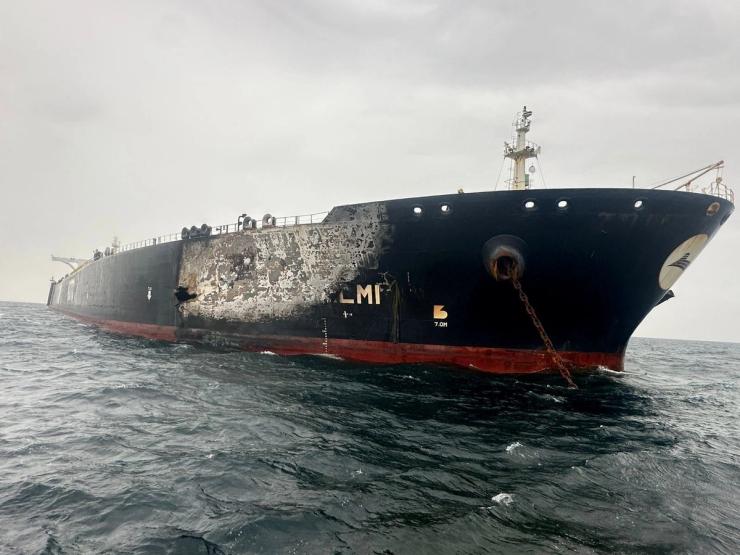
The reason is simple: the war may have paused, but the supply shock remains. Around 187 tankers carrying roughly 170 million barrels of crude are stranded inside the Gulf, which will take more than two weeks to clear at the current, post-ceasefire pace, and there are few signs of empty tankers entering the region to load fresh cargoes. Iran’s Islamic Revolutionary Guard Corps (IRGC) has demonstrated its ability to disrupt shipping, delay cargoes, and dictate transit conditions. (Tehran has attacked ships and ports at least 21 times, according to Kpler data.)
Vessel owners told me after the ceasefire that their crews were receiving messages from the IRGC demanding they seek permission to transit or risk being attacked, and those with stranded vessels in the Gulf are avoiding responding for compliance reasons: The IRGC is sanctioned as a terrorist organization by the US and EU. Iranian officials say control of the strait is part of the ceasefire agreement with Washington, while President Donald Trump has repeatedly said the US does not rely on the strait and that others should step in to secure it. Some Gulf countries are willing to join a coalition to protect the waterway, but most have refused to consider paying a toll as an option.
Taking a longer view, Gulf countries are revisiting plans to reduce their reliance on Hormuz. The effectiveness of bypass routes in Saudi Arabia and the UAE has reinforced their value during conflict.
Expanding pipeline infrastructure is critical. The most immediate options involve scaling existing systems. Saudi Arabia’s East-West pipeline — which runs about 1,200 km from the Gulf coast to Yanbu on the Red Sea — can carry around 7 million barrels per day. Riyadh is assessing capacity increases and terminal expansions, effectively debottlenecking exports from the current loading capacity of about 5 million barrels a day. Yet it must do so while protecting the existing link, which Iran damaged in a recent strike.
The UAE could also expand its route to Fujairah, thereby increasing capacity outside Hormuz from about 1.8 million barrels per day without the complications of cross-border infrastructure.
Other projects under discussion are more expensive and subject to political considerations. They include expanding the Iraq-Türkiye pipeline that runs from Kirkuk to Ceyhan on the Mediterranean. The Basra-Aqaba pipeline to Jordan would give Iraq access to the Red Sea but faces financing and other challenges. There is also renewed talk of restarting a pipeline which once transported Iraqi crude across Saudi Arabia — but its revival depends on political agreements that have proven difficult in the past.
Industry discussions are increasingly focused on building multiple routes rather than relying on a single alternative. A network of pipelines would allow flows to be redirected during disruptions, reducing dependence on any one corridor.
But the obstacles are significant. New pipelines require tens of billions of dollars in capital, years of construction, and must navigate difficult terrain and security concerns. There is a reason there is so little cross-border energy infrastructure in the region: projects often get bogged down in disagreements over ownership, tariffs, and operations.
Despite this, the economic calculation is shifting. Disruptions, higher insurance costs, and uncertainty over access have crippled energy and trade flows. For Gulf producers, investment in alternative routes is becoming essential to maintaining access to global markets.
Amena Bakr is the Head of Middle East Energy & OPEC+ research at Kpler, an independent global commodities trade intelligence company.

Notable
- Iran’s near-closure of the Strait of Hormuz has triggered the worst energy crisis in history. When the war ends, the US must lead a global effort to build the infrastructure needed to make Gulf energy supplies more resilient, writes Amos Hochstein, a former US diplomat and current managing partner at TWG Global, for The Atlantic.