



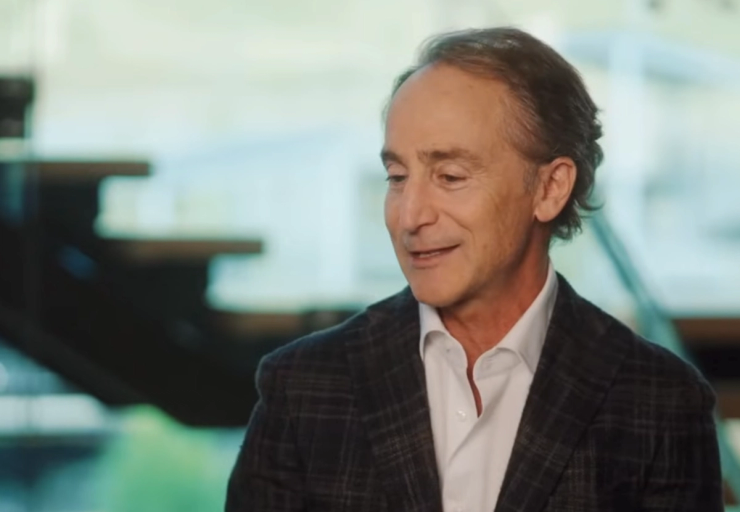

The Signal Insight
When Howard Hochhauser (“the name is German — high house”) decided to apply for Polish citizenship, he turned to the genealogy website he runs to help with the paperwork. Ancestry.com supplied him with the birth certificate, immigration record, marriage license, and even elementary school report card of his Polish immigrant grandmother to prove his lineage.
Opening his laptop, Hochhauser demonstrates how Ancestry is trying to bring documents like ships’ manifests to life. “The air must have been thick with anticipation as the 13-year-old girl prepared to board the steamship. Standing at four feet, seven inches tall, with brown hair and brown eyes…” a digital narrator begins, as Hochhauser explains how he is trying to keep customers renewing their subscriptions with such AI-powered audio stories.
The availability of such records, and their presentation, reflects a strategy of investing in content and technology that Ancestry’s former CFO has pursued since becoming CEO last year. Bought by Blackstone for $4.7 billion in 2020, Ancestry has announced plans to invest $450 million over the next 10 to 15 years in digitizing new records and applying AI to extract more accurate information from previously scanned material.
Last year’s acquisition of iMemories, a service for digitizing old photos and home videos, is pulling in more user-generated content. “The [return on the] content digitization is real and tangible. It’s just a pretty quick win,” Hochhauser says, pointing to more than a year of rising customer satisfaction scores and subscription revenues.
He notes, too, what genealogy fans don’t want AI to do. “It’s somebody’s hobby, the joy is in the doing and discovery,” he says. “You don’t want your AI assistant to do your crossword puzzle for you; that’d be wholly uninspiring.”
This interview has been edited for clarity and length.
Andrew Edgecliffe-Johnson: You became CEO in February last year. What did you identify as the task you were taking on?
Howard Hochhauser: When Blackstone bought the company, its thesis was that it would make the site more social. And frankly, that really wasn’t what our consumers wanted, so revenues flattened out, customer satisfaction declined. I took over, and pretty quickly said, “We’re ignoring our core customer, and we’ve got to listen to them.” So the first thing we did was change our mission statement to refocus on our core customer.
What was the mission statement, and what did it become?
It was: “We empower journeys of personal discovery to enrich lives,” which is very broad. Now it’s: “We help everyone discover, preserve and share their unique family stories.” So the first thing we did was take off some of the social features, invest more in content, and invest more in storytelling. We did our largest acquisition ever. And all these things are compounding on each other, so our customer satisfaction scores have been up every month for the past 13 months and we’ve delivered five quarters in a row of subscription revenue growth.
What do you mean by content in that context?
There’s an archive down in the basement of City Hall [in Manhattan] that has voting registers from the 1930s, including for my grandfather. They have that in paper format, in these really old books. They don’t have the funds to digitize it, and if it’s not digitized, it’s neither preserved nor accessible. So we would go in there with a camera and take a digital picture, then technology takes over and AI will take that handwritten script and make it searchable for everybody. Every day, we’re writing 10 million new records to the site.
We’re going to keep investing in birth, marriage, death records in the US, UK, Canada, Australia. We’re getting to Italy and Poland. On top of that, we’re [adding] user-generated content. My dad recently passed away, so we’re digitizing everything in his basement — all those photos and slides and VCR tapes are all going to live on Ancestry.
That’s a potentially gigantic collective archive. Can you accommodate everybody’s basements?
We would love to have everybody’s basement. Remember that one of our growth drivers is improving engagement to improve retention. And by having all my content there I am never going to cancel my subscription. Also, it’s curating it like a good museum would do. It is expensive to do that, but that expense will come down.
AI will translate my grandmother’s report card from Polish to English and now turn it into an audio story. We’ve had almost a million audio stories played, and we just launched them in December.
What’s the business model? What drives new subscriptions?
All of us have this desire to know who we are and where we come from, and you just need time to do that. Forty percent of people who sign up are under 35, but we’re focused on the 55-plus [demographic], which is the growth demo in the US. So it’s about making the product better, getting more content, talking about storytelling to this audience. It’s also about expanding outside the US, and that is AI-driven. In the span of a month, we launched in Italy, and we’re launching in about a half a dozen countries, because AI is translating the site, translating the content, translating even the marketing campaigns. That’s something we couldn’t do a few years ago, but now the cost has come down.
There is [also] a pricing component, just like [video] streamers have [raised prices] over time. As we’re ramping up our content spend and improving the product, we may [raise prices] from time to time.
You’re obviously trying to create a faster-moving culture. What have you found is most constructive for doing that?
Shortly after rewriting the mission, we redid the company culture statement, to start with passion for the customer, and curiosity. And part of that curiosity is to be candid with each other, ask lots of questions, and hold everybody accountable. And this Socratic method of asking people questions until they get to the truth is something that we’re pushing for internally, and we have reduced management layers [by almost 20%] to bring executives and everybody together to go faster in terms of decision-making.
Presumably that layer was there for a purpose initially, but what had gone wrong?
Previous management came from very large companies that probably were used to a certain level of infrastructure. [My goal was] to bring everybody closer to the customer, closer to the product, and to go faster — and part of going faster is eliminating layers. And the speed of innovation has absolutely accelerated. You can see engagement has improved for our customer and employee engagement, likewise, has improved. I think we are living up to our culture. We are being very candid. I did a 360[-degree performance review] on myself and then shared it with my team.
You shared your 360-degree review feedback with your team?
Yeah, which included feedback from the board. We had a record year, so it was a good review, but the reason you do it is to get better. Everything in there wasn’t perfect.
Are you encouraging people in your team to do this?
Yes. The only way to ask other people to do it is to do it yourself. We’ve just kicked off the next round of this process and no one’s pushing back.
Which of your earlier experiences most shaped the CEO you are at Ancestry?
I worked for Martha Stewart, and she is a passionate entrepreneur that is maniacal about her customers and absolutely genuine. I was CFO of Ancestry for 15 years, so I understand the leverage to drive revenue growth, and [I’ve tried to marry] that with Martha’s passion for the customer. I listen to customer service calls on my way home. I just send [myself] recordings, and when you hear a customer’s voice, it’s totally different than when someone gives you a written summary report. You hear their frustration.

Notable
- Genealogy sites’ expansion into DNA databases made them useful tools for law enforcement authorities investigating cold case murders and other crimes. But changes to Ancestry’s terms and conditions last year clarified that its services were off-limits “for law enforcement purposes” without a legal order or warrant. The company says its data is intended solely for family history research.