




The Signal Insight
When JLL CEO Christian Ulbrich flew from Frankfurt to New York two weeks after the Iran war began, his plane was emptier than any flight he had been on since the COVID-19 pandemic.
Back in 2020, expectations were rife that the office buildings JLL sources for companies around the world would stay vacant long after airlines were back to full passenger loads. Ulbrich insists he was always convinced that those predictions were wrong.
“Anybody who had a very good database in the real estate sector didn’t believe the headlines about the ending of the office,” he says. What he has seen since then has borne out his own belief: that the experience of having employees working from home during the pandemic would be “the accelerator of a different type of workplace,” where companies have to make their offices attractive enough to “earn the commute.”
That rethink of commercial real estate, coupled with AI investments to make more of JLL’s proprietary data, has helped the company double revenues over the past decade. Last month Ulbrich told investors that it could average 8% annual revenue growth over the long term. What will drive that, he says, is a selective approach to the clients JLL works with, and another of his convictions — that technology will transform his industry.
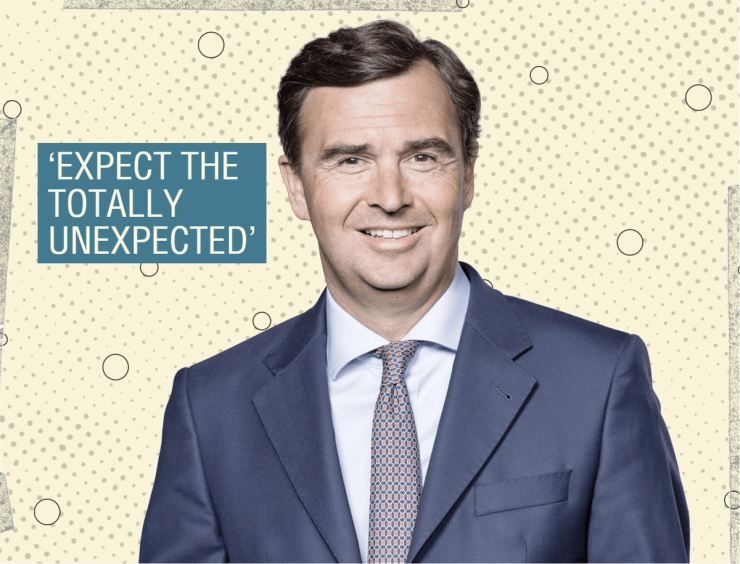
As of last month, JLL had seen little impact on clients’ confidence from the conflict in the Middle East. But Ulbrich says turmoil drives customers to partners who can reduce complexity, which has come to look like a constant. “The most lasting impact of COVID,” he says, is that we now “expect the totally unexpected.”
This interview has been edited for clarity and length.
Andrew Edgecliffe-Johnson: Do you expect the conflict in the Middle East to affect the confidence of your clients?
Christian Ulbrich: First of all, it’s a human tragedy, and we have a lot of people based there, so we are worried about our people there. No. 2, our business is very correlated to GDP and interest rates, and when you have geopolitical turmoil it has an impact potentially on interest rates.
We entered this conflict with a very, very strong outlook for 2026 across the board. It is a drag on sentiment. I think whether it will have a real impact — a negative impact — on this year will very much depend on how long this conflict will drag on.
Are clients delaying decisions on big investments?
Not at all. [Particularly in the US,] business is moving on, and frankly, anything else would have surprised me.
Looking at the charts in your latest investor presentation, COVID feels like a very distant memory. What did it actually change?
The reason why it’s a distant memory is because the world is keeping us constantly alerted with new things coming around the corner, so we forget about the old things. But I had absolutely not a minute of concern that this would change the usage of offices in the long term. What I was also convinced about was that this would be an accelerator for companies to think about what kind of workplace environment they have to offer to their people. It has accelerated that trend very much. It has reinforced that every company needs a place where their employees can come together.
What trends are you building into your growth assumptions now?
We are very focused on the companies which are most successful in their industries. And in every industry the gap between the top end and the lower end is growing. So, simply speaking, once we have convinced a top performing company that we are a great partner for their real estate needs, they grow, which means we grow, so their growth is our growth. The vast majority of our market share gains [come from choosing] our clients wisely.
The other big driver is that the world is complex, and we have to face a lot of disruption and turmoil. So if you have to deal with a lot of complexity as an organization, you’re trying to focus on those things you can influence and reduce the complexity. And one way of reducing complexity is that you choose partners which you can 100% rely on, and which offer you a feeling of confidence and certainty. And I believe that we are one of those partners. So you could translate that as: The more crazy the world is, the more people are attracted to us for their real estate services.
How do you create a culture that makes you a reliable partner?
This company goes back to 1783. It’s clearly not a company which is thinking about the short term. But in my first couple of years, I was kind of forcing the organization to invest heavily into technology and data, at a time where there was absolutely no return on [that investment] and very little appreciation for why we were spending so much money on it. But I was convinced that technology and data will completely change this industry. And if you have a very long-term perspective, you have to do those investments. There was not much return in the first couple of years. But hopefully now people understand why we did it.
What are those investments in data allowing you to do for clients that you couldn’t have done a few years ago?
In 2025, we transacted $256 billion of capital markets transactions. That’s more than $1 billion per working day. On every transaction, we have roughly seven underbidders. We can tell you now, precisely, which type of asset creates what kind of bidding intensity. Is the winning bid 3% ahead of bid No. 2? Is it half a percent ahead? Is the winning bid an outlier or are the bids all very close? This is very critical information, because if [the winning] one is an outlier, there’s a high probability that prices will come down over the next couple of weeks. If they are all centered around the winning bid, there’s a very high probability that prices will go up over the next couple of weeks. We wouldn’t have had that type of information 10 years ago.
Is there anything in your business that you think will be fundamentally disrupted by AI?
At the moment, there’s nothing which is being disrupted. We are clearly a net beneficiary of the AI world, because we have done our homework on data, and we have a well-trained workforce which is adopting those tools. When you look at the productivity of [“client-side” employees who work for owners, occupiers, or developers], we were able to increase revenues over the last two years by roughly 25% across the company, with exactly the same number of people.
A relatively small number of companies, the leading companies in each industry, have the investment dollars to really take advantage of AI, and they are gaining market share. They will take those productivity gains and invest them into their business, so I cannot see any reason why we would see less opportunity for us.

Notable
- The Middle East’s growth trajectory has been “interrupted for the time being,” Ulbrich told CNBC last week. JLL has a major footprint in the region, managing and leasing properties from Dubai and Abu Dhabi in the United Arab Emirates to Riyadh in Saudi Arabia.