



The Signal Insight
The world will need another 10,000 terawatts of energy by 2035, the IEA projects, “and this energy has to be more electrical,” Olivier Blum says. It is in Blum’s interest to say that, as CEO of Schneider Electric, but he adds that meeting the demand will not be easy. “The only way to bridge the gap is to make energy more intelligent,” he says.
That insight has driven Blum’s strategy since he became CEO in 2024. His goal has been to refocus the Paris-based Schneider from an equipment and infrastructure business to one that can “make energy more intelligent” by connecting AI tools to its legacy hardware and systems, extracting data that drives greater output and efficiency.
Achieving that goal requires a sharp culture shift at the 190-year-old company, though. When he joined Schneider in 1993, he notes, it would take five years to develop a new switchgear platform, which would stay in the market for a decade. But now, “every 18 months, more or less, you have a new category of infrastructure that you need to build to accommodate the GPU of Nvidia.” Schneider now has a partnership with the chipmaker to design and develop advanced power, cooling, and control systems for AI data centers.
Here’s how Blum describes the process of turning Schneider into a company able to move at the speed of its energy-hungry customers.
This interview has been edited for clarity and length.
Andrew Edgecliffe-Johnson: How do you take a 190-year-old company and make it move fast enough for what you just described, where every 18 months, you’re going to need to build a new category of infrastructure for your customers?
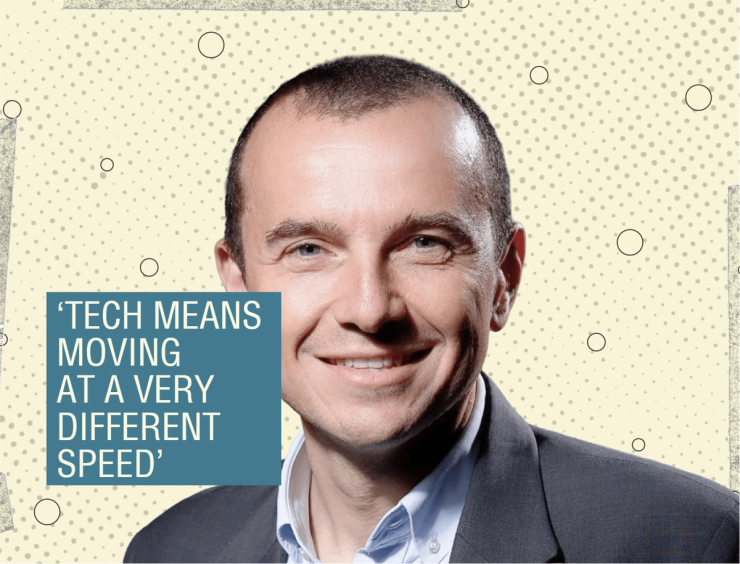
Olivier Blum: You summarize my job in your question. I told the management team when I took over in 2024, we are faced with three major accelerations: one, AI; two, [a changing] energy landscape; and three, geopolitics. And if we don’t operate Schneider as a tech company, which moves much faster, we will not be successful. So the first priority was to design this vision. Last year we introduced our new mission — advancing energy tech — to all the employees and leadership of Schneider. We are an energy tech company, and tech means moving at a very different speed.
To be more specific, I introduced last year a new concept that I call [a] “mission-based company,” which means that [we] don’t operate Schneider anymore as a hierarchical company, where people just work for one silo. We have to operate as a mission-based company, which means that we define a certain number of objectives we call missions. We appoint someone in charge of that mission, and everyone has to rally behind that mission to support it and bring resources to make sure we move much faster.
It’s one thing to articulate that ambition, but what do you think has actually been most important in getting Schneider to the point where you can say you are an energy tech company, and not just an old industrial company?
We are not yet there. But you have to be clear on what your North Star is, where you want to go. We’ve defined that very clearly and communicated it, internally and to our investors. Then the second step, which is more complicated, is to say, “Hey, to deliver that North Star, there are 10 critical missions that we need to achieve together. And I’m going to tell you who is the leader of each mission, and sometimes you are the leader, sometimes you support another leader. Because that’s how you create a kind of transversality in the company, versus a traditional model where you have been [trained] always to be the boss of everything you do in the company. If you want to be a tech company, you have to move at the speed of a tech company. And that’s why the CEO himself is involved, because there are a certain number of strategic directions that, as a CEO, you have to give to the rest of the company, [and] you cannot take one year to discuss, debate and negotiate on everything.
What picture do you have of how energy demand is going to change in the coming years, and how is that guiding your strategy?
When you look at the IEA’s estimates, we will need another 10,000 terawatt-hours between 2024 and 2035 and another 10,000 again between 2035 and 2050. So the demand that you have in front of you on the electrification [front] is already huge, even before I apply all the new demand from data centers. Whether you take it from the standpoint of sustainability, efficiency, or security, you need more energy, and this energy has to be more electrical. Based on all our scenarios, there is a gap between what the world needs from an electrification standpoint and what could be available. So the only way to bridge the gap is to make energy more intelligent. That’s what drives my strategy.
What do you think most CEOs misunderstand about their companies’ energy use? What should they be doing to bridge that gap, and to use their energy more intelligently?
I think what people underestimate is, again, that gap that will happen in the coming years. Now for some industries, it might not be a big problem, but some industries definitely will be affected. The war in Ukraine created a huge problem of inflation of energy costs in Europe that created panic. Now we are in another crisis with the Middle East, so there is a strong business case for people to ask, “Shall I continue only with fossil fuel and be dependent on fossil fuel? Or should I move to tomorrow’s energy, which is electrical, less dependent on gas, less dependent on oil?” That will give me probably more autonomy to run my business and be less connected to [energy cost] inflation.” And I think it’s probably much easier … to convince CEOs to look much more at energy when they will see the huge inflation again in the cost of energy.
Do you think this crisis in the Middle East will be a turning point in people’s thinking about fossil fuels versus electrification?
We saw it with Ukraine three years ago and I can tell you, we have seen it already [since the start of the Iran conflict]. They want to be less dependent, again, on access to energy or the cost of energy. Definitely, that’s going to be an accelerator. A lot of CEOs were already shifting, even before the Middle East crisis: They are not thinking too much about, “Do I need to do it or not?” The question is more, “At which speed am I going to electrify my processes? At which speed can I reduce the cost of energy?” … But definitely, the [Middle East] crisis is going to be another catalyst.

Notable
- Blum is one of a small club of former chief sustainability officers who have become CEOs. His experience in the role strengthened his belief that sustainability cannot exist “in a parallel universe” to core business interests, he told Reuters.