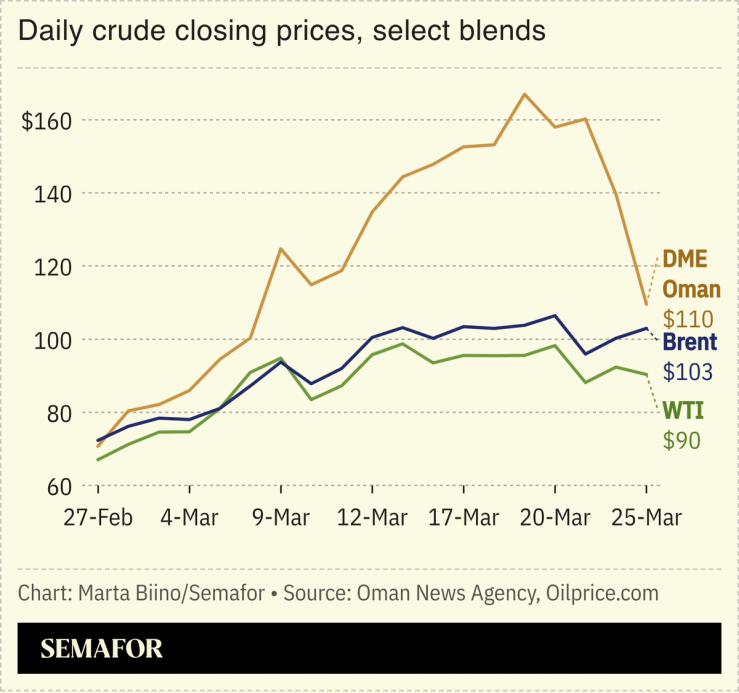
Amid all the oil market volatility, one grade of crude stands out: DME Oman. Before the war it was close in price to the two main international benchmarks — Brent, and West Texas Intermediate — but since the conflict erupted, it has risen and fallen far more rapidly.
That highlights a notable feature of this war: The closure of the Strait of Hormuz has led to oil prices diverging around the world, as buyers of physical cargoes react differently to traders playing the markets. Asia gets most of its oil from the Middle East, and Oman, whose crude is similar to other Gulf blends, is still able to get its oil to customers. That makes it an easy substitute for Asian refiners, but the price is also particularly sensitive to geopolitical signals around peace talks or escalation.
Oman’s government relies on oil and gas for two-thirds of its income, and the windfall should offset some of the wider economic disruption caused by the war. If the conflict continues, analysts say Brent and WTI may catch up with the higher price of Middle East crudes.