



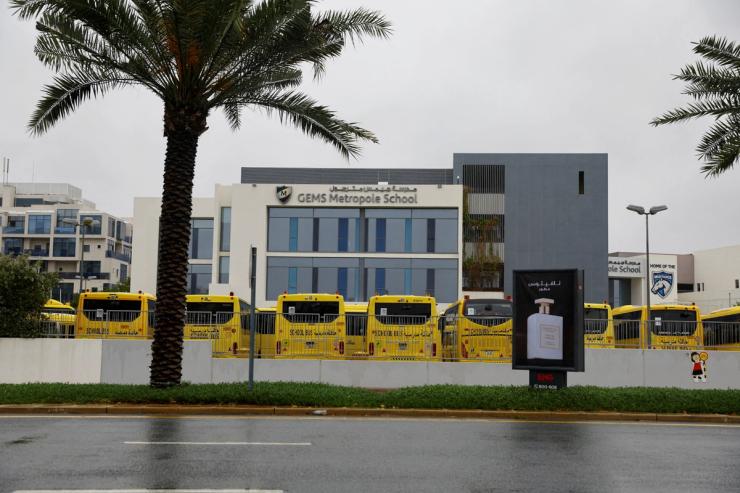

The Scene
Parents in Dubai this week received an unexpected — but welcome — survey from schools to gauge how comfortable they would be with sending their children back to the classroom. For one of the UAE’s biggest school operators, responses were mixed, with some saying they are willing to send their kids, and others still cautious. Other Gulf countries like Qatar have started to reopen campuses — and Saudi Arabia’s schools never closed — even as Iranian missiles and drones continue to hit cities.
UAE authorities have mandated distance learning until April 3, but in Dubai, they are now evaluating school reopenings on a case-by-case basis. Getting kids back to a normal routine is important to project “business as usual” and to keep some expats who have shifted to remote work from leaving the country for the rest of the school year.
Many families evacuated early in the war, on flights paid for by their governments or employers, while others decamped to Arab and European cities on extended spring breaks and Eid holidays. With air defenses proving to be largely effective and commercial flights returning, the lack of in-person education is starting to look like an outlier.
In this article:

Know More
Good schools are a major part of the Gulf pitch to foreigners (alongside tax-free income and security). The Dubai government is aiming for a top 10 global education ranking by 2033.
They are also big business, minting at least one billionaire in the UAE. Top-tier schools in the country have aggressive expansion strategies: Nord Anglia Education, a string of 80 elite private schools including six in the Gulf, was acquired by a consortium that included state-backed fund Dubai Holding. The deal valued the educator at $14.5 billion; Abu Dhabi’s Mubadala followed with the purchase of a separate $600 million stake last year.
Brookfield Asset Management led a nearly $2 billion acquisition of GEMS Education, the UAE’s largest private school operator — founded by billionaire Sunny Varkey’s family in 1959 — in mid-2024. Last year, it opened a $100 million campus in Dubai, becoming the most expensive school in the UAE with tuition upwards of $57,000 a year.
Taaleem, a Dubai-listed school operator, posted 20% revenue growth in its most recent full financial year, and has two Harrow campuses — among the most prestigious British school brands — in the pipeline for Dubai and Abu Dhabi.

The View From Parents
Efforts to improve education in the UAE are not yet “moving the needle” on convincing families to move here, a headhunter — and parent — who recruits hedge funders and financiers told Semafor.
Some residents told me that they are likely to keep their families out of the country for longer, enrolling their children in schools in their home countries, while returning to jobs in the UAE solo.
As parents grapple with the safety question, some are also considering the value their kids are getting from expensive private schools in the Gulf. An American-Lebanese mother of two who has lived in the UAE for more than a decade said the conflict has been a moment to reflect on whether the school system has kept pace with advances in technology or whether they are reflecting the diversity in the country. “The education system is still not up to par with the changing times,” she said.

Notable
- Closed schools across the Gulf are a reminder that when conflicts escalate, children are the first to pay the price, the UN’s secretary general told the Security Council earlier this month, Arab News reported.